Sweetness in the Belly by Camilla Gibb

British born, Canadian-raised writer Camilla Gibb’s stunning new novel Sweetness in the Belly divided my book club. I was among those who loved it. The book tells the story of Lilly, born to hippie parents and brought up as a Muslim, after their death, in the city of Harar. Her story is told by layering her young years in a politically charged Ethiopia with her life as a nurse in London. It’s a fascinating picture of a world torn apart by poverty and prejudice and by Lilly’s own beliefs. It is also a love story as we wait with Lilly to learn the fate of her lover, Aziz.

I know nothing of the politics of Ethiopia under Emperor Haile Selassie. I know very little about the Muslim religion, but Gibb’s beautiful prose and attention to detail (she conducted fieldwork in Ethiopia for her PhD in social anthropology) makes this book a page-turner. The characters are complex and interesting and the day-to-day struggles of the women, in particular, are riveting. I was both gutted and elated by book’s end.

The Lake Dreams the Sky by Swain Wolfe

I don’t know how Swain Wolfe’s novel The Lake Dreams the Sky ended up on my bedside table. Somehow I managed to score an advanced reading copy of it and it has been in my ‘to-read’ pile forever. I finally picked it up and couldn’t put it down.

The Lake Dreams the Sky
tells the story of Elizabeth, a high-powered something or other who returns to the lake of the title to visit her elderly grandmother and reacquaint herself with the Montana landscape of her youth. What follows is a beautiful love story prompted by Liz’s discovery of a picture she’d admired as a child.

Liz’s story isn’t anywhere near as interesting as the story the picture has to tell. Ruth, a white woman raised by the Red Crow and Cody, a drifter who arrives in town when his truck breaks down, meet and fall in love. They are both good people who got dealt a shitty hand and their relationship fuels the jealousy of the small-minded people who live in the town. Their only allies are the owner of a local business, who is also an outsider of sorts, and Rose’s Red Crow mother.

Theirs is a story of passion and hope and it is beautifully told. If you aren’t rooting for them to make it by the book’s end, you have a hole where your heart should be.

The Fifth Child by Doris Lessing

The Fifth Child by Doris Lessing has been on my to-read list for quite some time, but I had a difficult time finding it. I finally happened upon it at a second-hand book store. It’s a short book, only 159 pages, but it took forever to read because Lessing writes dense, intense prose. Every single word counts.

About The Fifth Child, Newsday said: “I’d be willing to wager that if she never wrote another word, it would be The Fifth Child– and not, say, her famous The Golden Notebook– that ultimately confirmed Lessing’s stature as a writer.”

Harriet and David meet at a party, fall in love, buy a house that is too big for them and immediately start to fill it up with children. Theirs is a seemingly happy family- extended at holidays with parents and siblings and over the years more children. Each of Harriet’s first four pregnancies are without difficulty. She seems one of those natural mothers, perfectly content to waddle around feeding whoever happens to be sitting around the table, doting and content.

But then she gets pregnant for the fifth time. Understandably, with four small children to cope with, Harriet is upset by this unexpected pregnancy- but it is more than that.

…she could not sleep or rest because of the energy of the foetus, which seemed to be trying to tear its way out of her stomach.

“Just look at that,” she said as her stomach heaved up, convulsed, subsided. “Five months.

The arrival of the fifth child, Ben, throws the Lovatt family into turmoil. The aftermath of his birth, his otherworldliness and Hariett’s attempts to cope make up the remainder of this book.

I can’t say that I loved The Fifth Child. As a mother, I certainly understood Harriet’s feelings, first of antipathy, later of remorse and finally of acceptance does get under your skin- but Lessing writes from a sort of detatched point of view and I never felt completely settled in Harriet’s world. Or maybe that was the point.

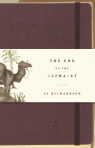
The End of the Alphabet by CS Richardson

Richardson’s first novel is a slim 139 page contemplation on how one would spend the remaining days of a relatively uneventful life. Ambrose Zephyr is diagnosed with an unnamed incurable disease on his 50th birthday. After the initial shock wears off he embarks on a whirlwind trip with his wife, Zipper. (Don’t even ask about the ridiculous names.) He decides to visit one place for each letter of the alphabet. A is for Amsterdam and so on.

My book club was divided down the middle on this one. Some of the women really loved it. They thought Richardson’s pared down, choppy prose suited the story- giving it an urgency which was mirrored by Ambrose’s desperate attempt to pack as much into his remaining days as he could. Others, like myself, thought the book failed to connect the reader with Ambrose. How can you care about someone you know so little about?

Before publishig this first novel, Richardson was an award-winning book designer.

Come Closer by Sara Gran

I dunno. Margot Livesey said Come Closer ought to carry a warning to readers. It’s impossible to begin this intense, clever, beautifully written novel without turning every page.” And Stewart O’Nan said: “Sara Gran has created a sly, satisfying novel of one young woman possessed not only by a demon but also by her own secret desires.”

I quote these two reviews because I have read both Livesey and O’Nan and admire their writing. Believing their assessment of this book is sort of like reading fic recced by an author you like. You sort of hope they’ll point you in the direction of the good stuff.

And while Gran’s novel isn’t exactly what I’d call the good stuff- it wasn’t rotten, either.

Amanda is an architect who lives with her wonderful husband, Ed, in an unnamed American city. We don’t get any real insight into Amanda’s life before weird things start to happen: funny noises in her home, strange and troubling dreams, black outs, missing time she can’t account for.  These events transpire in little snippets. Things happen, we hear about them and then we’re on to the next thing. I never really felt connected to Amanda. I didn’t fear for her or care for her and if the novel has a failing for me, that’s probably it. As Amanada says herself: “What we think is impossible happens all the time.” And sometimes those impossible occurrences are horrific.

Just not in this book.

Which is apparently being made into a flick.

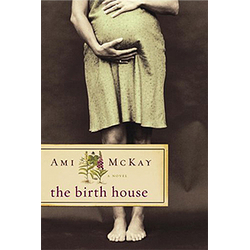
The Birth House by Ami McKay

One of the first books I read this year and easily the best novel I encountered in 2006, this account of a midwife in turn-of-the-(20th)-century Nova Scotia is everything a novel should be: funny and tragic, joyful and sorrowful, filled with rich, carefully drawn characters and experiences that linger long in the mind.

The Birth House
spent most of the year on bestseller lists and marked the arrival of a splendid new talent. I can’t wait to see what Ami McKay does next.
– Robert Wiersema, for the Vancouver Sun.

Ami McKay’s book The Birth House is a natural selection for book clubs. Set in rural Nova Scotia circa the First World War, it tells the story of Dora Rare, the “only daughter in five generations of Rares.” Dora is a smart girl who spends much of her time with Miss B, the area midwife. Miss B is part-healer and part-witch and Dora learns much under her tutelage.

Truthfully, it took me a while to get settled into Dora’s quiet world, but the book’s charms are undeniable. For one thing, Dora is utterly likeable. She is kind and sensible and although she is young, she is no shrinking violet. McKay does a wonderful job of creating a world far removed from technology and the horrors of the war, but certainly not immune to either. For example, Dora’s faith in midwifery is tested (as is the faith of all the women of her community) when Dr. Thomas arrives in the area and sets up a hospital, offering women pain-free births. And when the Halifax Explosion of 1917 happens, Dora rushes off to help and is forever changed by the experience. Scots Bay isn’t modern and McKay paints a riveting picture of poverty and backwoods thinking.

But the book isn’t without a sense of humour either. Dora’s marriage to town hunk, Archer, necessitates a visit to Dr. Thomas where he diagnoses her with “neurasthenia” and prescribes treatment using the Swedish Movement Health Generator. I dare you to keep a straight face.

The Birth House isn’t a flashy book, but it’s a book that will resonate with readers, particularly women, and I heartily recommend it.

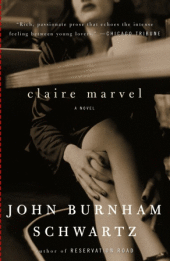
Claire Marvel by John Burnham Schwartz

A few year’s back I read Jonathan Burnham Schwartz’s devastating novel Reservation Road and was really impressed. So I was really looking forward to reading Claire Marvel. The book’s opening lines: “There was before her and now there is after her and that is the difference in my life” promised great things– but I’m not sure Schwartz actually delivers.

The book is narrated by Julian Rose, a grad student at Harvard who meets and falls immediately in love with Claire Marvel during a rainstorm. The book traces their relationship through all the requisite romantic obstacles and I suppose I can fairly say that the only thing that prevents this book from being totally been there, done that is the quality of Schwartz’s prose.

As Julian chases and abandons and chases and abandons the love of his life, we are never really certain of her and, in fact, even though the book is named after her– we really come to know very little about Claire as a person.

Members of my book club loved this book…but I found it somehow unsatisfying.

Breakheart Hill by Thomas H. Cook

“You’ll think you know who (and maybe you do) and you’ll think you know why (and I suppose it’s possible); but trust me, you won’t have guessed everything. “Breakheart Hill” is one of the best written and most marvelously crafted books I’ve read in a long, long time. It’s dark and it’s sad and it’s very, very good. Read it.” – Mystery NewsI picked up Thomas H. Cook’s 1995 novel Breakheart Hill at the second hand store. On the cover was the tagline “a mesmerizing tale of love and betrayal” and I thought, okay, good Sunday afternoon book and bought it. The opening line is one of the most intriguing I’ve read in recent memory: “This is the darkest story that I have ever heard, and all my life I have labored not to tell it.”

The narrator of this dark tale is Ben Wade, a respected doctor in Choctaw, Alabama. As a teenager, Ben grows to love the beautiful Kelli Troy who has moved to Choctaw from the north. It is 1962. The story expertly weaves Ben’s memories of high school with present day, dropping ominous clues about just what happened the afternoon Kelli’s battered body was discovered on Breakheart Hill.

I suppose in some ways, I’ve been spoiled by mystery/thriller/suspense novels which unfold at breakneck speed; I was often impatient reading this book. Sometimes it seemed to take forever to get anywhere, but ultimately that’s one of the book’s many charms.

Breakheart Hill is a leisurely southern gothic novel, filled with a real sense of place and time. The characters are interesting and flawed and I was 100% surprised by the ending, which wasn’t a cheat even though it felt like it should have been.

If you like an intelligent mystery that will break your heart, this is the book for you.

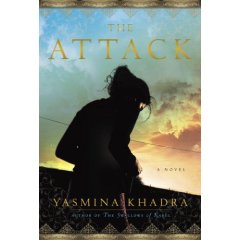
The Attack by Yasmina Khadra

Yasmina Khadra’s novel The Attack set off a firestorm of debate at book club. The novel follows the journey of Muslim surgeon Amin Jaafari, a naturalized citizen of Tel Aviv. He shares his life with the love of his life, Sihem. It isn’t giving anything away to say that Amin’s wife turns out to be a suicide bomber, detonating herself in the middle of a restaurant filled with school children. The novel then follows Amin’s journey from denial and disbelief to acceptance, if not of his wife’s actions then at least of the motivation behind the attack.

I didn’t like the book. The problem for me is that the character of Sihem is never humanzied. She is “the creature I loved most in the world.” Anything we learn about her, we learn through the eyes of the extremists with whom she had aligned herself behind her husband’s back. He doesn’t understand and neither did I. Mostly I felt as though I was getting a lecture about the very messy and complicated and, clearly, emotional landscape of the Middle East.

Still, the book led to a great, and often heated, discussion– if that’s your thing.

The Other Woman by Evelyn Lau

Evelyn Lau’s book Other Women is a difficult book to recommend whole-heartedly. Alternating between first and third person, it tells the story of an artist, Fiona, who is recovering from a 15-month affair with successful businessman, Raymond who is twenty years her senior and married.

The problem with the book isn’t the story (what little story there is) because anyone who has ever had an obsessive relationship with the wrong person will certainly relate. The problem isn’t the prose; Lau can certainly write, although I would have to say that this story is over-written– nothing is stated simply, there’s a metaphor for every emotion.

For me the problem is the characters. Raymond isn’t at all likeable; he comes across as narcissistic (and in fact Fiona actually says this of him) and although he once cautions Fiona that she  mustn’t let him hurt her, he yanks her along a romantic trail of self-destruction and worse, Fiona isn’t the only affair he’s ever had. Fiona isn’t much more sympathetic. The whole novel is spent lamenting Raymond’s loss. Fiona drinks and compares every other man to Raymond, and all this for a relationship that is never even consummated.

Still, it was hard not to be swept along by Lau’s poetic prose, even though I could have cared less about the characters and their rather soggy affair.