You Were Never Here – Kathleen Peacock

There are so many things to admire about Kathleen Peacock’s YA novel You Were Never Here, but let’s just start with the fact that it’s set in New Brunswick. I can’t tell you how much fun it was to read a book that takes place in my home province. Okay – now that that minor squee is out of the way, let’s talk about Mary Catherine Montgomery aka Cat.

Cat has been exiled from New York City, where she lives with her screenplay-writing father, to her Aunt Jet’s in small-town New Brunswick. (The town is called Montgomery Falls, but I pictured Fredericton, for those of you to whom that means something.) Aunt Jet is the caretaker of the family’s now crumbling ancestral home, which she operates – out of necessity – as a boarding house. The reason for Cat’s exile and her subsequent banishment creates just one of You Were Never Here‘s mysteries. Another is the disappearance of Cat’s childhood friend Riley Fraser.

The boy in the picture is handsome. Chiseled jaw and wavy hair kind of handsome. The kind of handsome that gets crowned prom king or maybe class president. Even though the smile on the boy’s face looks forced around the edges, it’s wide enough to bring out the dimple in his left cheek.

There are a thousand Riley Frasers in the world, and the boy in the poster is mine.

Riley Fraser has been missing for months. The two had been friends the summer they were twelve (five years ago, and the last time Cat had been to Montgomery Falls), but something happened between them (another mystery) and even though Cat knows “I don’t owe Riley Fraser anything – not after the last thing he said to me”, knowing that he has disappeared is deeply unsettling.

Cat has no intention of doing anything other keeping to herself while she’s in Montgomery Falls, but then she meets gorgeous Aidan Porter, one of Montgomery House’s boarders. He proves to be a welcome distraction as Cat tries to process not only what happened back home, but also her complicated feelings about Riley, their truncated friendship, and his disappearance.

Those feelings become even more complicated when she bumps into Riley’s older brother, Noah. At first, Noah seems disinterested in his brother’s whereabouts, but soon he and Cat team up to try to solve the mystery of what happened to Riley.

And there’s yet another mystery in You Were Never Here which has to do with Cat herself. She seems very reluctant to touch people. There’s an incident on the bus from NYC to New Brunswick, when Cat hesitates before letting a woman sit beside her.

…there’s only so much you can do when you’re big. You can twist and contort all you want, but volume is volume, and with both of us “fat” – “overweight,” my dad always corrects, as if that somehow sounds better – a trickle of sweat forms where our hips press against each other.

Cat’s size is only part of the issue, though. (And how awesome to encounter a protagonist who is not a ‘perfect’ size zero; neither is her weight a punchline or flaw.) The other reason for Cat’s reluctance to touch people is germane to who Cat is, but I’ll let you discover that secret on your own.

I flew through You Were Never Here because it was all the things I love in YA: well-written, suspenseful, peopled with realistic characters, and loads of fun. The last third of the book was so tense, I couldn’t turn the pages fast enough. The fact that I was in a somewhat familiar setting was just the icing on the cake.

Highly recommended.

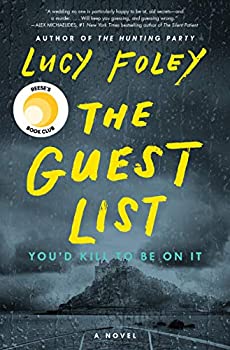
The Guest List – Lucy Foley

Lucy Foley’s thriller The Guest List is the perfect book to pick up if you’ve got a couple hours and you want to be distracted. Although I didn’t find the writing to be spectacular (do people not care about comma splices anymore?) and the twists weren’t necessarily twisty (once you see one, the house of cards starts to crumble), I still thoroughly enjoyed my time on Innis an Amplora or Cormorant Island.

Jules and Will (a digital magazine editor and a reality tv star) are getting married and they’ve decided to hold the exclusive event on Cormorant Island, located in the Atlantic, off the coast of Ireland. There’s nothing much on the island now, except for the Folly (aptly named as it turns out), a few crumbling buildings, a graveyard and a peat bog. To this event they’ve invited 150 or so of their closest friends, but the people who really matter come the day before.

There’s Hannah, wife of Charlie, who’s Jules’s best friend. Hannah’s quite aware that she and Jules are “the two most important people in [her] husband’s life.” There’s Johnno, Will’s best friend and best man. The two men went to an exclusive boarding school called Trevellyan. There’s Olivia, maid-of-honour and Jules’s half sister. Finally there’s Aiofe, wedding planner and owner of the Folly with her husband Freddy. Each of these people, and Jules, reveal their feelings about the event and the people in attendance in first person narratives. The book jacket tells us that one of these people is a murderer, although we don’t find out until the very end who has actually been killed.

Years ago, I read Agatha Christie’s magnificent “locked room” mystery (although at the time, I’m not sure I knew that’s what it was called) And Then There Were None. The “locked-room” or “impossible crime” mystery is a subgenre of detective fiction in which a crime (almost always murder) is committed in circumstances under which it was seemingly impossible for the perpetrator to commit the crime or evade detection in the course of getting in and out of the crime scene.[1] The crime in question typically involves a crime scene with no indication as to how the intruder could have entered or left, for example: a locked room. Following other conventions of classic detective fiction, the reader is normally presented with the puzzle and all of the clues, and is encouraged to solve the mystery before the solution is revealed in a dramatic climax. (From: https://en.wikipedia.org/wiki/Locked-room_mystery).

The Guest List isn’t totally a “locked room” mystery, but I think Foley does owe a debt of gratitude to Christie. And to every unreliable narrator on the planet. Every one one of the guests who arrive early on the island have something to hide. Secrets are alluded to. Friendships fray. Relationships strain. And it’s all enormous, mindless fun.

Sunburn – Laura Lippman

Sunburn is my second outing with Laura Lippman. I just re-read my review of The Most Dangerous Thing from 2014 and the issues I have with Sunburn are pretty much the same issues I had with that book.

Sunburn concerns the fates of Polly and Adam. Polly (who has several other names) walks away from her husband, Gregg, and daughter, Jani, while the three are on a beach holiday. She lands in a little backwoods town (Belleville, Delaware), and that’s where Adam finds her. Adam has been hired to find her, actually. He couldn’t have known that he would be so attracted to her. “It’s the sunburned shoulders that get him.”

Adam and Polly end up taking jobs at High-Ho, a dump of a bar, where Polly waits tables and Adam, who happens to be a trained cook, revamps the menu. At first they keep their distance from each other.

He doesn’t go in hard. He’s not that way. Doesn’t have to be, if that doesn’t sound too vain. It’s just a fact: he’s a Ken doll kind of guy, if Ken had a great year-round tan. Tall and muscular with even features, pale eyes, dark hair. Women always assume that Ken wants a Barbie, but he prefers his women thin and a little skittish.

Skittish is certainly one way to describe Polly. Secretive and calculating would also be apt. Polly’s complicated past stretches beyond leaving her family on the beach. “If anyone knew her whole story, that might be the truly shocking part, the way she ruined her own second chance. But no one knows her whole story.”

For a while, the dance between Adam and Polly is interesting. They each have secrets and they are keeping their true feelings and motives close to their chests. Is Polly a player, a maneater? How does a mother walk away from her kid? It’s a question worth asking. And Adam? Who is the mysterious man who has asked him to keep tabs on Polly? What is he really after?

Ultimately, though, in the same way that the climax of The Most Dangerous Thing was anticlimactic, Sunburn doesn’t really get anywhere….and it certainly doesn’t get anywhere quickly. The first third of the novel is far more page-turning than the last third. By the time I got to the end, I didn’t even believe in Adam anymore. He seemed sort of neutered.

I’ll say the same thing about Lippman as I did the first time around: she can write. And maybe some readers won’t mind a meandering journey like this one, but it was just so-so for me.

The Lies They Tell – Gillian French

Pearl Haskins lives with her alcoholic father on the wrong side of the tracks in Tenney’s Harbor, Maine. (For the record, I am spelling harbour that way because, USA.) Pearl works at the local country club, where the wealthy summer folk flaunt their, well, wealth. It was here, at Christmas, that Pearl last saw the Garrisons: David, the patriarch; Sloan, his beautiful wife and two of their children, seventeen-year-old Cassidy and ten-year-old Joseph. Tristan, the oldest Garrison child, is not present. Later that night, while Pearl’s dad sleeps in the Garrison’s gatehouse, someone broke into the house and shot the Garrisons in their sleep, then set their mansion on fire.

Gillian French’s impossible-to-put-down YA mystery The Lies They Tell picks up the story the following summer. Pearl has graduated from high school and she’s still working at the country club, still impossibly in love with her best friend, Reese, and still trying to manage her father’s drinking, which hasn’t really improved because most of the summer elite blame him for what happened at the Garrison’s – even though he is clearly not to blame. In fact, the culprit was never caught and the main suspect, Tristan, has an ironclad alibi.

And now here he was “with his entourage, the boys of summer, owning the place.” For reasons Pearl can’t quite understand, she is drawn to Tristan, “gripped by the physical and emotional recoil she – and almost everyone else – felt in his presence.” She feels a kinship to him because she senses he is “so alone, even in a room full of people….”

When one of Tristan’s friends, Bridges, takes a romantic interest in Pearl, she suddenly finds herself drawn into a world which she has only ever watched from the outside. Bridges seems nice and seems to genuinely like Pearl, but is he to be trusted? The third boy in the group, Akil, seems to openly disapprove of her. And Tristan, he doesn’t seem to know she exists, until he turns his laser focus on her.

I really enjoyed this novel. For one thing, it’s very well-written and the characters are believable. You know how characters in mysteries and thrillers sometimes do stupid things? Not here. Pearl is smart. She wants to figure out what happened to Tristan’s family, on the surface so that the blame can be shifted away from her father, but also because Tristan just seems like a whipped puppy to her. As she sifts through the gossip and tries to make sense of Tristan himself, she comes closer and closer to danger.

Like Pearl, I kept changing my mind about whodunnit and by the time I got to the book’s final pages my palms were sweating.

Highly recommended.

Island of Lost Girls – Jennifer McMahon

Rhonda Farr, the protagonist of Jennifer McMahon’s second novel Island of Lost Girls, has stopped at the Mini Mart for gas when she sees something that sends her reeling back through her past. A gold VW Beetle pulls up next to her, a car she recognizes, but instead of being driven by the eccentric Laura Lee, it’s being driven by a large, white rabbit.

…when the rabbit got out of the car, there in the Pat’s Mini Mart parking lot at quarter to three on a Monday afternoon, it didn’t occur to Rhonda that there might be a person inside. He hopped like a bunny, moved quickly, nervously, jerking his white head one way, then the other. He turned toward Rhonda, and for an instant he seemed to stare at her with his blind plastic eyes.

While Rhonda watches, the rabbit knocks on the door of another car parked in the lot and leads little Ernestine Florucci, whose mother is inside the store, away. It is from this absurd beginning that Jennifer McMahon (Promise Not to Tell, Dismantled, The Winter People) spins the tale of not one missing girl, but two.

Rhonda, perhaps out of guilt, decides to help with the search effort and to do a little investigating of her own. She’s aided by Warren, Pat’s nephew. Pike’s Crossing is a small place, and Rhonda knows everyone. Trying to help find Ernestine also brings back a wave of memories about Lizzy, Rhonda’s childhood best friend who also went missing many years ago. It also brings to mind the summer they spent together launching a production of Peter Pan with Lizzie’s older brother, Peter, who is the object of Rhonda’s unrequited affection and also her dearest friend. As she searches for clues, Rhonda comes to suspect that Peter might have something to do with Ernestine’s disappearance.

There is a mystery, well two mysteries, at the centre of McMahon’s novel and I think she successfully pushes the plot of both along, switching between the past and present with ease. (I read the book in pretty much one sitting, which is about a good a recommendation as I can offer, really.)

This is also a book about the loss of innocence. Rhonda loses hers when she discovers family secrets, and when she realizes her feelings towards Peter are not returned. It also ruminates on the end of childhood. Rhonda recalls her role as Wendy in Peter Pan and remembers saying her lines and having “a sudden vision of herself as an adult, saying that line quietly on some far-off night as she stared up at the sky, like it might help bring her back.”

I haven’t always liked everything McMahon has written, but I did enjoy this book.

The Wildling Sisters – Eve Chase

The four Wilde sisters (Flora, Pam, Margot and Dot) are spending the summer at Applecote, a manor house in the Cotswolds. They have many happy memories of time spent here, but this summer is different. For one thing, their cousin, Audrey, is gone — having disappeared without a trace five years earlier — and their aunt and uncle haven’t quite recovered from the loss. For another, there’s Tom and Harry, the boys from the estate across the river. Their arrival upsets the easy camaraderie between the three oldest sisters as they vie for the boys’ attention.

Eve Chase’s novel The Wildling Sisters is a slow burn gothic novel that slips back and forth between that summer in 1959 and the present day when Jessie and her husband Will, (and their young daughter Romy, and Will’s teenage daughter from his first marriage, Bella) buy Applecote in an effort to escape London’s madness and settle into a quieter life. There’s also that thing that happened at Bella’s school. Fresh start and all that.

Crime. Crowds. The way a big city forces girls to grow up too fast, strips them of their innocence. It’s time for the family to leave London, move somewhere gentler, more benign.

Jessie also hopes that this will be a new beginning for her and Bella. Being a step mother is hard enough without the shadow of Bella’s mom, the perfect and tragically-killed-in-a-car accident super mom, Mandy, hanging over their heads. The idyllic notion Jessie has of what Applecote might do for her family doesn’t quite come to fruition, though. Will spends a great deal of time in the city dealing with a work crisis, and Jessie begins to feel more and more isolated. Plus, there are all sorts of rumours about Applecote and what happened there 50 years ago.

Fifteen-year-old Margot is our narrator in 1959. The middle sister, she is aware of her shortcomings. She doesn’t “turn heads like Flora” or “command attention in a room like Pam through sheer, unembarrassable life force.” She was closest to Audrey, and so she is the most apprehensive about returning to Applecote.

…the sky is as I remember it: blue, warm as a bath, the air transparent. not washing-up-water-tinged as it is in London, alive with butterflies and birds, so many birds. So much is the same that it highlights the one crushing, unbelievable thing that is not: Audrey isn’t about to come belting out of the house, running down the path, excitedly calling my name.

This is a mystery: what happened to Audrey? It also begins with the image of the girls dragging a body across the lawn of Applecote. That can’t be good, right? It takes a long time to get anywhere, which isn’t a criticism because the book is well-written and does evoke a specific time and place. It also plumbs the depths of family relationships, not just between the Wilde sisters, but also the longings of daughters for mothers and mothers for daughters.

Definitely worth a read.

One of Us is Lying – Karen M. McManus

Nate and Bronwyn 4eva! Yeah, sure, there are other characters in Karen M. McManus’s super fun YA page-turner One of Us is Lying, but as we all know I am a sucker for a misunderstood bad boy. (At my age, I should really be over that. ) Okay, let’s not get off track here.

Bronwyn (super-smart), Nate (known drug dealer), Cooper (star athlete), Addy (beauty queen) and Simon (outcast) are all sent to detention for having phones in class. (Cue The Breakfast Club soundtrack.) Yes, these are the stereotypes you’d expect to find in a YA novel, but McManus manages to make each of these characters way more than they appear on paper.

Each character is given their opportunity to speak, so the narrative clicks along really quickly. (I read this novel in about one sitting – mostly because I couldn’t put it down.) Before detention is over, Simon is dead and the four remaining students find themselves prime suspects in his death. (Murder?)

Simon wasn’t actually a very nice guy. He ran a blog called About That which reported high school gossip and revealed dark secrets, secrets students would certainly rather not share. And it turns out that the four remaining teens all have something to hide. As Bronwyn says: “As a general rule, and especially lately, I try to give Simon as little information as possible.”

As some of these secrets come to light, suspicion shifts from one student to the other. And all the while, someone is still posting on Simon’s blog. So whodunnit is definitely a big part of the fun with this book.

Additionally, though, McManus makes you care about each of the four main characters. They are fully realized individuals, with back stories which will likely speak to many teen readers. There are a slew of equally compelling secondary characters and even the parents (who are often remote, shadowy creatures in YA) are not static.

The fun of this novel is not only trying to figure out who might have a motive to kill Simon (they all do), but how this supposed murder might have taken place. And that would have made for a great book all on its own. but McManus makes this novel about so much more than that. She tackles bullying, the weight of expectations, friendships, toxic relationships, the rumour mill and its devastating consequences, and trust without making any of it instructive.

I loved these characters and I had so much fun reading this book. Can’t wait to read the sequel.

Highly recommended.

A Game For All the Family – Sophie Hannah

gameSophie Hannah’s novel A Game For All the Family belongs in the “WTF did I just read category?” Hannah is a well-known and much-lauded British writer of thrillers, but this is the first book I have read by her.  And I didn’t love it.

Justine Merrison has left her high powered job as a TV exec to move from London to a country house called Speedwell located in Devon. She will do “Nothing” with a capital ‘N’ except look after her fourteen-year-old daughter, Ellen, and her opera-singing-husband, Alex.

Life in Devon doesn’t turn out to be as blissful as Justine imagined though. Only a few months into the move, she starts to receive anonymous and increasingly threatening phone calls. Then Ellen starts to act strangely, and when Justine presses her Ellen admits that her best friend at school, George, has been expelled because of a stolen coat, which Ellen insists that she gave to him. When Justine goes to Ellen’s school, the headmistress assures Justine that no such pupil has been expelled. In fact, George doesn’t even exist.

Interspersed with this weirdness, is a story Ellen is writing for school. The story traces the strange history of the Ingrey family, also inhabitants of Speedwell House.

Perrine Ingrey dropped Malachy Dodd out of a window. She wanted to kill him and she succeeded. Later, no one believed her when she screamed ‘I didn’t do it!’

Eventually these two stories (Justine’s and Ellen’s made-up story — or is it? duhduhduh–) merge. I was constantly adjusting my notion of what was true…if, in fact, the truth could be stranger than fiction, or the fiction  actually be the truth. Ellen says as much in her story:

But what about you, who are reading this story? Do you respect the truth? I haven’t told you what it is yet, have I? I could have done quite easily, but then you would have taken it for granted. I don’t want you to do that. I think you’ll appreciate the truth more if you struggle for a while to work it out.

I suppose that’s the ‘fun’ of any mystery/thriller: trying to work it out. There’s no question, Hannah is a capable writer and A Game For All the Family is a skillfully plotted story, it’s just that after I feverishly turned all 419 pages, I felt sort of disappointed in where I landed.

The French Girl – Lexie Elliott

Ten years ago, Kate spent a week in the French countryside with five of her friends fromfrench Oxford. That’s where they meet Severine, the girl next door.

Severine, slim and lithe in a tiny black bikini, her walnut brown skin impossibly smooth in the sun, one hip cocked with the foot pointing away as if ready to saunter off the moment she lost interest. Severine, who introduced herself, without even a hint of a smile to soften her devere beauty, as “the mademoiselle next door,” and who disappeared without a trace after the six of us left for Britain.”

Her disappearance has remained a mystery. Until now.

Lexie Elliott’s novel The French Girl ticks a lot of boxes for me. First of all, I am a sucker for books about groups of friends whose loyalties shift and erode over time. Kate’s circle includes Lara, her bestie; Seb, her beautiful ex-boyfriend; Tom, Seb’s cousin and best friend; Caro, the ice queen of the group and Theo, whose parents owned the French farm where the group stayed. When Tom calls to tell Kate that Severine’s body has been found on the farm property, and that the French police will be wanting to speak to them all again, it exposes the cracks in Kate’s relationships with these people.

Elliott wisely chooses to set her novel in the present and make Kate our first person guide through these events. First, her reunion with Tom — returned from Boston after a break-up with his fiancé. Then, more fraught, a reunion with Seb, whom she has not really seen since their break-up at the French farm. Suddenly, the former friends are thrust back into each other’s orbits, trying to align their memories about the last time they saw Severine and speculating about what actually might have happened to her.

Ever since the discovery of Severine’s body, Kate has sensed “a presence that rests on my consciousness just out of reach of my field of vision.” Kate sees Severine’s bones “bleached white, and neatly stacked in a pile with the grinning skull atop” and on other occasions  as “a fleshed-out version of walnut-coloured skin, secretive eyes and a superior lack of smile.” As the investigation progresses, Severine insinuates herself more and more into Kate’s life. Is she a manifestation of guilt or memory or something even more sinister?

I really enjoyed The French GirlKate is a smart and likable character and even though we only see the other characters through her eyes, I trusted her assessment of them and their shared events because she was constantly readjusting her own perspective as new information revealed itself. This is a clever mystery and would certainly appeal to anyone who enjoys character-driven plots. I look forward to reading more by this author.


No Saints in Kansas – Amy Brashear

A chance encounter with the relative of Bobby Rupp, one of the original suspects in the deaths of the Clutter family, inspired Amy Brashear to write No Saints in Kansas. In this YA novel, Brashear reimagines the murders, made famous in Truman Capote’s masterpiece of non-fiction In Cold Blood, from the point of view of fifteen-year-old Carly Fleming. Although she is a work of fiction, her father, Arthur, is the lawyer who ultimately defends one of the two men convicted of the homicides.

Carly and her younger brother Asher and their parents have relocated to Holcomb, Kansas from New York City after one of Mr. Fleming’s cases goes sideways. Holcomb is a backwater compared to Manhattan, and Carly has a hard time fitting in. She is an “outsider” and no matter what she does, it feels like she always will be. From her point of view, the way “in” is through Nancy Clutter because “Everyone likes – I mean, everyone liked – the Clutter family.” It feels like a dream come true with she is asked to tutor Nancy, although Nancy seems less happy about it. In her imagination, Carly imagines that tutoring Nancy is

…how we became best friends. From that moment on, we were inseparable. We were attached at the hip. At lunch, at 4-H club, at every school event, double dates, sleepovers, I was popular by association.

I wish.

When the Clutters are found dead in their home, and Carly learns that Nancy’s boyfriend Bobby is a suspect, she is determined to clear his name. She snoops in ways that are, truthfully, wholly unbelievable including a visit to the Clutter farm post-murders and stealing documents from the courthouse.

Although the real-life Clutter murders are the backdrop for Carly’s story, this is just as much about what it is to not fit in. Holcomb is a tight-knit community where everyone knows everyone. Some of the teens in Carly’s orbit are downright mean to her. Her one “friend”, Mary Claire, runs hot and cold. No Saints in Kansas is as much about navigating an awkward adolescence as it is about the Clutter crime.

For anyone who has read In Cold Blood, this book will obviously pale in comparison. Capote’s book, which I read many, many years ago, is meticulously researched (interestingly, Harper Lee spent time in Holcomb acting as Capote’s researcher), but still reads like fiction. Capote reconstructs the Clutter’s last day, follows the investigation and also paints a picture of their murderers that is often quite sympathetic, particularly towards Perry Smith, with whom Capote had a close relationship.

None of this is to say that Brashear’s  book is without merit. I think most younger readers would find it compelling enough and reading it  might encourage them to tackle Capote’s book, too.