Twisted River – Siobhan MacDonald

I was that customer at Indigo a couple weeks ago when I sent  Matt and Jerrod looking25810336 for a book that I described as “blue” and “used to be on the front table.” Yep. So ridiculous, right, thinking that those descriptors would help them locate a book in a store filled with books. Talk about the proverbial needle in a haystack. Strangely enough, I found it on my own in the mystery section – although the book’s cover is definitely not blue.  (And it might have helped if I’d remembered the keys on the cover.)
Kate and Mannix O’Brien and their children Izzy and Fergus, and Hazel and Oscar Harvey and their children Elliot and Jess, are the central characters in Siobhan MacDonald’s novel Twisted River. We meet them separately, the O’Briens in their house in Limerick, Ireland and the Harveys in their Manhattan apartment. Each family has their own domestic rhythms and  difficulties. For example, Fergus is being bullied at school. Hazel is lying to her children – and herself – about her damaged cheekbone and her eye which “had swollen a mix of red and purple.” Mannix and Oscar each have work-related troubles. Then there’s Mannix’s brother Spike, a nightclub owner who’s mixed up with a local crime family.  When the families’ crises reach a boiling point, the moms take matters into their own hands and arrange a vacation. Using a house swap site they connect and swap houses; the O’Briens head to New York and the Harveys to Limerick, Hazel’s place of birth.

And a family vacation sounds great – except the novel starts with Oscar stuffing the body of a woman into the trunk of a car. (Not a spoiler – the novel’s opening line is “She would never have fit as neatly into the trunk of his own car.”) From that compelling opening line, the story weaves past and present, revealing secrets and lies.

Twisted River is twisted, all right. It’s really one of those books where things are not entirely as they seem. MacDonald’s layered narrative reveals characters and their motives with slippery-eel finesse. I didn’t feel duped by MacDonald’s  plot as much as I did by the novel’s kind of fallen souffle ending.  But as  far as being a page-turner, yes, I turned the pages.


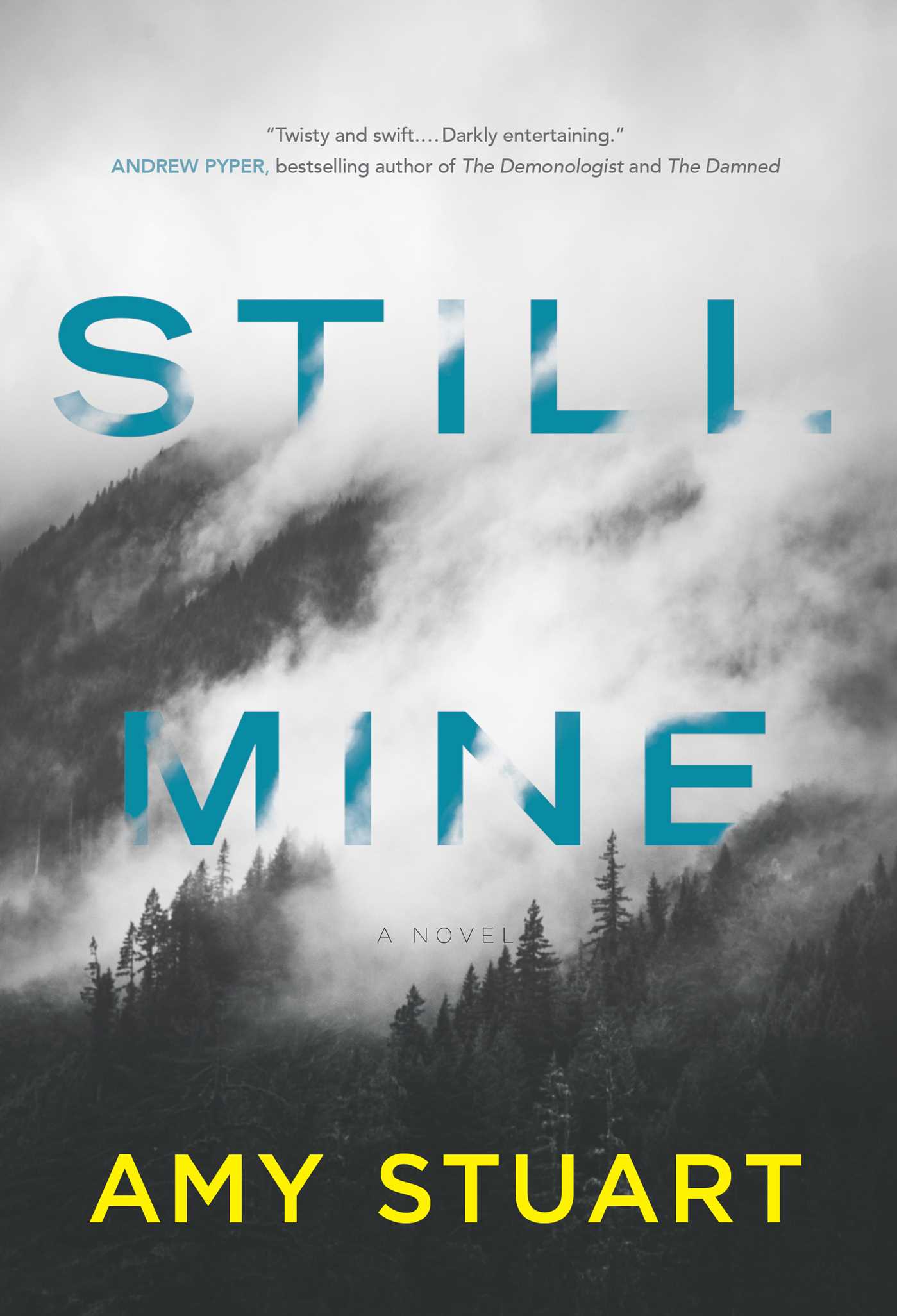
Still Mine – Amy Stuart

I haven’t read a book quite as weird as Amy Stuart’s Still Mine  in a long time and I still can’t decide whether it was good weird or just weird. It reminded me a little of Go With Me – a quirky, but affecting novel by Castle Freeman Jr.

still-mine-9781476790428_hrClare O’Dey has run away from her abusive husband, Jason. In an unusual twist, the man Jason sends to find her, Malcolm Boon,  hires Clare to go to Blackmore, a remote mining town in the mountains, to look for another missing woman, Shayna Fowles.  For reasons that won’t be immediately clear, Clare invests wholeheartedly in the search for Shayna, a woman whose past is as tricky and messed up as Clare’s.

Blackmore is a shriveled up nothing of a town. “A blast at the Blackmore Coal Mine five years ago killed thirty-two men and trapped  eighteen others underground for three weeks,”  Malcolm’s notes tell Clare. She pretends to be a photographer in town to take pictures, but it’s a ruse no one buys. The only hotel in town is closed and so Clare rents a trailer on Charlie Merritt’s property. Charlie is the town drug dealer and his property (his father and brothers were killed in the mine) butts up against Shayna’s parents’ place.  Clare figures it will be a good place to snoop.

Blackmore is filled with broken people: Jared, Shayna’s ex-husband; Sara, her friend; Derek, the town’s only doctor and Shayna’s parents, Louise (who is suffering from early onset Alzheimer’s) and Wilfred, her father, the man responsible for saving the eighteen men who did make it out of the mine alive (but also the man Charlie holds responsible for the deaths of his father and siblings). None of them seem to know what happened to Shayna and with no police in town, no one is looking for her.

As Clare attempts to find out what has happened and which of the town’s odd assortment of outcasts might be responsible for Shayna’s disappearance, her own past is revealed; her own frailties are exposed. Like Shayna, Clare has a penchant for drugs and alcohol, making Charlie particularly dangerous to her. She also finds herself strangely attracted to Shayna’s ex-husband, Jared. She forges a bond with Louise, replacing the mother she recently lost to cancer. In many ways, Clare steps into the life Shayna has abandoned. Even so she realizes

These people in Blackmore, they are not Clare’s friends. Derek and Jared and Sara and Charlie. They are not even one another’s friends. They are only characters in Shayna’s story and Shayna is not here.

Still Mine is an unusual, albeit strange, psychological mystery. Apparently there is a sequel on the way, but I was quite content with how the book ended.

Definitely worth checking out.


That Night – Chevy Stevens

I suppose that some fans of psychological suspense might call BC-based Chevy Stevens the Canadian Gillian that nightFlynn – except that, in my opinion, Flynn takes the prose prize and the plotting prize and, well, all the prizes, really. Sorry, Chevy.

This is the second novel I’ve read by Stevens. The first, Still Missing, won the International Thriller Writers Award for Best First Novel in 2011. I liked Still Missing, actually, though – if memory serves – I wasn’t keen on its ending. I didn’t like anything about That Night, although I wanted to. I didn’t abandon it to my Book Graveyard, though,  and I guess that’s saying something. Maybe it’s because Stevens is Canadian.

Toni Murphy and her boyfriend, Ryan Walker,  are in prison for the murder of Toni’s younger sister, Nicole. They maintain their innocence and while the evidence against them is circumstantial at best, they’ve both been locked away for fifteen years. (Not in the same institution, obviously.) The novel weaves between the events leading up to Nicole’s horrific murder, Toni’s incarceration and ultimate release (after serving her full sentence) and her attempts to reintegrate herself into society in her hometown of Campbell River, a town on Vancouver Island.

Toni is the problem child and Ryan is the son of a drunken criminal – so a bad boy by blood. Everyone seems to be waiting for them to get into trouble even though Toni seems more like a victim than a victimizer. She and Ryan are just waiting for high school to be over so they can get on with their lives together. Toni is especially anxious to get out of Dodge because of Shauna McKinney. “Most of the girls in our class either feared her or desperately wanted to be her friend, which I guess was kind of the same thing in the end,” Toni observes. Toni and Shauna used to be friends, but a misunderstanding over a boy changed all that and now Shauna does whatever it takes to make life living hell for Toni. Clearly, Toni is not as bad-ass as people think she is.

Nicole is the golden girl, the  mom’s favoured daughter because of her grades and sunny disposition. Until she starts hanging out with Shauna and her hench-women. Then she’s sneaking out of the house, coming home drunk and acting all weird.

Stevens’ first person narration allows us to see Toni’s journey through her final months in high school and then a sped up fifteen years in the big house where we watch Toni negotiate her way through a system that is bound to fail her. She makes friends; she makes enemies, and finally she is paroled. One of the conditions of her parole is that she has no contact with Ryan, who has also been released and who has also headed back to Campbell River. Despite the no contact rule which, if broken, has the potential to send them back to jail,  Toni and Ryan are determined to find out what really happened to Nicole.

Mostly I didn’t like That Night because I didn’t care about any of the characters. Toni’s parents were particularly irksome. Yes, it’s true that they’ve lost one daughter at, supposedly, the hands of another. But she swears she didn’t do it. How about a little faith, people?

When the true story of what happens is finally revealed, all the pieces click into place with precision, but ultimately this is less a mystery and more a story (sort of) of redemption. I found the writing a bit clunky – lots of exposition – and the characterizations superficial. For me, That Night wasn’t all that.


Between the Devil and the Deep Blue Sea – April Genevieve Tucholke

Seventeen-year-old Violet and her twin brother, Luke, live in a crumbling mansion in the town of Echo, somewhere on the coast of the Eastern United States. Their parents are absent, artists traipsing through Europe, so Vi and Luke are left to fend for themselves in the house built by their rich great grandparents. The money is long gone and now the house is no longer “dignified and elegant and great and beautiful.” Vi calls it Citizen Kane, but mostly because her grandmother, Freddie, had given it the nickname. Now Freddie is gone and so is the rest of the money Vi’s parents had left for her and Luke to live off until they returned from Europe. That’s the reason Vi decides to rent the guest house and that’s how River comes into her life. between-the-devil-and-the-deep-blue-sea

He was not tall – less than six feet, maybe – and he was strong, and lean. He had thick, dark brown hair, which was wavy and parted at the side…until the sea wind lifted it and blew it across his forehead and tangled it all up. I liked his face on sight.

River’s arrival shakes things up for Vi. She’s an introspective girl, prone to solitude and tucking herself away with a volume of Nathaniel Hawthorn short stories. Her one friend, Sunshine (the daughter of hippies who live down the road) is more a friend of proximity than anything else.

April Genevieve Tucholke’s YA novel Between the Devil and the Deep Blue Sea is a strange hybrid of gothic romance and suspense thriller. Although Vi is naive, she’s no – wait for it – shrinking violet. River’s just about the most exciting thing to happen in Echo in her whole life. The problem is that shortly after his arrival strange things start to happen. For one thing, a little girl goes missing and children in town claim to have seen the devil. Then the town drunk slits his own throat, in broad day-light, in the town square. Then River’s brother, Neely, shows up and Vi discovers that River has a tendency to lie about just about everything.

There are some truly creepy moments in Between the Devil and the Deep Blue Sea and, like Vi, you’ll be conflicted about River’s motives and actions. I don’t want to say too much about what’s going on because it’ll be more fun if you find out for yourself. Let’s just say, there’s some nasty energy in Echo and this book has a kick-ass denouement. There is a second book, Between the Spark and the Burn and according to Tucholke there are no plans for a third (praise the book gods!) so I will probably purchase the second book just to see what happens.

Lovely writing and page-turning fun makes Between the Devil and the Deep Blue Sea a winner.

The Winter People – Jennifer McMahon

A few years back I read Jennifer McMahon’s debut novel Promise Not To Tell, and I enjoyed it a great deal. A couple years after that I read McMahon’s novel Dismantled, a book I did not like one bit. Now I’ve just finished reading The Winter People, and I have to say it falls sort of in between.winterThe Winter People is a story which bounces between present day and 1908. In the past, Sara Harrison Shea lives on the farm where she grew up with her husband, Martin, and her little girl, Gertie. West Hall, Vermont is well-known for its mysteries and ghost stories, many of which center around Sara and her family farm, a house filled with secret places and, well, secrets.

In her diary, Sara writes “The first time I saw a sleeper, I was nine years old.”

I had heard about sleepers; there was even a game we played in the schoolyard in which one child  would be laid out dead in a circle of violets and forget-me-nots. Then someone would lean down and whisper magic words in the dead girl’s ear, and she would rise and chase all the other children. The first one she caught would be the next to die.

Turns out, though, there is dark magic and Sara’s Auntie, an Indian woman who cared for Sara’s dying mother before she started sleeping with Sara’s widowed father promises to “write it all down, everything I know about sleepers.” In case it’s not obvious, sleepers are people brought back from the dead, but they only exist for seven days, you, know, unless they shed blood during that time – then they live forever.

In the present, nineteen-year-old Ruthie lives in Sara’s farmhouse with her mother, Alice, and her little sister, Fawn. One morning Ruthie gets up to discover her mother is missing. Cold tea on the table, truck in the barn – vanished into thin air.

Then there’s Katherine. She’s still grieving the loss of her son, Austin, when her husband, Gary, is killed in a car accident. Thing is, he told her he was going to be one place and he was actually in West Hall. Last seen: Lou Lou’s Cafe with Alice.

These disparate threads do come together by novel’s end, but I lost interest about half-way through. The Winter People is clearly meant to be a ghost story, but once crazy Candace shows up, intent on getting the missing pages of Sara’s diary so she can sell the secret of raising the dead so she can fight for custody of her son -yeah, right about then I was…c’mon. Oh, plus there’s a gun. Two guns actually. And other crazy shenanigans. And then, a lot of exposition to tie up those pesky loose ends.

When McMahon stuck to the ghost stuff…there were some creepy moments, but The Winter People is nowhere near as good as Promise Not To Tell.

Think of a Numb3r – John Verdon

numberJohn Verdon’s debut novel Think of a Numb3r introduces readers to retired NYC detective Dave Gurney, the man responsible for catching several well-known serial killers. Now he lives a quiet life in Walnut Crossing with his second wife, Madeleine. He spends his time “enhancing, clarifying, intensifying criminal mug shots” which he sells through gallery owner Sonya Reynolds, a woman he spends just a tad too much time thinking about.

Out of the blue he receives a message from an old college classmate, Mark Mellery. Mellery is ” the director of some sort of institute in Peony and he did a series of lectures that ran on PBS.” Mark needs Dave’s help. He’s received a cryptic note:

Do you believe in fate? I do, because I never thought I’d see you again – and then one day, there you were. It all came back: how you sound, how you move – most of all, how you think. If someone told you to think of a number, I know what number you’d think of. You don’t believe me? I’ll prove it to you. Think of any number up to a thousand – the first number that comes to your mind. Picture it. Now see how well I know your secrets. Open the little envelope.

The note is creepy; the fact that the envelope contains the very number that Mark thought of, creepier still. Mark claims that the number he thought of –  658 – “has no particular significance to me.” The note also asks Mark to send $289.87 to  a post office box in Connecticut.  Mark has sent the money, but the check has not been cashed. It’s a perplexing situation and Mark is looking for some guidance.

Think of a Numb3r is a well-written mystery but I found it just a tad slow. Even after the bodies start to pile up, I felt like the same evidence was being recounted  too often. A lot of names to remember- DAs and other detectives and such. As for Dave, he just seems pissed off all the time. Okay – yes, there’s been  tragedy in his life which may explain some of it away, but then the reconciliation with Madeleine at the end seems a little trite. We get to hear just a little too often how famous Dave is and , yeah, we get it – he’s caught some monsters.

As far as the mystery – it’s good enough. There are certainly some compelling elements – footsteps in the snow which vanish into thin air, clues left for the police which are clearly meant to demonstrate how smart the villain is. I just wish it had all unfolded a teensy bit quicker.

The Girl on the Train – Paula Hawkins

girlontrainSo, you know how everyone and their dog was reading and talking about Gone Girl when it was released? The Girl on the Train, Paula Hawkins’ debut novel, is this summer’s version of that book. I talked about books with buzz  last week on Information Morning and this book most definitely had buzz. Is it worthy, though? That’s the question.

Rachel takes the same trains from Ashbury, a tiny suburb outside of London, every day –  into the city on the 8:04 and home from the city on the 17:56. From her seat, she can see into the gardens of the homes she passes and one garden in particular captures her interest. That’s the house where Jason and Jess live.

They are a perfect, golden couple. He is dark haired and well built, strong, protective, kind. He has a great laugh. She is one of those tiny bird-women, a beauty,  pale- skinned with blonde hair cropped short. She has the bone structure to carry that kind of thing off, sharp cheekbones dappled with a sprinkling of freckles, a fine jaw.

Every day when Rachel’s train shudders to a stop at the red signal, Rachel imagines the life Jason and Jess must share (imagining is all she can do because she doesn’t really know them, not even their real names).  But  there is another reason that Rachel is fixated on this house and that’s because for five years she lived just down the road with her husband, Tom. Tom still lives in their old house, only now with his new wife, Anna, and their infant daughter, Evie.

It won’t take the reader very long to figure out that Rachel is an unreliable narrator and the reason for that will be obvious: Rachel is a drunk. She drinks in the morning, in the evening, mostly alone. She throws up, passes out and often doesn’t remember what has happened to her. She calls her ex-husband at all hours. She admits

I am not the girl I used to be. I am no longer desirable, I’m off-putting in some way. It’s not just that I’ve put on weight, or that my face is puffy from the drinking and the lack of sleep; it’s as if people can see the damage written all over me…

Then one day Jess (whose real name is Megan) goes missing and Rachel is sure that she has seen something that will help the police to find her. The problem is, of course, that once she pulls on the thread of what she thinks she saw, a whole lot of things start to unravel.

As messed up as Rachel is, it’s difficult not to empathize with her; her life has gone to hell in a hand basket in a variety of ways and she isn’t quite sure how to right herself.  Hers is not the only viewpoint Hawkins allows the reader, though. We also spend time with Megan and Anna and each woman has their own suspect relationship with the truth.

The Girl on the Train is an entertaining read. I can certainly see what all the fuss is about and given that it only took me a few hours to read, I certainly can’t say that I didn’t like it. But I didn’t love it.

The Silent Girls – Eric Rickstad

silentgirlsI picked up Eric Rickstad’s novel, The Silent Girls, on a whim. Creepy cover. Compelling blurb. Killer opening. But. (Trust me, you’ll get it in a moment.)

So, Frank Rath is a former cop turned private investigator who lives in Canaan, Vermont. He’s a single dad to daughter, Rachel, who is away for her first semester at college. By his own admission, Rath was a womanizing asshole, until his sister and her husband were brutally murdered in their own home. Now he’s a middle aged ex-cop with a bad back and too much time on his hands.

Then local cop, Harland Grout, calls about a missing girl who happens to be the daughter of his wife’s cousin. He wants Rath’s help. Looking into the case, another cop, Sonja Test (yes, all the names are this weird) discovers that there have been several other missing girls in the area over the last few years. Rath starts poking around, as you do, allowing the reader to meet a strange (and often reprehensible) cast of minor characters complete with the requisite red herrings.

As far as mysteries go, this one is okay. Not fabulous, not horrible. I think part of the issue for me was that there was – perhaps – too much going on. The latest missing girl is one thing. All the other girls another thing. And Rath’s own troubled past also factors in and contributes to a completely implausible denouement. I don’t mean to imply that the plot is convoluted; it’s not hard to keep track of any of this. It’s just that…

I was distracted by the writing. So, instead of staying with Rath the whole time, Rickstad chose a less limited point of view. Okay – fair enough. However, he had this weird writing tick that drove me nuts.

“She sort of seems familiar. But. In that way that reminds you of someone from TV or a dream.”

*

“But. State borders aren’t going to stop a sicko,” Sonja said.

*

But. How did one person, or even two people, choose these girls. And why?

*

“Of course I can read.” Gale sighed. “But. Her handwriting is a first grader’s. I’ll give it my best.”

*

“That was when I thought you were an intruder. I’ve been known to fib, if circumstances warrant. But. He’s harmless.”

I’m sure you get my drift. It would be one thing if one character said “But.”  in this manner. Unfortunately, Rickstad uses it in exposition and every piece of dialogue I’ve quoted above is a different character. Is it a Vermont thing? Drove me bonkers.

Is The Silent Girls a page-turner? After all, that’s why we read books like this, right?  I was intrigued by the book’s opening  – which was uber-creepy and reminiscent of the movie The Strangers. (It took me three tries to watch that thing) but I can’t say that the rest of the book lived up to its promise. I didn’t really care for any of the characters and I hated the ending. I turned the pages, sure, but I wouldn’t turn the book over to someone else.

The Little Woods – McCormick Templeman

littlewoodsTen years after the death of her older sister, Clare,  Cally Woods gets accepted at St. Bede’s Academy, a boarding school in the Sierra region of California. It’s a big deal for Cally: her father is dead, her mother is a mostly absent drunk and Cally’s been offered a full-ride scholarship to St. Bede’s because of what happened to her sister. Seems that as a kid, Clare had visited St. Bede’s with a friend whose mother taught there and “on the third night of her visit, she and her friend had vanished from their beds. Their bodies were never found.” That’s pretty much the premise of  McCormick Templeman’s debut novel, The Little Woods.

There’s a lot going on in this novel, making it difficult to decide whether or not it’s a straight up mystery.  (There are definitely some mystery elements; Cally is there, after all, to figure out exactly what happened to her sister. Although as the police never have it’s ridiculous to think she’ll be able to solve the whodunit on her own. Still.) Is it a coming of age stor? (It’s certainly got all the bells and whistles: mean girls and first love.) It’s peopled with a wide variety of teenage characters: the beautiful jock (“he was black with vaguely Asian features, bright eyes and the most incredible body I’d ever seen); the student body president (whom Cally catches going through her underwear drawer) and Jack (“one of those boys who make you dizzy when you look at them). You’ll recognize all the players well enough.

Cally finds it relatively easy to infiltrate the inner-circle and soon enough learns that St. Bede’s is a hot-bed of rumours and disappearances. In fact, she’s moved into the room of a girl who disappeared only a few months ago. There’s also talk about the “little woods.” Hunky Alex explains at a party:

“All due respect, but everyone knows these woods are straight-up haunted. We do this walk all the time, and there’s always some scary fucking noise that can’t be explained. Ask anyone.

I’ll tell you what we’re hearing…We’re hearing the lost girls.”

It is at this party that Cally discovers that her sister’s death is legend: “The woods are haunted. These two little girls were murdered out there….Seriously, you guys. They wandered off into the woods or whatever, but they were totally murdered.”

Although Cally doesn’t expose her connection to Clare, she watches and listens for any clue that will help her uncover the truth.

As far as mysteries go, The Little Woods is decent enough. The problem I had with it is that the story is bogged down by so many other things – side-plots and intrigues, that it was hard to keep the whole convoluted story straight. Doesn’t mean avid YA readers won’t eat it up, though.

Sharp Objects – Gillian Flynn

sharpMy son Connor recently purchased Sharp Objects and zipped through it in a couple days. I had the same reading experience and now I’ve read all three of Flynn’s novels. Of the three I liked Dark Places the best, though I know Flynn is most well-known known for Gone Girl. One thing I can say for sure, she sure does like damaged female protagonists.

Camille Preaker is a reporter for a third-rate Chicago paper, the Daily Post. Mostly she covers “slice-of-life” pieces, stuff her curmudgeonly editor Frank Curry hates. Then, when a young girl goes missing in Camille’s home town, Wind Gap, Missouri, Curry suggests Camille head home and see what’s the what. Camille isn’t all that fussy about going back to Wind Gap, a town she describes as “one of those crummy little towns prone to misery,” but she can’t say no to Curry, a man whose always looked out for and believed in her.

Wind Gap truly is a backwater, though, and it’s been eight years since Camille has visited. Her mother, Adora, and step-father, Alan, still live there. So does, Amma, her half-sister who is just thirteen. Then there’s the ghost of Marian, Camille’s baby sister who died many years ago.  Camille’s arrival back at the family home, “an elaborate Victorian replete with a widow’s walk, a wraparound veranda, a summer porch jutting toward the back, and a cupola arrowing out of the top” is fraught with polite tension. When Camille rings the doorbell and her mother answers, Adora actually asks if everything okay and “didn’t offer a hug at all.”

Small towns don’t change and secrets are hard to keep, but as Camille works the few connections she has in Wind Gap, another girl goes missing and Camille struggles to keep her equilibrium. Wind Gap, it seems, is filled with old ghosts, ghosts she has worked extra hard (including a stint in a psychiatric hospital) to keep at bay.

Camille is not dissimilar to the main character in Dark Places, Libby. Both are women with troubled pasts. Both are prickly and anti-social. Both are smart and resilient.  I think, ultimately, I liked the mystery in Dark Places better than the one in Sharp Objects but if you are looking for a well-written psychological page-turner, Flynn won’t disappoint, no matter which book you read.