The Kind Worth Killing – Peter Swanson

kindworthI have been in a bit of a reading slump this year – which seems like a ridiculous thing to say considering we are only two months in. The first couple of books I read at the start of 2017 were lackluster at best, and I just haven’t been able to find my reading groove. Peter Swanson’s The Kind Worth Killing may have actually changed all that.

Lily Kintner and Ted Severson meet in a bar at Heathrow. Over martinis,  Ted discloses a few details about his life including the fact that he thinks his wife, Miranda, is having an affair with Brad,  the contractor that is building their dream home in a coastal town in Maine.

Ted admits to Lily that he wants to kill his wife. Perhaps even more unusual, Lily offers to help. It might take a teensy bit of suspension of disbelief to believe that a cuckolded husband would meet a beautiful woman in a bar in a foreign country who expresses a desire to help him plan his wife’s murder, but stranger things have surely happened.

Once on the plane, Lily suggests that “…since we’re on a plane, and it’s a long flight, and we’re never going to see each other again, let’s tell each other the absolute truth. About everything.” During the trans-Atlantic flight, the two reveal tidbits both mundane and philosophical. Lily remarks: “…everyone is going to die eventually. If you killed your wife you would only be doing to her what would happen anyway. And you’d save other people from her. She’s a negative.”

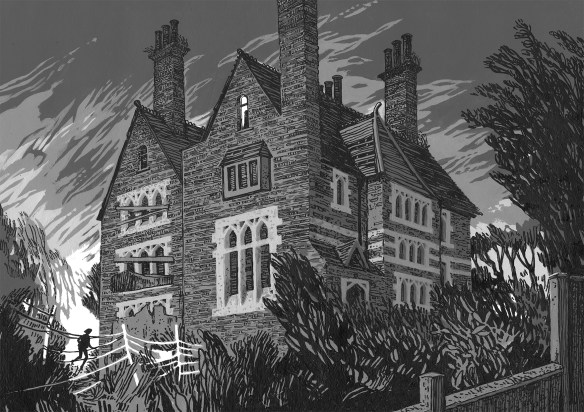
Lily isn’t quite as forthcoming about her life as Ted is about his. Her story is revealed in alternating chapters. The daughter of  bohemian academics, Lily is an intelligent, thoughtful child. Through her eyes, we learn about growing up in “Monk’s House,” a Victorian mansion  deep in the Connecticut woods, about an hour from New York City.

There was never only one guest at Monk’s House, especially in the summertime when my parents’ teaching duties died down and they could focus on what they truly loved –  drinking and adultery. I don’t say that in order to make some sort of tragedy of my childhood. I say it because it’s the truth.

Lily has a skewed morality, but it’s the very thing that makes her such a fascinating character. She’s a charming psychopath, and it’s almost impossible not to like her, to root for her, even. She’s  – by far –  the most interesting of cast of characters in Swanson’s novel. She reminded me a little bit of Alice Morgan, a character in the brilliant BBC crime series, Luther. (If you haven’t ever seen the show, you must watch it immediately. It’s on Netflix.)

There are twists and turns aplenty in The Kind Worth Killing. The plot did unravel slightly for me towards the end, but that in no way undermined my enjoyment of the shenanigans these people got up to.

The Kind Worth Killing was a whim purchase for me. I needed a book for my book club and this one was popular on Litsy. I am pleased to report that everyone in my group really enjoyed the book, even though it was definitely a departure from the sort of stuff we normally read.

This is a page-turner.

Where They Found Her – Kimberly McCreight

9200000033245456I’ve had a slow start to the 2017 reading year. Usually I power though a handful of books over the Christmas break, but this year I tended to binge-watch Netflix (The Fall – check it out if you haven’t already seen it) and sleep. I have about a half-dozen novels started, but none of them really grabbed me. Although it rarely happens to me, I’ve been in the book doldrums. I needed something to grab me by the throat and swing me back into reading gear. I chose what I was sure was going to be a winner, but I was disappointed. I did finish though.

Where They Found Her is the second book by Brooklyn-based novelist Kimberly McCreight. I read her debut novel, Reconstructing Amelia last year and loved it. It was one of those books that you just couldn’t put down and was well-written to boot. A literary win-win. Where They Found Her didn’t work for me at all.

When the body of an infant is found floating in the creek at Essex Bridge, Molly Anderson gets the call to check it out. She’s the Lifestyles reporter for the Ridgedale Reader and crime wouldn’t normally be her beat, but she’s the only one available to cover the story.

Molly’s at a fragile point in her life. She and her husband, Justin, are new in Ridgedale, a bedroom community in New Jersey. Justin teaches English at the local college and their daughter, Ella, is in kindergarten. Life is just starting to settle down after the death of Molly’s unborn baby, so the discovery that the body at the creek is also an infant is almost more than Molly can handle. She’s plucky, though.

On the other -shittier – side of town lives sixteen-year-old Sandy and her floozy of a mother, Jenna. Sandy is the adult in that relationship. She loves her mother, but she’s also tired of being the adult.

Barbara is the Stepford-wife of Steve, the town’s police chief. Her daughter, Hannah, is tutoring Sandy so that Sandy can graduate. Her young son, Cole, has been sucking all the oxygen from the room with his odd behavior.

Although it won’t be immediately obvious how the lives of these women intersect, their paths will cross and that’s when the gears started to grind for me. (It took me about 100 pages just to keep all the names straight – and that’s only a slight exaggeration.)

In all the ways that Reconstructing Amelia was a tightly focused story about a mother and daughter who are close, but still keep secrets from each other, Where They Found Her borders on melodrama. As Molly starts to unravel the identity of the baby and what happened to her, the reader will, too. There’s a fair share of red herrings, but everything gets tidied up in the end.

I turned the pages (once I got going), but I can’t say that I cared very much about any of the players and, for me, that’s one of the failings of McCreight’s novel. Where They Found Her just didn’t resonate on any level with me. I’m definitely in the minority, though. Critics loved it.

So – decent mystery (red herrings and tidy-ending aside). McCreight can certainly write and I would definitely read her again. But Where They Found Her was only so-so for me.

Ten – Gretchen McNeil

There are enough diversions and red herrings in Gretchen McNeil’s YA mystery Ten to tenkeep attentive readers on their toes. The straight-forward narrative and familiar characters (the mean girl, the jock, the good girl) will certainly be appealing to readers of a certain age, but there isn’t much on offer here for anyone else.

Meg and her best friend, Minnie, have been invited to a weekend party on Henry Island, one of the islands off the coast of Washington State. Meg’s not really the party type and she’s already anxious about the fact that they’ve “lied to [their] parents and gone to a house party in the middle of nowhere.”

The party comes on the heels of a gruesome discovery at a rival high school – “the charred remains of a body found in the locker room.”

When the girls arrive (by ferry), they find the rest of the party guests: T.J. Fletcher, hunky football player and Meg’s not-so-secret-crush; Ben, the new boyfriend of their hostess, Jessica (who never shows us); Gunner, surfer dude; Kumiko, Gunner’s new girlfriend (Minnie was his former girlfriend); Vivian, seemingly sensible; Lori, random girl; Nathan and Kenny; token Neanderthals.

The festivities start with a few beers and then things start to go whacky. First of all, Ben almost dies from anaphylactic shock. Then, the group watches a strange and disturbing video that claims : “Vengeance is Mine.”  Someone tosses the room Meg and Minnie are sharing. Meg finds a strange diary. And then, one by one, people start to die.

Alliances and nerves start to fray as the teens realize they are cut off from civilization (no cell service or Internet) and that no one knows where they are. The most they can hope for is that Jessica arrives, as planned, on the next ferry.

McNeil keeps the action ticking along. The third person narrative is focused pretty tightly on Meg – but who hasn’t heard of an unreliable narrator before? There’s not a lot of opportunity for character development, not that it really matters. I think most teens will enjoy the straight ahead action, the creepy deaths and Meg’s valiant attempt to figure out who the killer is before it’s too late.

For the record: I didn’t get it right.


The Last September – Nina de Gramont

Brett loves Charlie. He’s the older brother of lastsepther best friend, Eli. She and Eli are students in Colorado and one stormy night they attend a party and Charlie is there, too, his flight delayed because of the storm.

That day, the first day I ever saw him, he had three days’ worth of stubble. He wore a thin black thread around his neck, beaded with a smooth lapis stone that matched the color of his eyes.  When I looked at him, his lips slid up at the corners. My heart lurched. I don’t know why. It lurched toward him and refused – stubbornly – to ever lurch away.

Nina De Gramont’s book The Last September takes zero time to hook you by the throat and it doesn’t let you go until the very end. I really couldn’t put this book down. On the surface it’s a love story. But it’s a love story that goes horribly wrong because by the end of the first sentence we learn that Charlie is dead. Brett tells us “Because I am a student of literature, I will start my story on the day Charlie died. In other words, I’m beginning in the middle.” By the end of the first page we’ll know that Charlie has been murdered.

Their love story unfolds in flashback. When the novel opens, Charlie, Brett and their toddler daughter, Sarah, are living in Charlie’s family cottage at Cape Cod Bay. Brett is finishing her PhD dissertation; Charlie is doing odd jobs.  On this particular day, Brett is frustrated with Charlie, a feeling not at all out of place in most marriages. When Charlie mentions that Eli had called and that he wanted to come for a visit, Brett is reluctant to see her old friend because “the last time we saw Charlie’s brother he’d dropped an enormous amount of weight and begun scribbling notes on his jeans and forearms.”

I have guilty reading pleasure buttons and, I have to say, The Last September hit every single one of them. Angsty love affair. Check. Unbearable suspense. Check. Heartbreak. Check. Check.

What happened to Eli? What happened to Charlie? What happens when Ladd, Brett’s former fiancé arrives back in town? If this sounds suspiciously like Peyton Place, you’re not wrong. But, omg, The Last September is so much fun to read. The writing is luminous and so even when I didn’t 100% buy the plot twists, it didn’t matter because I just wanted to find out what had happened to Charlie and I wanted to know that Brett was going to survive the grief.

Highly recommended.


The Dogs – Allan Stratton

Cameron and his mom have been on the run for as long as Cameron can remember. the_dogs_uk_cover_med_frontCameron’s dad is dangerous and they’ve never been able to stay in one place for very long. This last move takes them to a farmhouse in the middle of nowhere, outside of a small town called Wolf Hollow.

“Whoa! Somebody! Put this place out of its misery.” That’s how Cameron describes the two-storey, ramshackle building he and his mom are going to call home. Mom notes the two staircases and says “It’s good to have more than one escape route…in case of fire.” Mr. Sinclair, the old farmer who owns the house, is secretive and slightly menacing.

But Cameron’s creepy father isn’t the only creepy thing going on in Allan Stratton’s YA novel The Dogs. Cameron discovers some drawings and a photograph in the coal room and the discovery connects him to a strange mystery that has haunted the farmhouse for decades. One of the drawings depicts “a pack of wild dogs ripping things apart.” Further investigation reveals that the previous owner, Mr. McTavish, was ripped apart by his dogs after his wife and son, Jacky, ran off with another man.

The clever things about The Dogs is that it operates on many different levels. As Cameron spends more and more time trying to figure out what really happened in the farmhouse all those years ago, he also begins to question his own memories of his father. Is his mother telling him the whole truth or is she leaving out essential details? Is his dad really as bad as his mother says?

Cameron’s traumatic childhood makes him especially suggestible and readers will share every spooky bump-in-the-night incident with him as he tries to reconcile his memories with what is happening in the house. Is he crazy, as his mother worries he might be, or are the things he sees and hears really happening?

“It’s not my fault I picture things, or talk to myself. If I try to keep all the stuff in my head inside, I’ll explode,” Cameron explains to his mother.

The Dogs is written in straight-forward prose, which will appeal to many young readers particularly reluctant readers. I think any reader will enjoy the book’s eeriness and honest portrayal of a teenage boy who despite his own difficulties shows tremendous resilience. I know I did.


The Wicked Girls – Alex Marwood

wicked.jpgIt’s 1986 when eleven-year-olds Jade and Bel meet in the village store. Their paths weren’t likely to have crossed before because Jade is one of the notorious Walkers – a family from the far side of the tracks – and Bel lives in a fancy house with servants. This fateful meeting is to change the course of the girls’ lives forever because by the end of it another little girl will be dead and Jade and Bel will be arrested for the murder.

This isn’t the only thing happening in Alex Marwood’s novel The Wicked Girls, though.

There’s Amber, head cleaner of Funnland, a boardwalk amusement park in the seaside town of Whitmouth (I imagined Blackpool only smaller and seedier). She lives with Vic, a handsome but slightly passive-aggressive carny. Amber lives a quiet, tidy life. She takes pleasure in overseeing her crew of cleaners and helping them when she can. When Amber discovers a dead girl in the park’s  hall of mirrors, her life becomes significantly more complicated.

Then there’s Kirsty , a freelance journalist married to Jim, an out of work  IT guy, and mother to a couple children. When the body is found at Funnland, Kirsty finds herself on assignment and inevitably comes face-to-face with Amber, the last person she’d ever expected to see again.

The reason: after their release from prison,  Jade and Bel were given new identities and cautioned about ever making contact with each other again. Not that the girls were likely to meet; they barely knew each other to begin with.

Marwood balances the story of Jade and Bel, unspooling the narrative of what happened that long ago day with the present day  Amber and Kirsty, two women who have made a desperate attempt to reinvent their lives.

As if that weren’t enough, let’s not forget Martin, creepy Whitmouth resident. He’s been rebuffed by Jackie, one of the Funnland cleaners. He’s clearly deranged and

the rage of rejection crawls beneath his skin; invisible, unscratchable. All she needs to do is text him back. He doesn’t want to go out, but if she refuses to respond he’s going to have to. As his mother was always assuring him, persistence is the most important quality in life. And he knows he is the most persistent of all.

The seemingly disparate threads of Marwood’s novel do come together, but whether you find the ending satisfying or not will depend on how you like your mysteries. There were a few super tense moments in The Wicked Girls, but there were also moments I found really slow going – not superfluous exactly. I guess I just like a little more ass-kicking and a little less naval-gazing in my thrillers. That said, the characters were definitely nuanced and sympathetic and the writing was good, but over-all I would have to say  The Wicked Girls is more slow burn than page-turner. That’s not necessarily a bad thing, though.

In a Dark, Dark Wood – Ruth Ware

Ruth Ware and I have lived parallel lives. I, too, have worked as a waitress, EAL teacher and  bookseller. Okay, I may have never been an official book publicist, but I could argue that I sell books all the time by talking about them here and in my classroom and on the radio. I have not, however, written a much-lauded “instant New York Times bestseller.” Crap.

Leonora (also known as Lee and Nora and Leo) is a reclusive and slightly odd mystery th9H5NVHJNwriter who lives in a small flat in London. One day she receives an email invitation to a weekend bridal shower (a “hen” night) for her once best friend, Clare. The invitation is puzzling to Nora because she hasn’t seen Clare in a decade and it seems as though they may have ended things on relatively awkward terms.

The invitation to the party starts Nora’s trip down memory lane, but it’s not a journey she takes willingly.

Clare had been my friend. My best friend, for a long time. And yet I’d run, without looking back, without even leaving a number. What kind of friend did that make me?

There’s only one other name Nora recognizes on the invite list: Nina da Souza. Nora reaches out and the two women make an “I’ll go if you go” pact. This is how they end up in the middle of the woods at a house that seems “as if it had been thrown down carelessly by a child tired of playing with some very minimalist bricks.” For someone used to living in close quarters in the middle of a huge city, Nora finds the location of Clare’s hen night “painfully exposed.” There’s a reason the place is called ‘The Glass House.’

The party’s host is Clare’s best friend from university, Flo. The other attendees are Melanie, a new mother and Tom, the token gay friend. When Nina and Nora arrive, Clare is not yet there. The whole event is awkward and fraught with tension.

Ware intersperses the hen night shenanigans with the aftermath of the weekend. Nora wakes up and “everything hurts. The light in my eyes, the pain in my head. There’s a stench of blood in my nostrils, and my hands are sticky with it.” There are police officers outside her hospital room door and someone is dead.

I enjoyed reading In a Dark, Dark Wood, but I sure wish people would stop comparing every psychological thriller/mystery to Gone Girl. This book is nothing like Gone Girl. That’s not a criticism, by the way. Ware doesn’t waste time with verbosity; this book moves along lickity split. Nora is a perfectly serviceable character, although not particularly endearing. There are plenty of creepy moments – as you’d expect in the fishbowl of a location.  The book has “blockbuster movie starring Reese Witherspoon (an early fan of the novel)” written all over it.


The Girls in the Garden – Lisa Jewell

Although I have hundreds of books waiting for me on my tbr shelf, I can’t seem to stop buying new books whenever I am at the bookstore, which is – let’s face it – often. There’s been all these suspense thrillers out there like I’m Thinking of Ending Things and The Widow and Twisted River  and The Crooked House which I seem to be drawn to like the proverbial moth to the flame. Maybe it’s because it’s summer and I just like to read something that’s fun, I dunno. But I have no trouble ignoring the huge catalogue of back-listed books I have waiting to be read and, instead, buy the shiny new books.

the-girls-in-the-garden-9781476792217_hrThe Girls in the Garden is one of those books. Although it turned out to be not the book I thought it would be, it was a great read nonetheless.

Clare has moved to a small enclave somewhere in urban London. Virginia Park is “formed in the space between a long row of small, flat-fronted Georgian cottages on Virginia Terrace and a majestic half-moon of  stucco-fronted mansions on Virginia Crescent, with a large Victorian apartment block at either end.” She and her children, eleven-year-old Pip and twelve-year-old Grace are recovering from a horrible incident involving Clare’s husband, Chris. (And again, what is it with book blurbs getting it wrong? The back cover says Pip is older, but she’s not.)

From the outside, Virginia Park seems like a miracle of a place. In the boundary formed by the buildings is a beautiful park which Pip describes in a letter to her father as being “like Narnia.”

…there are all these pathways and little tucked-away places. A secret garden which is hidden inside an old wall covered with ivy, like the one in the book. A rose garden which has bowers all the way around and benches in the middle. And then there’s a playground, too.

It’s a place of magic for the girls and a place for Clare to catch her breath. Except, of course, the magic is short-lived.

Adele also lives in Virginia Park with her husband, the handsome and slightly oily Leo, and their daughters Catkin, Fern, and Willow. The girls are home-schooled and the family leads a slightly bohemian life. Soon, Clare and her girls are brought into the welcoming embrace of Adele’s family. (Okay, maybe the girls aren’t 100% welcoming; you know how kids are.)

Tyler, another pre-teen who lives in one of the flats and her best friend, Dylan, the beautiful thirteen-year-old boy who also lives at the park, round out the gang that Grace and Pip find themselves hanging around with.

The Girls in the Garden reads like a thriller. The novel begins with the discovery of Grace’s unconscious and bloody body being discovered by her sister in the rose garden and then backtracks to unspool the story, mainly from the point of view of Clare, Adele, and Pip.

Jewell cleverly manipulates the reader into imagining a variety of very plausible scenarios before the story takes an unexpected (but not unbelievable) turn, ultimately making The Girls in the Garden less of a thriller and more of a domestic drama. But really, is there anything more thrilling than that? Isn’t it absolutely true that we never really know people, even those closest to us?

I thoroughly enjoyed this book.

The Crooked House – Christobel Kent

I can certainly see why Christobel Kent’s novel The Crooked House has drawn comparisons with the British mystery Broadchurch. Like that story, Kent’s novel takes place in an isolated village (in this case, Saltleigh) and concerns a horrific crime which has rippled out into the community.

Alison used to be Esme and when she was fourteen her entire family was slaughtered. 748d3761900605840ce32be83a67d549Since that horrible night, Alison has flown under the radar. She lived first with her aunt in the south and then, after school, she moved to London where she worked in publishing, and where she met Paul. Paul is older, in his forties, and a professor. They had “Long, lazy conversations about books and movies and work, eating dinner at his big wooden table, or leaning against each other on his old sofa.” Alison likes him, so when he asks her to accompany him to Saltleigh to attend the wedding of a former girlfriend, she can’t seem to refuse even though she hasn’t been back since the crime.

Saltleigh is the same as Alison remembers. The smells, the colours, the landscape, and the memories of living there with her older brother, younger twin sisters, and her parents are palpable. On the first morning, while Paul sleeps on, Alison answers the memories and goes to her childhood home.

The house was boarded and derelict, weathered plywood splintered and graffitied at each window and the purple spikes of some plant sprouting above the lintel over the front door. The little enclosed yard behind where they had hidden and whispered and left secret messages. Thirteen years.

Despite the fact that she has spent the last thirteen years trying to forget, the memories have been triggered by coming back and she can do nothing but follow where they lead. What really happened that night?

The Crooked House was clearly a big hit in the UK. My version was covered with praise — a combination of praise from other authors, which is always suspect to me, and from the press.  Good Housekeeping said it “Demands to be read in one sitting.” I think that might actually be wise advice because although I did like this book (it’s clever, smart and well-written), I found it really disjointed. It shifts time periods all over the damn place and there are loads of characters and subplots (all relevant, mind you) to keep track of. If I managed to read without interruption, I easily settled into the book’s rhythms. but it definitely wasn’t a book you could pick up on the fly.

I think this book would make an excellent mini-series or movie. Get on that, would you, BBC!

The Interrogation – Thomas H. Cook

My love affair with Thomas H. Cook goes back several years when I stumbled upon his novel Breakheart Hill in a secondhand bookstore. Since then I have read several of his books including Instruments of Night, The Chatham School Affair, Places in the Dark, Evidence of Blood, The Fate of Katherine Carr, Master of the Delta, Red Leaves and The Cloud of Unknowing. Geesh, that’s a lot of books by one author!  In my reading life perhaps Stephen King is the only author I’ve read more of. (Yes, I am ending that sentence with a preposition; sue me.)

Cook is a prolific writer (he has over 30 novels to his credit) and has won many awards including the Edgar and the Crime Writers’ Association Duncan Laurie Award, yet you’d be lucky to find any of his novels on the shelves at your local bookstore – trust me, I look.  So how come he isn’t as well known as other authors writing in the same genre? Unless you’ve read him, or are a super mystery novel aficionado, you may have never even heard of him. How come? Ali Karim asked the same question for an article in January magazine.

I buy his books whenever I find them and I hang on to them, usually until I can replace the one I am about to read with a new one. I like to have one waiting in the wings for the next time I need a fix.

Albert Jay Smalls is an odd little man who lives in a drain pipe in a local park. He’s been 237180arrested for the murder of a little girl. The problem is there’s no evidence and no witnesses and so the police can only hold him for twelve hours before they have to cut him loose. Thomas Burke, the chief of police ( a man with his own troubles) sends  his two best interrogators into the room to get a confession from Smalls.

The Interrogation is the story of those two cops, Norman Cohen and Jack Pierce. Each man has a heart full of demons (Cohen is haunted by his experiences in war; Pierce’s young daughter was a murder victim), but they are tenacious and accomplished interrogators. Since the story is set in 1952 they have to rely on the evidence they gather the old-fashioned way: visiting crime scenes, talking to people, chasing leads. There’s no Google and everything takes time and time isn’t on their side.

As Cohen and Pierce question Smalls and try to follow a breadcrumb trail, the reader will try to determine Smalls’ guilt or innocence too. Make no mistake, Cook’s novels are mysteries and half the fun is trying to figure out whodunit, but that’s not the only thing Cook’s got going on.

As with every single Cook novel I’ve read – his characters are really dynamic. You believe them from the minute they open their mouths. They have complicated interior lives. His heroes are always men trying to do the right thing – even when they can’t. Minor characters, like garbage collector Eddie Lambrusco, are equally well-drawn. Cook can create empathy with just a few word as he does when we watch Eddie handle his father’s watch and thinks

a laborer’s timepiece with its chinks and scratches and slightly skewed hands that circled turgidly around the yellowing dial. After a lifetime, he thought, this.

There are a lot of father/child motifs in The Interrogation –  dads who are helpless to save their children; dads who do everything for them; dads estranged from their children. It’s a theme Cook visits often and yet he always seems to have fresh things to say about the topic.

And like with virtually every Cook novel (I almost said book there and then thought better of it) I’ve read, the story’s resolution will be a surprise. It won’t feel like a cheat, either…because with Cook the clues always exist.

If you like mysteries that are thoughtful, intelligent and well-written – try to get your hands on Thomas H. Cook. You will not be disappointed.