Bird Box – Josh Malerman

birdboxIt seemed like everyone was talking about Josh Malerman’s debut novel, Bird Box, but it was still a surprise when it was chosen as our April read for book club. In the 15 years we’ve been together we’ve never read anything even resembling a horror story. I was really looking forward to this one because I love a scary book.

Malorie lives alone in a house in a Detroit suburb with two children she calls Boy and Girl. The house used to be nice but now she notices the “rusted utensils and cracked dishes. The cardboard box used as a garbage can. The chairs, some held together by twine.” Clearly, it’s not situation normal and Malorie’s musings allude to “older stains,”  for which there are “no chemicals in the house to help clean.”

Malerman doesn’t waste any time with preamble. That’s probably a good thing because Bird Box relies on a heavy dose of the unknown to make it tick. Something has happened to the world. The “Internet has blown up with a story people are calling ‘the Russia Report.'” People are behaving monstrously, attacking strangers and family members in gruesome ways (a mother buries her children alive) before ending their own lives. It’s a “the whole world’s going crazy” scenario, but it spreads from Russia to North America (and who knows where else) like wildfire. The only way to prevent doing harm to others and yourself is to prevent yourself from seeing whatever is out there. People hole up in their houses, windows covered, and if they must venture outside, they wear a blindfold.

Bird Box bounces between Malorie’s perilous journey down the river in a boat (she’s heard that there is a safe community and after four years alone, she longs for something more for herself and her children who she laments “have never seen the sky. Have never looked out a window.” ) and her time in the house with a group of strangers she discovered through an advertisement in the paper.

I can’t say I was fussy about the beginning or the ending of Bird Box, but I was seriously creeped out in the middle. There’s a scene when members of the house have to go out into the backyard to get water from the well. They have to be blindfolded, of course, and a rope is tied around their waist. The person whose job it is to go to the well must make the journey three times. On this occasion, it’s Felix’s turn. On the third and final trip from the house to the well he hears a sound.

But now he can tell where it is coming from.

It is coming from inside the well.

He releases the crank and steps back. The bucket falls, crashing against the stone, before splashing below.

Something moved. Something moved in the water.

It’s moments like these when Bird Box is at its best. Like Malerman’s characters, we are blind and we realize that the scariest thing in the world is what we can’t see.


Kept in the Dark – Penny Hancock

keptinthedarkI read Penny Hancock’s debut novel Kept in the Dark in one breathless gulp. I absolutely couldn’t put it down. I love it when that happens.

Sonia lives in a house next to the Thames. Her husband, Greg, is a lecturing neurosurgeon; her daughter, Kit, is a student at university and Sonia herself is a vocal coach. From the outside looking in, it would appear that Sonia has it all. It’s pretty obvious, though, that Sonia isn’t entirely sane. When the nephew of a friend drops by to pick up an album, Sonia plies him with wine, then drugs him and locks him upstairs in the sound proof music studio.

Jez is just fifteen. He’s in London visiting his Aunt Helen and Uncle Mick and applying to colleges. His mother, Maria, lives in Paris. Sonia is taken with Jez immediately.

His dark fringe has fallen across one eye. He flicks I back, and looks at me from under long, perfectly formed black eyebrows. I notice his sinuous neck with its smooth Adam’s apple. There’s a triangular dip where his throat descends towards his sternum. His skin has a sheen on it that I’d like to touch. He’s of adult proportions yet everything about him is glossy and new.

The novel’s first person narrative is so creepy and claustrophobic.  We get to watch as Sonia justifies her behavior and work through the endless complications of keeping a fifteen-year-old boy captive. First of all, what happens when her husband arrives home from his business trip? What will she do when her daughter and her boyfriend come home from university. And then there’s Seb. He’s clearly someone from her past and Jez obviously reminds her of him, but who is he? Sonia says he was “the most beautiful creature that ever walked upon the earth.” Hancock seamlessly weaves Sonia’s present with her past and the mystery of Seb is equally as compelling as Jez’s fate.

There is a second narrator: Helen. Jez’s aunt is a bit of a mess in her own way. Jez’s disappearance while under her care has thrown Helen’s life into turmoil. When her sister arrives from Paris and the police get involved, Helen feels more like a suspect than a relative.

This book was so good. S.J. Watson, author of Before I Go to Sleep, sang its praises and I have to say I agree with Mr. Watson. Sonia’s midlife crisis – a rather strained relationship with her daughter; a sexless marriage; a difficult mother; and the house she grew up in that she vows never to leave despite the fact that her husband wants to sell and move to Geneva all seem to be conspiring against her. But none of it is convoluted or silly. The plot unravels like a dream that is both terrifying and strangely erotic.

Highly recommended.

The Girl in the Park – Mariah Fredericks

parkRain, the compelling narrator if Mariah Fredericks’ YA mystery, The Girl in the Park, attends the prestigious Alcott School in Manhattan’s Upper West Side. “At our school,” she says. “everybody is the child of a somebody.” Rain’s somebody is her mom, an opera singer and “if you’re into opera, you probably know her.”

Rain is a watcher, a listener. Mostly it’s because she was born with a cleft palate, and although speech therapy has smoothed out some of the T’s and S’s, Rain’s still self-conscious. She hates how she sounds, “mushmouthed and nasal.”  That is, until Wendy starts school and tells her “Big deal. Okay, maybe you sound a little funny. But you need to forget about that and speak up girl.”

Wendy is larger than life. Although she’s rich, she comes from Long Island and doesn’t have the right kind of money or pedigree. The students at Alcott are snobbish and clique-ish, but that doesn’t stop Wendy from trying to make inroads. It’s when Rain tells her that she’s approaching it all wrong that the two girls become friends.

We only ever really see Wendy through Rain’s eyes because when the novel begins, Rain discovers that her friend has been found dead in Central Park. At this point, Rain and Wendy were friendly but no longer really friends. Wendy’s blatant disregard for the prep school rules and her reputation as a “skank” have caused Rain to distance herself from the girl who once told her that “You. Other the other hand. Listen. And you think. So when you do speak? You’re brilliant. So, give up the silence, okay”

Rain can’t stand the thought that something so horrible has happened to Wendy. Worse, the night it happened Rain was at the same party as Wendy and she feels she may have seen something that could help the police — she just doesn’t know what it is.

The Girl in the Park is a fast-paced mystery with enough suspects to keep readers engaged and guessing whodunit. It’s also a story that peers into the nasty, and sometimes heartbreaking, world of teenagers. I couldn’t put it down.

The Coldest Girl in Coldtown – Holly Black

Thank goodness for Holly Black — she’s put the bite back into vampire fiction.coldest  If you’ve been playing the home game, you’ll know that Stephenie Meyer pretty much took fangs and sex out of the vampire equation with her hugely popular Twilight series.  I didn’t hate the first book, but it went downhill fast afterwards. I loved The Coldest Girl in Coldtown. The prose sparkles, but the vampires don’t, so it’s win-win for lovers of vampire fiction.

Tana woke lying in a bathtub.

It doesn’t take very long for Tana and the reader to realize that something just isn’t right. Tana had been attending a sundown party and had locked herself in the bathroom to avoid her ex boyfriend, Aidan. Exiting the bathroom the morning after, Tana is aware of the quiet.

She’d been to plenty [of sundown parties], and the mornings were always full of shouting and showers, boiling coffee and trying to hack together breakfast from a couple of eggs and scraps of toast.

What Tana finds instead, as she moves through the house which smells of spilled beer and “something metallic and charnel-sweet,” are the bodies of her classmates “their bodies pale and cold, their eyes staring like rows of dolls in a shop window.”  And we’re only on page five, people!

The Coldest Girl in Coldtown takes the best parts of standard vampire mythology and ups the ante. The vampires in this book are rock stars, revered and coveted.  Black builds a mythology that is believable. Patient zero in Black’s world is Caspar Morales, a vampire who decided that he wouldn’t kill his victims, he’d infect them instead. Essentially, you’re bitten by a vampire, you’re infected, or Cold.

If one of the people who’d gone Cold drank human blood, the infection mutated. It killed the host and then raised them back up again, Colder than before. Cold through and through, forever and ever.

Pretty soon, the government has no choice but to barricade the infected people (and the wannabes) in places called Coldtowns. People who suspect that they are infected must,  by law, turn themselves in. And once you’re in a Coldtown, there’s no getting out.

As Tana comes to terms with the fact that her friends are dead, she discovers that Aidan is, in fact, not. He’s been bungee corded to a bed and chained beside him is a vampire boy, a boy who “must have been handsome when he was alive and was handsome still, although made monstrous by his pallor and her awareness of what he was.”

This is Gavriel. He is everything a vampire should be: dangerous, cunning, tortured and impossible to resist. (Okay, maybe I am just a little bit fixated on my personal notion of a vampire here, but Gavriel ticks all the vampire ticky boxes for me. )

The Coldest Girl in Coldtown is so good. Tana is smart and resourceful and brave. The book builds a world that is believable and terrifying. It is a world that just is. The book isn’t scary, but it is definitely a page-turner. The descriptions of vampirism are bloody and sensual (without being over-the-top, so there’s nothing sexually graphic).

I raced to the end, concerned for all the characters and their fates.  Should there be a sequel?  Black had this to say on her website:

Coldest Girl in Coldtown was written as a stand-alone. That said, I know what happens next, and maybe someday you will too. Right now, as with Curse Workers, I’m happy with where I left everyone. I’m sure they’ll be fine. Right?

I’m good with that.

Highly recommended.

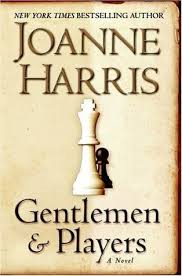
Gentlemen & Players – Joanne Harris

gentlemenGentlemen & Players is an intricate mystery by Joanne Harris, an author probably best known for her best-selling novel, Chocolat. Before she made it big in the publishing world, Harris was a school teacher which probably came in handy while writing this story of a public (in Britain this is the equivalent of our private, thus you pay a tuition)  school in England. For readers unfamiliar with the British school system, the story will likely seem extra exotic. I grew up reading Enid Blyton books and dreaming about going to boarding school in the UK, so I was all over the notion of the tuck shop (the place to buy sweets) and copious gallons of tea consumed by the teachers.

The novel gets its name from cricket, another very British enterprise. A first class cricket match pitting a team of amateurs (the Gentlemen) against the professionals (the Players) is a throw back to the class system in the 19th and 20th centuries. The Players were the working class guys and the Gentlemen from the middle and upper classes.

Harris’s novel has two narratives taking place over two different time periods. In one we follow Roy Straitley, a Classics teacher at St. Oswald’s Grammar School. He’s been in the business for over three decades and is soon to be turning 65. (I was relieved to see that Mr. Straitley still enjoys teaching since I’ll be at least that old before I will be able to afford to retire.) Straitley has dedicated his adult  life to teaching at the school and prides himself on his ability to control his class and remember all the boys he’s taught over the years.

In the other narrative, an unnamed narrator watches St Oswald’s from the gatehouse where they live with their father, the school’s porter (aka custodian).

I understood at once that they were a different race to myself; gilded not only by sunlight and their proximity to that lovely building but by something less tangible; a slick of assurance; a mysterious shine.

Later, of course, I saw it as it really was. The genteel decay behind the graceful lines. The rot.

Fifteen years later, the narrator shows up at St. Oswald’s with forged credentials and begins to teach and all hell breaks loose. At first the pranks are minor, missing registers and pens, but before long things get serious and lives are ruined and lost.

Gentlemen & Players was an easy read (despite all the wacky names I had to keep straight). Does it have something to say about the haves and the have-nots? Not really, since the second narrator just seems jealous and, quite frankly, crazy. Will I be thinking about these characters in a week? Not likely. Was I shocked by the surprise? No, I figured it out. Careful readers will. Still, I passed a pleasant few hours reading the book and if you like suspense thrillers, this is well-written (except for the over-the-top use of semi-colons!) and fun – if you don’t think too long on all the novel’s implausibilities.

The Lantern – Deborah Lawrenson

lantern If you’ve ever been to Provence, I suspect you’ll recognize the lush and aromatic landscape Deborah Lawrenson describes in her novel The Lantern. I’ve never been, but after reading this gothic romance, I’d love to go.

…the lavender fields, sugar-dusted biscuits, wild-flowers in meadows, the wind’s plainsong in the trees, the cloisters of silver-flicking olives, the garden still warm at midnight

The Lantern is two stories in one, stories that share Les Genevriers, an abandoned house in southern France. In one story we meet Benedicte, the youngest of three children who grows up in the house back when it was a working farm. In the other we meet Dom and an unnamed narrator, who is affectionately called ‘Eve,’ who have recently purchased Les Genevries with a view to restoring it to its former glory.

Eve is a twenty-something translator who meets Dom, a forty-something composer, in Switzerland, in a maze – which is prescient, as her life suddenly becomes a tangle of wrong turns and dead ends. She is instantly smitten with him and he seems to return the affection. When they return to London, Eve says “I tried to play it cool. So did he. But we both knew.” Their whirlwind romance eventually takes them to France and Les Genevries.

That summer, the house and its surroundings became ours. Or, rather, his house; our life there together, a time reduced in my memory to separate images and impressions: mirabelles – the tart ornage plums like incandescent bulbs strung in forest-green leaves; a zinc-topped table under a vine canopy; the budding grapes; the basket on the table, a large bowl; tomatoes ribbed and plump as harem cushions; thick sheets and lace secondhand from the market, and expensive new bed covers that look as old as the rest; lemon sun in the morning pouring through open windows; our scent in the linen sheets. Stars, the great sweep of the Milky Way making a dome overhead. I have never seen such bright stars, before or since.

Sounds romantic, eh? But it’s also isolated and when Dom starts to behave strangely and Eve starts to smell things and see things that aren’t actually there, The Lantern  crosses over into gothic territory. There’s also, as it turns out, an ex-wife whom Dom doesn’t want to talk about and a real estate agent in the local town who does. The plot thickens.

Then there’s Benedicte. She lives her whole life at Les Genevries. Her story, and that of her blind sister Marthe and malevolent brother, Pierre, weave throughout Eve’s narrative and make up some of the “many stories about the place.” As an old woman living in Les Genevries, Benedicte becomes convinced that she is being haunted. She sees her brother, Pierre, “standing, waiting expectantly in front of the hearth, silent, as if his intention was perfectly clear.” And then he is gone. Benedicte has never believed in ghosts, but it is hard to deny that Les Genevries is full of spirits.

Lawrenson does a fabulous job of weaving together the stories of Eve and Benedicte, their connection to Les Genevries and of making Provence jump off the page. The novel is creepy, clever and compelling and a lot of fun to read.

Highly recommended.

The Ice Cream Girls – Dorothy Koomson

icecreamTold in the alternating voices of Serena and Poppy, The Ice Cream Girls, by British writer Dorothy Koomson, is part suspense novel and part family drama. Koomson expertly weaves the story of two teenaged girls accused of murdering their history teacher, Marcus  Halnsley. They’re called ‘the ice cream girls’ because of a photograph of the pair wearing bikinis and eating ice cream. Their story, and their relationship with Halnsley,  is anything but sweet, though.

We meet Serena at the moment when her husband, Evan, proposes to her for the second time. We meet Poppy as she leaves prison, where she has been incarcerated for the past twenty years. These are two women, one black and one white, who might have never met if it hadn’t been for Halnsley.

We meet him through Serena first who says that “all the girls said he should be a film star because he was good-looking.” Serena doesn’t really like him at first because he was “always picking on me.” But when Mr. Halnsley starts to take a special interest in her, Serena feels singled out and special. Halnsley convinces her she could excel at History and offers to give her private lessons. It isn’t long before he crosses the line. It’s a simple (although inappropriate gesture) at first, but it’s easy to see how easily Halnsley manipulates fifteen-year-old Serena.

I walked home instead of getting the bus and along the way, I kept reaching up to touch my face. His touch had been so gentle and soft. And the way he said he wanted to take care of me made my stomach tingle upside down every time I ran it through in my head. He wanted to take care of me. That must mean I was special. Someone as clever and grown-up as him thought I was special.

Just a few short weeks after Halnsley has convinced Serena that he loves her, he meets Poppy. It’s clear, of course, that he’s a predator and that both Serena and Poppy are vulnerable despite the fact that they come from decent families. For the next couple of years the girls share the man who alternately abuses them and plays them off against each other – all the while convincing them that he loves them.

The story requires some finesse and Koomson does a terrific job of layering all the bits together. There’s a lot the reader wants to know. Why did Poppy go to prison, for example, and not Serena? Serena went on to college, met and married Evan (a doctor) and now lives in suburban bliss with her two children. Of course, behind the scenes she’s a hot mess. Every night before bed she has to hide all the knives.

The dinner knives are safe but the sharp ones, the ones that can do serious damage, seem to be missing in action. Admittedly, that’s my fault: I hid them last night, and I can’t quite remember where.

Things aren’t much better for adult Poppy, either. She arrives home to her parents only to discover that her father isn’t speaking to her, can’t even look at her and her mother

managed to sit down at the same table as me for more than three seconds. She didn’t make herself a cup of tea, so I knew she wasn’t staying, but it was a start. She actually came into the kitchen and didn’t immediately walk out again.

Poppy is intent on finding Serena and getting her to admit that she is actually responsible for Halnsley’s death and while their reluctant reunion dredges up all sorts of bad memories, it also allows the women to finally have a chance at exorcising the ghost of Halnsley, a man whose hold on them has poisoned their lives long after his death.

Great book.


The Raft – S. A. Bodeen

raftRobie, the fifteen-year-old protagonist of S.A. Bodeen’s YA novel The Raft has been back and forth between Hawaii and the island of Midway dozens of times. She lives there with her research scientists parents, but when the novel opens she’s visiting her aunt in Honolulu. When her aunt is unexpectedly called to work on the mainland, Robie isn’t bothered about being alone. She’s used to it and knows how to look after herself.

Looking after yourself on 2.4 square miles of island, as it turns out, is different from looking after yourself in downtown Honolulu. Unfortunately Robie gets accosted on the street one evening — nothing serious — but it spooks her and she decides to take the cargo plane home. Unfortunately, phone and Internet service is spotty on the island and so Robie isn’t able to let her parents know she is coming home. Even more unexpectedly, the plane hits bad weather and goes down. Only Robie and the co-pilot, Max, survive.

This novel is terrific. Like, couldn’t-put-it-down terrific. Robie is resilient and smart and is able to cope with her circumstances better than people twice her age. The raft she floats in leaks, there are sharks in the water — and not much else. It’s impossible to imagine that Robie will make it, but she does.

I don’t want to say too much about the things Robie endures. Once you start reading The Raft you’ll find out pretty quickly because you won’t be able to stop turning the pages. I should also mention that Bodeen slips some compelling stuff about ocean and bird life, conservation and pollution into the mix and it all feels necessary and organic. Robie is at home in this environment and knows “more about ocean fish and seabirds than most post-graduate researchers.” It’s a good thing, too.

Bodeen’s prose is straightforward and Robie’s voice is authentic. In a moment of prescience she remarks: “Lately it seemed there were a lot more days when my life felt less  like luck and way more like suck.”

I’m not one for survival stories, really, but I enjoyed Robie’s tremendously.

Highly recommended.


Good People – Ewart Hutton

goodpeopleD.S. Glyn Capaldi, the protagonist of Ewart Hutton’s debut Good People, is a Welsh cop who got into a bit of trouble in Cardiff and had been reassigned to a dinky town in the middle of nowhere, a place where the higher-ups figure he can’t get into any more touble.

The reader doesn’t get to learn very much about Capaldi. He’s divorced. He’s smart. He’s got good instincts, but isn’t really a team player and he’s very much an outsider in Carmarthen. Detective Chief Superintendent Galbraith describes him as ” someone who used to be a good cop,” which is why Galbraith has rescued him so he isn’t “wearing a rinky-dink security uniform and patrolling the booze aisle in some shanty-town supermarket.” Capaldi is getting another chance, but he’s on a short leash.

Which is why no one wants to give him the time of day when Capaldi is suspicious about Carmarthen’s latest crime. Six men coming home from a soccer game in England, disappear into the woods with a young girl. Their abandoned mini-bus is found on the side of the road, but hours later when the party is found, not everyone is accounted for.

Police who are familiar with the men believe their story – convoluted as it is – but Capaldi isn’t as convinced.

Good People is a relatively straightforward mystery that is fast-paced and intriguing. Capaldi certainly grows on you and the story is not your standard whodunit. Instead, Good People is about  the underbelly of a town that, on the surface at least, seems quaint and shiny and  our capacity for deception.

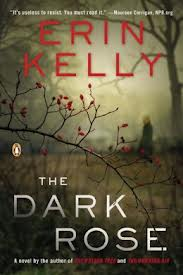
The Dark Rose – Erin Kelly

darkroseSO ANNOYED! I had an awesome review of this book written and when I posted it all that posted was what is below between the **…and I am tired and never going to be able to recreate what I had written and I could SCREAM.

So, briefly:

39-year-old Louisa and 19-year-old Paul are both working on the restoration of a ruined Elizabethan garden in Kelstice, a small town northwest of London. She’s hiding out – as she has done for the past twenty years or so – because she’s still obsessed with the guy she was in love with when she was 18. Paul’s hiding out because his best friend, Daniel, will soon be on trial for murder and he’s the star witness for the prosecution.

Paul’s had a traumatic childhood. He lost his father in a rather traumatic and gory accident which he witnessed. Then he started to get picked on in school and Daniel became his saviour.  He’s really a decent guy who just made some stupid choices because of his loyalty to Daniel.

**It’s also impossible not to relate to Louisa – at least I could relate to her. She falls madly in love with Adam Glasslake, lead singer of the band Glasslake and the more distant and unattainable he is, the more she wants him. What 18-year-old hasn’t been on that roller coaster ride?

After they make love for the first time and after Adam falls asleep, Louisa

…inhaled the thick oily skin between his shoulder blades where he smelled most like himself. If you could distill and bottle the essence of a human being, if you could crush skin like petals , then she would do this with Adam Glasslake. The vetiver scent was faint now, but his neck still bore the visible traces of the oil he had anointed himself with earlier. It was a faint dark green. Below this, on his clavicle, she had marked him for herself, a vivid red circle, half kiss, half bite. She felt intensely female and powerful, like a witch.

Louisa and Adam’s relationship is rocky at best and ends badly and years later she still gives in to a ritual that requires liquor and a few tatty mementos.   The first time she sees Paul she is so overcome that she felt that “the strength of her longing had finally called him [Adam] into being, that she had conjured his spirit.” She is so overcome she “would have smashed through the glass walls of the greenhouse to get away from him.”

When Louisa and Adam’s separate but equally compelling lives intersect, things don’t turn out at all like you might expect. And I mean that in a good way. Kelly does an admirable job making both Louisa and Paul into characters that you actually kind of root for thus elevating The Dark Rose  from run-of-the-mill thriller to literary page-turner.

The Dark Rose is my first encounter with Erin Kelly, but I will certainly be reading more of her work.**