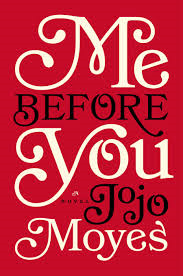
Me Before You – Jojo Moyes

mebeforeyouLast night, my book club met to discuss Jojo Moyes’ novel Me Before You.  I was the only member of the group that didn’t love the book. I liked the book a lot, but it won’t go down in my personal annals as one of the most amazing, romantic, beautiful, (insert other appropriate adjective here) books ever. Trust me, I am the gushiest romantic on the planet so it came as just as much of a shock to me when I didn’t get all weepy and heartbroken at the end.

Me Before You is the story of  26-year-old Louisa Clark, an ordinary girl from an ordinary family. Until recently, she’d been working at the local cafe in the little market village she lives in in England. She lives at home with her parents and her younger sister, Treena and Treena’s young son, Thomas. Their house is too small; they don’t have much money and so when Louisa loses her job at the cafe she is desperate to find new employment so she can continue to contribute to the family coffers.

Enter the Traynors.  They live in Granta House which is on the other side of Stortfold Castle – I presume that’s the posh side. Camilla Traynor hires Louisa as a companion to her son Will who, two years ago, had been in a serious motorcycle-meets-pedestrian accident that has left him as a quadriplegic. He’s a bit of a git.

Circumstances being what they are, Louisa doesn’t feel like she’s in a position to quit, even when Will is arrogant and unkind. Instead, Louisa is determined to make friends with Will and so, of course, that is what happens. Will softens because of Louisa’s friendship; she  flourishes because of his. They are both irrevocably changed.

Me Before You was an easy book to read. I motored through 200 pages on Saturday night. I liked Louisa and I liked Will and I liked their story. Although I didn’t agree with the stylistic choice Moyes made to interrupt the story’s predominantly first person narrative to give readers a glimpse into the heads of a few other characters, I did appreciate this observation by Will’s mother:

It’s just that the one thing you never understand about being a mother, until you are one, is that it is not the grown man – the galumphing. unshaven, stinking, opinionated offspring – you see before you, with his parking tickets and his unpolished shoes and complicated love life. You see all the people he has ever been rolled into one.

I am a mom and so I knew what she was talking about. Could I have lived without her insights?  Absolutely.

I also took issue with the epilogue. It felt cheap to me. Way, way too tidy. But no matter.

One of the questions  posed last night was whether or not Me Before You was a great book. Define great. That’s the cool thing about reading. Everyone’s definition of what makes a great book is going to be different. I am going to have to figure out how to articulate what makes a book great for me and get back to you.

As for Me Before You – it was a very enjoyable book to read. Could I niggle over a bunch of little things? Sure, but none of them really detracted from my reading experience which was totally pleasant. I didn’t shed any tears, but I did well up once or twice. So, almost, Ms. Moyes.
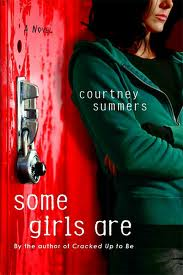


Some Girls Are – Courtney Summers

somegirlsareSome girls are bitches. In Courtney Summers’ compelling and disturbing YA novel Some Girls Are, calling the characters bitches is an extreme understatement. Some of these girls are psychopaths.

Regina Afton used to be one of the Fearsome Fivesome – a pack of girls led by Anna Morrison. Every high school has them, I suppose, that group of mean girls who take extreme pleasure in ruining the lives of others. That said, I don’t recall any from my high school days (yeah – okay, it was a million years ago!) and I don’t know of any at the school where I teach – at least none as venomous as this. And man, these girls are really, really awful.

The novel opens at a party where “everyone is wasted.” Everyone except Regina, that is,  because it’s her turn to be the designated driver, a job she takes relatively seriously even though it’s “boring.”  When she tries to rouse a passed out Anna, she encounters an obstacle of another kind: Anna’s equally intoxicated boyfriend, Donnie.

I’d turned him down in the ninth grade. Anna says we’ve been close to hate-fucking ever since, which is too gross for me to even contemplate. It’s a gunshot kind of thing for her to say – a warning. The way she says it, it’s like she can see it happening, and the way she says it lets me know I better not let it happen.

But then the unthinkable almost does happen and when Regina turns to another member of the Fearsome Fivesome for help and advice, she suddenly finds herself frozen out of the group she was once an integral part of.

The interesting thing about Regina is that she isn’t all that likeable. She’s mean. She wasn’t always mean, though. That would have to be true for readers to root for her even a little bit, but her exterior is so prickly it takes a while to warm up to her. Like, a long while. And I found that interesting. She’s an anti-hero.

Life becomes almost unbearable for Regina once Anna and Kara, Regina’s replacement, get going. It’s not just covert tactics they employ to ostracize Regina – they humiliate her, physically abuse her and truly make her life a living hell. Regina has no allies because when she was part of the clique, she’d been horrible to just about everyone in the school.

I’m  used to everyone’s eyes on me; that’s nothing new. When you’re Anna Morrison’s best friend, people look. We’re the kind of popular that parents like to pretend don’t exist so they can sleep at night, and we’re the kind of popular that makes our peers unable to sleep at night. Everyone hates us, but they’re afraid of us, too.

There’s really no relief for Regina until Michael  Hayden – one of her former victims – slowly lets her into his life. And with his friendship comes Regina’s redemption.

Okay, I’m a teacher – I know that the vast majority of teens aren’t like the people portrayed in this book – but some of them are. Some teenagers are nasty, messy, insecure, and hateful. And hopefully some of those will, like Regina, have the opportunity to make amends for the damage they do.

Some Girls Are crackles with real energy and I couldn’t put it down.

Joyland – Stephen King

joylandAlthough I devoured Stephen King as a teen and young adult, it’s probably been 15 years since I’ve read a King novel (Bag of Bones, which I loved). I decided to give Joyland a go and it was like settling into a comfortable pair of slippers. (I know, it’s ridiculous to compare the Master of Horror to a pair of comfy slippers, but I’m talking more about that feeling of just knowing that you are in really good hands — which you always are with King.)

Joyland is not a horror story really. It’s the story of Devin Jones, a college student who takes a job at Joyland, a Disney-style amusement park (I imagined Family Kingdom at Myrtle Beach, S.C., which I visited once as a teen) in North Carolina.  Devin tells the story of his summer and autumn at Joyland through the lens of late middle age. He says

That fall was the most beautiful of my life. Even forty years later I can say that. And I was never so unhappy. I can say that, too.

Devin’s unhappiness stems from his recent break-up with his first serious girlfriend, Wendy. Devin has an inkling that their relationship has run its course when Wendy doesn’t even hesitate to encourage him to take the job at Joyland, even though it means that they will be separated for the summer. “It’ll be an adventure,” she tells him, without realizing just how much of an adventure it’ll actually be.

Devin meets a cast of interesting characters at Joyland and in the little seaside town he calls home while he works there. Characters like Lane Hardy (who shows him the ropes around the park) and Rosalind Gold (the resident fortune teller who makes a couple of astute predictions about Devin’s future) and Emmalina Shoplaw (who owns the boarding house where Devin rents a room and who tells him about the murder associated with Joyland’s  Horror House) add a bit of local character to the story.  Other characters, like Mike and his mother, Annie, have a more profound impact on Devin’s life.

Devin Jones calls that summer “the last year of my childhood” and he is right. King expertly balances the story’s nostalgic look back, and his protagonist’s bittersweet reminiscences (“I still want to know why I wasn’t good enough for Wendy Keegan”). Joyland is as much a coming-of-age tale as it is a murder-mystery. Both aspects of the novel will keep you turning the pages.

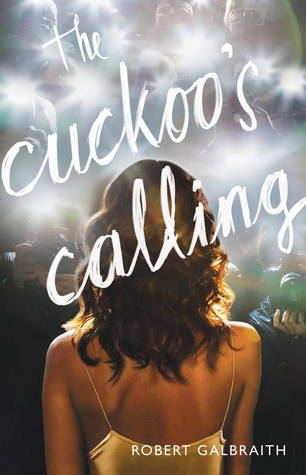
The Cuckoo’s Calling – Robert Galbraith

cuckooDespite the fact that my children, my daughter in particular, are over-the-top Harry Potter fans, I have only ever read the first book, Harry Potter and the Philosopher’s Stone. When my daughter was really little, say four or five, I had tried to read the book to her and I just couldn’t do it.  I did end up reading it out loud to a grade nine class a couple of years ago and they loved it; so did I.

That said, I wasn’t really looking forward to tackling J.K. Rowling’s massive post Potter novel, The Casual Vacancy, when it was one of last year’s book club selections. That book ended up being a really pleasant surprise, however,  and proved once and for all (as if being one of  the best-selling authors of all time wasn’t proof enough) that Ms. Rowling can write the hell out of a story.

My book club recently met to discuss Rowling’s mystery novel The Cuckoo’s Calling, which Rowling wrote using the pseudonym, Robert Galbraith. (There’s an interesting article about her decision to do so here. ) By the time we got to the book, though, the gig was up and we already knew Rowling had penned the book.

Cormoran Strike, the novel’s protagonist, is a former soldier who lost a leg below the knee to a land mine in Afghanistan. Now he lives in London where he works – although not very successfully – as a private investigator.  His relationship with Charlotte has just ended badly – again. He’s broke and living in his office. And then John Bristow arrives with a case for him.

Bristow is the brother of Strike’s childhood friend, Charlie, who had died when they were kids. He’s also the brother of Lula Landry, the most famous model on the planet. Landry recently committed suicide, but John believes something more sinister happened and wants Strike to investigate.

Of course, it’s really impossible to say much more about the story without giving away important plot points. Suffice it to say that as far as the ‘detective’ part of the novel goes – there’s lots to keep mystery-lovers in the game.

Rowling’s real strength as a writer is characterization. And as I tell the students in my writing class – character is the most important thing anyway; they are what drives your plot.

The Cuckoo’s Calling is chock-a-block with characters of all sorts, the most important of which is Cormoran Strike himself.

The reflection staring back at him was not handsome. Strike had the high, bulging forehead, broad nose and thick brows of a young Beethoven who had taken to boxing, an impression only heightened by the swelling and blackening eye. His thick curly hair, springy as carpet, had ensured that his many youthful nicknames had included “Pubehead.” He looked older than his thirty-five years.

Although the women at book club couldn’t agree on whether we found Strike attractive or not (trying to cast him in a movie version was hysterical), we all agreed that he was super-smart and that’s always the sexiest thing anyway.

Strike and his office temp, Robin (who is pretty smart herself) work their way through the list of Lula Landry associates, turning over rocks in an effort to understand the model and the world she inhabited. It makes for a pretty compelling tale.

The best endorsement I can offer for The Cuckoo’s Calling is this: I bet we’ll be seeing Cormoran again and since he’s a character I can’t seem to stop thinking about, I welcome the opportunity to join him on his next case.

Paper Towns – John Green (with a shout out to John Hughes)

If you are a person of a certain age, you probably have fond memories of John Hughes’ films. Even though I was already in my early 20’s when he started producing arguably the best teen movies ever – I was still young enough to see myself in the characters he committed to celluloid.

Sixteen Candles is my all-time favourite Hughes film, for reasons which will be apparent to anyone who has ever seen the film. I still watch it occasionally and it still makes me laugh and it breaks my heart a little now that Hughes has died.

Yes, you can argue that Jake Ryan isn’t perfect – he did let an underage, unlicensed driver take his very drunk girlfriend home in his father’s Mercedes, but it was the 80’s and, come on,  Jake Ryan is pretty damn dreamy. Also, who didn’t see some part of themselves in the other characters on the screen: Molly Ringwald’s slightly awkward Samantha Baker, Anthony Michael Hall’s loveable dork. Everyone you ever went to high school with is lovingly represented in this flick and in Hughes’ other teen masterpieces, Pretty in Pink, The Breakfast Club,  and Ferris Bueller’s Day Off. 

I would posit that John Green is this generation’s John Hughes and I hope Mr. Green will consider that a compliment because it is certainly meant as one.

Last year because everyone and their dog was reading The Fault in Our Stars I did, too. That was a reading experience I will never forget – curled in the fetal position on my bed at 2 a.m., laughing then crying, then laughing again. That is the experience I want my students to have.

PaperTowns2009_6AThe only other John Green book I have in my classroom library is Paper Towns and I just finished it yesterday. (Trust me, I’ll be rectifying the lack of Green books post-haste.) Paper Towns received rave reviews and the Edgar Award (a prize awarded by the Mystery Writers of America) and it’s totally deserving of both.

Quentin Jacobsen is just weeks away from graduating from high school when his next door neighbour Margo Roth Spiegelman shows up at his window in the middle of the night. Although Quentin and Margo had been childhood friends, they’d drifted apart as they’d gotten older and now, in Quentin’s eyes at least, Margo is this exotic and beautiful creature, but not necessarily his friend.

Margo Roth Spiegelman, whose six-syllable name was often spoken in its entirety with a kind of quiet reverence. Margo Roth Spiegelman, whose stories of epic adventures would blow through school like a summer storm: an old guy living in a broken-down house in Hot Coffee, Mississippi, taught Margo how to play guitar. Margo Roth Spiegelman, who spent three days traveling with the circus – they thought she had potential on the trapeze.

The stories, when they were shared, inevitably ended with, I mean, can you believe it? We often could not, but they always proved true.

Quentin’s best friend, Ben, describes Margo as “the kind of person who either dies tragically at twenty-seven, like Jimi Hendrix and Janis Joplin, or else grows up to win, like, the first-ever Nobel Prize for Awesome.”

Anyway, Margo needs Quentin’s help. She also assures him that this will be the best night of his life. Quentin is a guy who generally plays by the rules, so his decision to help Margo is slightly out of character for him. Nevertheless, he helps Margo carry out a list of tasks, some of them vengeful and some of them contemplative and he is indeed changed by the experience. Which is why when Margo suddenly disappears, he is compelled to follow the breadcrumb trail of clues she’s left behind.

Paper Towns is a clever mystery for sure, but that’s not the only reason to admire the heck out of it. What I love about John Green is the way he writes dialogue. His characters are smart and funny and honest-to-goodness people. In the same way that John Hughes made his characters painfully awkward or awesome or self-deprecating or ironic, Green’s teens are whole and fragile and super smart and laugh-out-loud funny.

And they think thinky-thoughts. The fact that Paper Towns is set in Orlando, Florida (John Green’s hometown) is significant. Margo says “you can see how fake it is…It’s a paper town. I mean, look at it Q: look at all those cul-de-sacs, those streets that turn in on themselves, all the houses that were built to fall apart.”

Quentin’s journey to find Margo makes him question not only everything he thought he knew about her, but also everything he believes about himself and Green does a great service to his characters (and the young adults who will be reading this book) by not giving us pat answers.

So – read John Green. Watch John Hughes. Through their eyes you’ll see teenagers at their worst…and their best. And it’s all beautiful.

Blacklands – Belinda Bauer

blacklandsTwelve-year-old Steven Lamb, the protagonist of Belinda Bauer’s debut novel Blacklands, lives with his mother, Lettie, his grandmother and his little brother, Davey,  in a small English village called Shipcott.  Steven spends his time out on the moors digging holes. He’s looking for the body of his mother’s brother, Billy, who had been killed by pedophile and serial killer, Arnold Avery, eighteen years earlier.  Avery had never given up the location of Billy’s body (or that of two of the other children he’d killed) and Steven thinks if he can find the body, it might bring closure for his perpetually grim and unhappy grandmother and his own mother, who has had to live under the weight of the tragedy her whole life.

Everything in Steven’s young life is miserable. Not only is his home life unhappy (even though he loves his family), he only has one friend at school (and it’s a relationship of convenience more than anything) and he’s constantly bullied by the “hoodies,” three lads who make it their mission to pick on him in and out of school. Even the teachers don’t know him. So Steven is a relatively solitary kid whose only goal is to find Uncle Billy so that “everything would change. [His nan] would stop standing at the window waiting for an impossible boy to come home; she would start to notice him and Davey, and not just in a mean, spiteful way, but in ways that a grandmother should notice them – with love, and secrets, and fifty pence for sweets.”

But Blacklands isn’t just Steven’s story; it’s Arnold Avery’s story, too. He’s rotting away in prison and, trust me, time spent with him isn’t so we can know his story and empathize with him. He’s reprehensible –  a cunning deviant with a predilection for sexual torture and murder. He’s been a model prisoner because “model prisoners wanted to be rehabilitated, so Avery had signed up for countless classes, workshops and courses over the years.” It had all paid off, too, because two years earlier he’d been moved from a high-security prison to Longmoor Prison, a low-security facility.

So when he receives Steven Lamb’s first letter, a plea for help in finding Billy’s body, Avery begins to dream of escape.

Blacklands was the 2010 winner of the Crime Writers’ Association Gold Dagger Award for Crime Novel of the Year.  It works on multiple levels – as a story of what grief does to a person and how that legacy trickles down to poison all who come after, as a coming-of-age tale, and finally, as a can’t-turn-the-pages-fast-enough thrill-ride. Bauer manages the tricky shift between Steven and Avery with finesse and the whole story races, with only a couple minor missteps, towards an inevitable and  thrilling denouement.

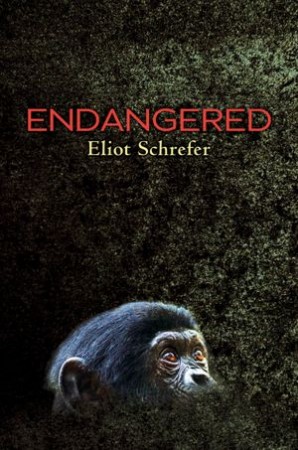
Endangered – Eliot Schrefer

endangeredWhen my 14-year-old son saw that I was reading Eliot Schrefer’s novel Endangered he rolled his eyes and said, “Mom, our teacher tried to read us that book last year and no one liked it – not even her.” Connor is a voracious reader and we have often read and enjoyed the same books so I have to admit that I was skeptical as I started this book.

Fourteen-year-old Sophie is visiting her mother in the Democratic Republic of the Congo (DRC). Her parents  are divorced and she has been living with her father in Miami since she was eight, but it’s the summer holidays and so she is visiting with her mom at the bonobo sanctuary her mother runs in Kinshasa. Bonobos are a member of the ape family and they are endangered. Bonobos, as it turns out, are our closest relatives, “sharing over 98.7 percent of our DNA.” Adult bonobos are often killed for food; babies are kidnapped and sold on the black market. It is just such an encounter that starts Sophie’s story.

The little ape sat down tiredly in the dirt and lowered his arms, wincing as his sore muscles relaxed. I kneeled and reached out to him. The bonobo glanced at his master before working up the energy to stand and toddle over to me. He leaned against my shin for a moment, then extended his arms to be picked up. I lifted him easily and he hugged himself to me, his fragile arms as light as a necklace.

Sophie’s mother is none-too-happy when her daughter arrives at the sanctuary with the bonobo. Not because Sophie rescued the bonobo, but because she didn’t follow the proper protocol and that could cause more trouble down the road. But Sophie has fallen in love with the little bonobo she names Otto and their relationship sustains them through the difficult times ahead.

In the beginning I found Endangered a little didactic. Admittedly, I knew nothing about bonobos and even less about the scary situation in the DRC, but the way the information was relayed to the reader – via Sophie – just didn’t feel organic. Thankfully, Schrefer didn’t spend a lot of time instructing us.  When the Congo’s president is assassinated and rebels flood into the area Sophie’s peaceful existence at the sanctuary crumbles.  That’s when things get really interesting.

Sophie is a remarkably resilient character. Despite the fact that she has been leading a relatively privileged life in the States for the past six years, she hasn’t forgotten where she came from. As she and Otto travel through the jungle and up the Congo river to find her mother (who had left just before the coup to take some bonobos to an island release site), my heart was really racing. I mean, this war (despite being fictional) is based on decades of bloody conflict and although Schrefer stays away from the truly graphic, one only has to use their imagination to imagine the atrocities Sophie and Otto encounter on their way.

And don’t even get me started on the subject of Sophie’s bond with Otto. If even half of what transpires between them is true, bonobos are beyond remarkable; they’re us.

Con, honey, I respectfully disagree with your assessment of this book.

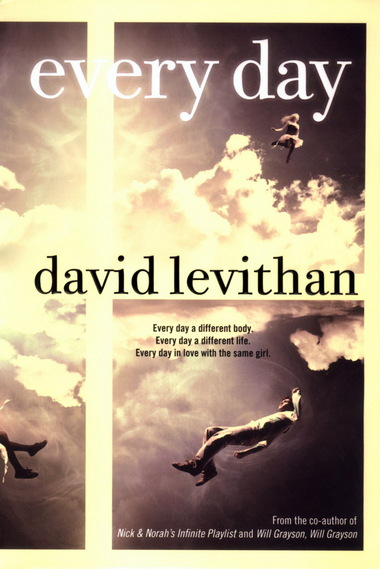
Every Day – David Levithan

16BLEVITHANWhat if every day you woke up in someone else’s body? You are you, but also them; you have access to their memories, but also retain your own. This is A’s predicament in David Levithan’s clever and emotionally resonant YA novel, Every Day.

I don’t know how this works. Or why. I stopped trying to figure it out a long time ago. I’m never going to figure it out, any more than a normal person will figure out his or her own existance. After a while, you have to be at peace with the fact that you simply are. There is no way to know why.

Dispensing with the prickly question of how this works (or doesn’t) early on, Levithan dumps the reader into A’s life on Day 5994. He is 16.  Today he is in Justin’s body.  Justin’s not a particularly likeable guy and A figures that out pretty quickly. He admits: “I know I am not going to like today.”

A’s ability to access information from each person he inhabits allows him to live each day with relative ease, plus he always has an escape hatch because he knows that he will wake up as someone else the next day. Even if he wakes up in the body of an idiot, he knows it’s not forever.  Justin is a bit of an idiot and that wouldn’t be such a big deal if it weren’t for Rhiannon. She’s Justin’s girlfriend.

…there’s something about her – the cities on her shoes, the flash of bravery, the unnecessary sadness – that makes me want to know what the word will be when it stops being a sound. I have spent years meeting people without ever knowing them, and on this morning, in this place, with this girl, I feel the faintest pull of wanting to know. And in a moment of either weakness or bravery on my own part, I decide to follow it. I decide to find out more.

Thus begins A’s relationship with Rhiannon. And as you might imagine, there’s nothing typical about it. There’s nothing typical about Every Day period.

A has spent his entire existence trying to keep himself separate from the person whose body he inhabits. His feelings for Rhiannon complicate his life in ways too numerous to mention; suffice it to say that every day becomes a challenge to see her, but first he somehow has to convince her of the truth of his strange reality.

In one sense, Every Day works as a terrific page-turner: will A and Rhiannon find a way to be together despite their terrific obstacles? After all one day A could be in the body of a hunky football player and the next he could be an overweight teenage girl. Will Rhiannon love him back despite his outward appearance? What is love anyway?

But I think this novel also works hard to be something more and in that way I think it will probably speak to teenagers everywhere. It allows us to inhabit the bodies of confident, beautiful teens and also depressed teens who wish themselves harm. We hang with straight teens and gay teens, teens with parents who smother them and parents who trust them. Each scenario allows Levithan the opportunity to show the reader his tremendous capacity for empathy. And it also allows us to see A  – despite his lack of corpreal form – as the embodiment of what it means to be human.

Master of the Delta – Thomas H. Cook

masterofthedeltaI always say Thomas H. Cook is a mystery writer and he is…but I think he is also so much more than that. Master of the Delta is my 8th outing with Cook and it didn’t disappoint, even though some of the themes were familiar. The novel has the propulsive energy of a mystery, a book with a thread of whodunit twined with a ribbon of ‘is this going to end like I think it’s going to end?’ And of course – nothing is ever quite what it seems. But Cook operates on another level and this is where I think he excels.

Master of the Delta is Jack Branch’s story. Branch is a twenty-three year old teacher who has returned to his hometown to teach at Lakeland High School. Branch has had a priviledged upbringing: he grew up at Great Oaks, one of the town’s massive plantation homes.  It is 1954.

As a boy I’d sat with my father on just such a veranda, evenings that despite all that has happened since still hold a storied beauty for me. There was something calm and sure about them, and it would never have occurred to me that anything might shatter the sheer stability of it all, a father much admired, a son who seemed to please him, a family name everywhere revered and to which no act of dishonour had ever been ascribed.

Branch is a fussy young man – no, fussy isn’t the right word. He’s cocky. He believes his own hype. I don’t mean to say that he is without merit, but his youthful arrogance is partly to blame for events that haunt him for the rest of his life.

And that’s one of the cool things about Master of the Delta (and Cook’s novels in general). Cook always manages to weave past and present together seamlessly so Branch’s story is told as it unfolds, but also from the vantage point of Branch as a much older man – someone who is, from this vantage point at least, able to see his own character flaws.

Branch is teaching a course on evil through the ages and he discovers that one of his students, Eddie Miller, is the son of Luke Miller, the Coed Killer – a man who had killed a local girl and subsequently been killed in jail. Branch encourages Eddie to write a paper about his father. He feels it will help Eddie get out from under the weight of his awful heritage. So Eddie starts to research the father he barely remembers, but when this research reaches into his own life, Branch’s age and inexperience begin to show.

Really, Master of the Delta is a book about fathers and sons, about the part luck plays in how our lives turn out, about kindness and cruelty.  It is a book that has something to say about teachers and books and as a teacher who loves books, I enjoyed that. I truly believe Cook is a masterful observor of human life – our weaknesses and our strengths.  He might wrap it all up in a mystery, but I can’t think of anyone who does it better than he does.

The Guardians – @andrewpyper

guardiansAndrew Pyper’s been on my literary radar for a few years now – ever since I read his first novel, Lost Girls. (This was well before I blogged, or even knew what blogging was, so I have no review. I do remember that I thought it was smart, well-written and creepy.) A couple years ago I read Pyper’s novel. The Trade Mission, a book I had some trouble with. Not because of the writing, more because I felt like I was in way over my head.  The Guardians was a much easier read, well, perhaps not easier, but more accessible.

Carl, Ben, Randy and Trevor, the novel’s narrator, grow up in Grimshaw, Ontario. It’s a one-horse town, a place they can’t wait to leave. They are solid friends and have been since they were kids. They play hockey for the Grimshaw Guardians, smoke up in Carl’s car before class and fantasize about Ms. Langham, their young and beautiful music teacher. On one level, The Guardians is about this friendship. But there’s more to this story than four boys making out with their girls and smoking dope.

Because there’s this house which just happens to be across the street from Ben’s house and as Trevor recalls: “it alone is waiting for us. Ready to see us stand on the presumed safety of weed-cracked sidewalk as we had as schoolchildren, daring each other to see who could look longest through its windows without blinking or running away.”

The Guardians opens with Ben’s suicide in the present. Trevor must return to his old stomping grounds to attend the funeral. He’s at a bit of a crossroads, Trevor. He’s recently been diagnosed with Parkinson’s and he’s a man of a certain age (40) and he’s feeling the full force of death’s lingering gaze. Pretty much the last place he wants to be is back in Grimshaw, where he’ll have no choice but to remember certain events from his youth that he has sworn a pact with his buddies to never talk about.

I hope Mr. Pyper will consider it a compliment when I say that The Guardians reminded me a little bit of Stephen King’s brilliant novel, It. I loved that book, not just because it scared the bejeesus out of me  (which, frankly, seems silly now given that the monster was a giant girl spider that lived in a cave) but because of the friendships between the characters – which King always handles so deftly. Pyper does a fine job, too, of giving us characters to care about even when they make bad decisions. And they do; they’re kids.

The house has a part to play, too. It’s long abandoned and creepy as hell and bad things happen there, both real and imagined. Their relationship with the house drives the narrative both in the past and now, present day.

The strength of the story, though, is that it taps into that very human feeling of helplessness, and frailty. Trevor’s feeling it as his body begins to betray him. There’s also this notion of “you can’t go home again.” I’m not a 40 year-old-man, but I understand perfectly that idea of returning to the place of your youth but no longer being young. Trevor feels it when he is reunited with Randy. “That’s what we see in each other’s eyes, what we silently share in the pause between recognition and brotherly embrace.”  Their youth is gone, but they are haunted by it nonetheless.

The Guardians is a sad tale, well told.