Crooked Letter, Crooked Letter – Tom Franklin

Although there is a murder mystery at the centre of Tom Franklin’s novel, Crooked Letter, Crooked Letter, it isn’t what kept me reading.

In the late 1970s in rural Mississippi, Larry Ott lives with his parents. Larry’s an awkward kid who spends his spare time reading Stephen King novels and trying to ingratiate himself with the students at school. His father owns the local garage, and while Larry admires the way his father can tell a story, he and his dad aren’t close.

Then Silas Jones moves to town. Silas and his mother live in a shack deep in the woods, property owned by Larry’s father. A tentative friendship blossoms between the boys. Then, when the boys are in high school, Larry takes a local girl to the drive-in and she’s never heard from again. There’s no evidence to prove Larry had anything to do with her disappearance, but serious damage is done to his reputation.

Twenty years later, Larry operates his father’s garage but has no customers because of his tarnished past. Silas returns home to Chabot as a constable and another girl goes missing. Larry is the obvious suspect.

It sounds like a murder mystery and that is part of Crooked Letter, Crooked Letter‘s appeal, but the book is  more than that.  I felt a great deal of sympathy for Larry, for his awkward relationship with his father – a man he tried to please but never could. When the story opens, we see him lovingly tend his mother’s chickens. He’s built them a contraption, a “head-high movable cage with an open floor” which he could move around so the hens would always have new grass to graze. Not exactly the actions of a cold-blooded killer. He also forms a relationship with a petty criminal, Wallace, out of sheer loneliness.

The story alternates between present-day and the boys’ shared past. Of course, it’s perfectly reasonable to ask why Larry didn’t stay away when he had the chance, or why Silas came home, but I still think Franklin handled their relationship, its secrets and revelations well.

Breathe My Name – R.A. Nelson

Fireless is the country where we live. Every day Momma teaches us something new about it.

Frances is 18 and something of a loner. She lives with her parents and two younger brothers in small-town Alabama.  It isn’t until the new boy, John Mullinix  or Nix, arrives at her school that Frances’ life cracks open.  Frances has been living in the shadow of a traumatic event – an event so horrible that she never talks about it and has, in many ways, surpressed its horror.

Frances’ best friend Ann Mirette insists that Frances tell Nix about her “first family,” but Frances is understandably reluctant. She really likes Nix and one senses that Frances doesn’t form attachments easily. She’s afraid that if she tells Nix what happened in Fireless, he’ll bolt.

Breathe My Name is a beautifully written book about facing your past and freeing yourself from its terrible hold. I don’t want to spoil the novel by spilling Frances’ closely guarded secrets. She’s been protected by her parents for eleven years, but the past has a way of finding you even when you’re trying desperately to hide from it.

I gladly went along with Frances on her journey to adulthood but I do have one niggle with the book. I just didn’t buy what happened in Charleston. The book had this beautiful rhythm going and Nelson deftly handled the past and the present, but the climax of the novel just felt out of place and Carruther’s motivation seemed like an afterthought. One of those: okay now why would this guy behave in this manner, wait, let’s make him an obsessed psychopath sort of solutions. I would have been just as happy if after he set Frances on her journey he was never heard from again.

Still, in the great scheme of things it hardly matters. Breathe My Name had lovely things to say about family and the courage it takes to confront your past and, more importantly, forgive yourself for surviving it.

The Knife of Never Letting Go – Patrick Ness

Patrick Ness …I think I may love you just a little bit. Okay, maybe a lot. I can’t remember the last time I read a book where I literally had to force myself to slow down while reading. I’d start a page and I just couldn’t stand it – my eyes would race to the bottom of the page, skip over to the next page…I was so invested in these amazing characters and this  story and look, I’m doing it here.

Context coming right up.

The Knife of Never Letting Go is the first book in the Chaos Walking trilogy (The Ask and the Answer and Monsters of Men are the other two titles in the series.) I purchased it based on someone’s blog review – sorry, don’t remember the blog – and it languished on my tbr pile for several months before I finally picked it up. I read about 10 pages and put it aside. I had the same sort of lukewarm feelings about the book as I did after my first attempt to read The Book Thief. And we all remember how that turned out, right?

The second time I picked up Ness’ book, I fell into the narrative. By page 38 there was NO WAY I was putting the book down; I couldn’t have put it down even if I’d wanted to.

Todd is just days away from becoming a man; that’s what he’ll be on his 13th birthday. He lives in Prentisstown, a place notable for two reasons: there are no women and everyone can hear everyone else’s thoughts. Todd calls it the ‘noise’ and we hear about as he heads off to the swamp to pick apples.

…the swamp is the only place anywhere near Prentisstown where you can have half a break from all the Noise that men spill outta theirselves, all their clamor and clatter that never lets up, even when they sleep. men and the thoughts they don’t know they think even when everyone can hear. Men and their Noise. I don’t know how they do it, how they stand each other.

This visit to the swamp is remarkable though; Todd hears…silence. But that can’t be because “there’s no such thing as silence. Not here, not nowhere. Not when yer asleep, not when yer by yerself, never.” When he returns to the home he shares with Ben and Cillian, he gets an even bigger surprise: Ben tells Todd he has to go. There is no time for discussion or explanation, Todd must run.

The shocks keep coming for young Todd and his faithful dog, Manchee. (And can I just say here that I have never been one to fall for the old ‘boy and his dog’ story until now – I love that dog, whose thoughts Todd can also hear.)

Patrick Ness has created a compelling, suspenseful narrative.  Todd’s life is constantly in danger and  he has to keep adjusting his own story because, clearly, he hasn’t been told the whole truth about the town he comes from or even his own personal history. He leaves Prentisstown with a book he can’t read and a knife and a sense of urgency that propels him forward with barely a chance to catch his breath. I felt like that, too.

I know that dystopian literature is all the rage these days and yes, I am a fan of The Hunger Games, but I think Ness has done something else quite original with The Knife of Never Letting Go. This is a story that grabs you by the throat and shakes the living daylights out of you for 479 pages.  The subject matter is often dark. The character of the preacher, Aaron, is one of the creepiest psychopaths I’ve encountered in literature in a long, long time. And this is a book I want to hand to people and say “read this now!” I love it when that happens.


Dark Harvest – Norman Partridge

Peter Straub, a writer I have admired for several decades said that Norman Partridge  is “probably the most exciting and original voice in horror literature to have appeared in the last decade.”  Coming from the man who wrote Floating Dragon and Ghost Story, two books I read with the lights totally on, this is high praise.

An unnamed Midwestern town is cursed. Every Halloween the October Boy (or Ol’ Hacksaw Face or Sawtooth Jack) rises from the cornfields and heads to town where all the eligible teenage boys try to kill him. They’ve been denied food for the past few days and the October Boy has a gut full of candy.  This year, Pete McCormick is one of those boys. He’s had a rough few months: his mother has died of cancer, his father’s grief led him to the bottle and that led to the unemployment line. Killing the October Boy is Pete’s way out of town because that’s what the prize is: a way out of the one-horse town he lives in and free everything for his dad and little sister.

What Pete doesn’t know is that the October Boy is on a quest, too. He has to make it to the church by midnight and so he’s every bit as determined as Pete. Neither of them know the town’s dark history or its secrets, though.

I liked Dark Harvest. Was it the scariest book I’ve ever read? Uh, no. It was unusual, though. Creative. And strangely, I sort of felt myself rooting (no pun intended – but you’ll have to read the book to know what I mean) for both Pete and the October Boy. It’s a short book, you could read it in a couple hours if you were so inclined. Save it for Halloween night.


One Day – David Nicholls

One Day was the first book of our book club’s 2011-12 reading season (and our 12th year together!) After last year’s (mostly) snooze-a-palooza, it was terrific to come back to some current fiction. One Day comes with a little bit of hype, but I think it totally delivers on its promise.

Emma and Dexter  meet on the eve of their graduation from the University of Edinburgh in 1988. Although Emma has admired Dex from afar, this is their first real encounter and she is totally smitten. Although they come from different worlds (Emma is working class and Dexter comes from money) their one (unconsummated) night begins a friendship that we see in snapshots over twenty years. The beauty of Nicholl’s novel is that we revisit Dex and Emma on the same day, July 15th, and sometimes threads of their lives are left dangling.

In the beginning, both Emma and Dexter suffer from post-college malaise. What are we going to do with our lives? Dexter travels and Emma writes him long letters. He falls into a plum job in TV production. Emma works at a crappy tex-mex restaurant, then becomes a teacher. Through it all they prop each other up and tear each other down in the manner of friends who might be more if only they could get their act together.

This is one of the things Nicholls handles so beautifully in this novel. He juggles their lives – their various liaisons and miscommunications- with such finesse. Even when Dexter is acting like a complete prat we see exactly what Emma sees in him. When Emma is perhaps too serious, we just want to shake her. They are beautifully realized characters, flawed and heartbreakingly fragile.

But Nicholls has even more in store for the reader. The book’s denouement adds a layer of richness to the story, bringing us full circle and allowing the reader to consider the infinite possibilities inherent in just one meeting. Oh, the difference a day makes.

I loved this book.

The Cloud of Unknowing – Thomas H. Cook

It was bound to happen sooner or later;  my first Cook novel to elicit a lukewarm reaction. That’s not to say it was horrible; I don’t actually think it’s possible for Thomas H. Cook to write a horrible novel. The Cloud of Unknowing was a bit of a bust for me, though.

David and Diana Sears were raised by their brilliant but schizophrenic father.  Now they are adults and they carry all the baggage from that often difficult childhood. David is a married lawyer with a teenage daughter. Diana is also married, with a young son who suffers from mental illness. We meet David as he sits in an interrogation room at the local police station. Diana’s young son, Jason,  has drowned and Diana blames her husband, Mark.  More than blames him; Diana thinks Mark has murdered their son.

The Cloud of Unknowing cleverly weaves David’s deposition  and the backstory necessary to make Diana’s story both believable and suspect. David is, as many of Cook’s protagonists are, an average man – honest and hard working.  This novel has less to do with the mystery surrounding  Jason’s death, and more to do with David’s feelings of helplessness as Diana’s fears about Mark grow and as she pulls other people into her orbit.

I can’t fault Cook’s writing. As always, I turned the pages quickly. The Cloud of Unknowing  just didn’t have either the emotional payoff or the clever twist I’ve come to expect from Cook’s novels.  My ho-hum feelings about this novel in no way undermine my deep admiration for Cook’s work. I intend to read every single one of his novels: I love him that much.

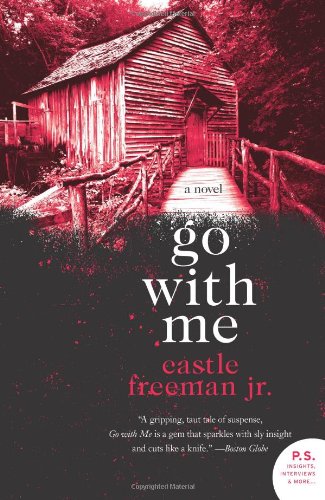
Go With Me – Castle Freeman Jr.

Lillian is a young woman who has recently moved to a small Vermont town. Early one morning, the town sheriff finds Lillian asleep in her car in the police station parking lot. She’s come for help. The town thug, Blackway, has been harrassing her; has, in fact, driven her boyfriend out of town and killed her cat. The sheriff’s advice is simple: go home.

Blackway is an enigmatic, altogether menacing, figure. The sheriff himself is afraid of him.

“You’re telling me you can’t do anything. You’re telling me I have to wait till he does something. till he gets to me, kills me, before you can do anything?”

“You could put it that way, I guess,” the sheriff said.

“How would you put it?”

“That way.”

The sheriff’s advice is to head over to the mill and find Scotty Cavanaugh because “he and Blackway have had dealings.” But Cavanaugh is not at the mill and instead Lillian solicits the help of the strange, quiet brute, Nate, and an old man named Lester to help her find and confront Blackway.

Go With Me is the strangest book I’ve read in a long time. It is both laugh-out-loud funny and strangely creepy. The book tracks Lillian and her small posse to various places where they might find Blackway, breaking the tension of their search with the commentary of the men at the mill who wonder – Greek chorus style –  at how it might all turn out.

Blackway, as it turns out, is not a man to be trifled with. He deserves his reputation. Lester is resourceful, though, and Nate “ain’t scared” and this slim book rockets along to its shocking climax.

I’d never heard of Castle Freeman Jr. before, but this book was well received and although it wasn’t really my cup of tea, it was weirdly compelling.

Love the One You’re With – Emily Giffin

Emily Giffin is really popular, I guess, but I’d never read her. I’m a huge consumer of chick flicks, but not much of a reader of chick lit. I tend to like my fiction a little grittier and heroines in these sorts of books almost always settle – at least in my view.

Not even a full year after she’s married upstanding and handsome lawyer, Andy, (who also happens to be the older brother of her best friend, Margot), Ellen runs into Leo crossing a busy Manhattan street. Leo is “the one who got away” although in this instance, it’s more like the one who fizzled away. Ellen is sent into a tailspin of memories and she indulges every one of them, glossing over how Leo was kind of a schmuck at the end of their relationship.

Okay – so far I’m with you Ellen. I mean, seriously, who hasn’t had the same sort of intense relationship – the one where you’re up all night…um…talking? But Ellen has moved on from all that. Now she’s a successful photographer and Andy, he’s a great guy. She hasn’t settled. At least she doesn’t think she’s settled until Leo comes crashing back into her life.

And that’s when my cell phone rang and I heard his voice. A voice I hadn’t hears in eight years and sixteen days.

“Was that really you? he asked me. His voice was even deeper than I remembered, but otherwise it was like stepping back in time. Like finishing a conversation only hours old.

“Yes,” I said.

Oh, Ellen. Don’t go down that road. But we all do. We all wonder about the might have beens and question the choices we make. Ellen’s marital bliss is about to get bumpy as she hides her reunion from her husband and best friend, and then makes all sorts of minor adjustments to the truth so she can sort through her feelings for Leo.

The truth, it turns out, is more complicated than it appears on the surface. And so is the first year of any marriage. When Ellen and Andy move to Atlanta to be closer to Andy’s family, sister Margot included, Ellen is further tested.

I’ll give Giffin props; Love the One You’re With isn’t sheer fluff because Ellen is a character who is deeply conflicted about her feelings even though she never doubts her love for her husband and the life they’re building together. The new improved Leo is worth a second look, but Ellen is also mature enough to know what the consequences of taking that leap of faith might be.

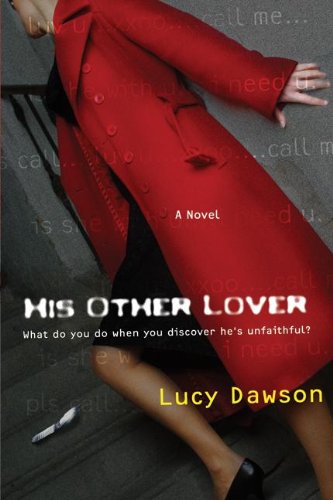
His Other Lover by Lucy Dawson

I seem to be on an infidelity kick lately. I read Lucy Dawson’s debut novel, His Other Lover, over two nights, reading until my eyes burned. In all the ways Love and Other Natural Disasters failed, His Other Lover succeeded.

One night, Mia, a 20-something woman who works for a small advertising firm somewhere near London, discovers a text message on her live-in boyfriend’s phone. Mia thought Pete was the one. Turns out he’s someone else’s one, too. That someone else is an actress named Liz.

The discovery of the text message begins a downward spiral of destructive behviour which upends Mia’s life. But hers is not the only life shattered by the discovery.

It’s interesting, but true, I think: women who are cheated on often blame the other woman. Mia pours all her anger and hatred on top of Liz. She almost makes Pete seem like another victim, someone who fell into Liz’s Black Widow trap and was helpless against her sticky charms.

Of course it’s all much more complicated that that. Mia goes completely off the rails, calling in sick for days on end while she tries to track down Liz. She wants her boyfriend back and the only way to do that is annihilate the enemy.

Dawson does a terrific job of getting inside of Mia’s head. The whole range of emotions are there: grief, anger, the hot desire for revenge. Mia is single-minded in her thirst for getting back her man. The thing is: he’s not worth it.

But the book is.

Testimony by Anita Shreve

Testimony

Explosive… Shreve flawlessly weaves a tale that is mesmerizing, hypnotic and compulsive. No one walks away unscathed, and that includes the reader. Highly recommended. – Betty-Lee Fox, Library Journal

Pretty much everyone has raved about Shreve’s latest novel, Testimony. I’ve been a Shreve fan since Eden Close, so I was looking forward to reading this book. The novel opens when Mike Bordwin, headmaster of Avery Academy, a private New England boarding school, views a tape depicting three of the school’s top basketball players having sex with  a female student who is clearly underage. While the story opens with Mike’s point of view, the novel flips back and forth allowing us to see how this event and its aftermath affects everyone concerned: the so-called victim, the three boys, their families and even members of the press called upon to report the event once the story is leaked from the school’s hallowed halls.

Shreve is  a talented writer and she manages to make individual characters come alive in this novel by employing third, first and even second person points of view. When the young girl speaks, she seems every bit like a fourteen year old, both naive and culpable. One  boy’s mother speaks in the 2nd person – perhaps to distance herself from the news that her son has done something reprehensible, inexplicable.

It may seem odd that the story’s inciting action is revealed in the novel’s opening pages, but as it turns out, the story unravels to reveal another event which contributes to at least one of the boy’s bad decisions. Silas’s story is heartbreaking and, for me at least, he  carried much of the story’s emotional weight on his shoulders.

We had an excellent discussion about this novel at Indigo’s book club. The ripple effect this event sends through the school and community- upsetting lives and relationships- was immensely powerful. In less confident hands, the novel might have slipped into tabloid sensationalism. Not for Shreve; she’s far too good a writer and Testimony is far too good a book.