
Yellowface – R.F. Kuang

R. F. Kuang’s novel Yellowface — a book about as buzzy as its possible to be right now — is the story of June Hayward, a struggling writer with one mediocre published novel under her belt. June is “friends” with Athena Liu, a celebrated Chinese-American novelist, who shot to fame after her debut novel was published and has since gone on to further acclaim and a Netflix deal. (Here’s how readers will know that this book is very much of the moment; it’s not enough to be published — you want to be nominated for awards, Internet famous, and optioned for a streaming service adaptation.)

The truth of the matter is, June doesn’t really like Athena all that much. Athena doesn’t have any friends and June is convinced that people find her as “unbearable” as she does.

She’s unbelievable. She’s literally unbelievable.

So of course Athena gets every good thing, because that’s how this industry works. Publishing picks a winner – someone attractive enough, someone cool and young and, oh, we’re all thinking it, let’s just say it, “diverse” enough – and lavishes all its money and resources on them.

June is not without some talent, but she’s just “brown-eyed, brown-haired June Hayward, from Philly.” No one is interested in stories by white female writers. When Athena dies accidentally (not a spoiler — the novel’s first line tells us this happens), June does the unthinkable: she steals an unfinished manuscript from Athena’s desk. The manuscript needs some work, but June can see that it is a “masterpiece.” The problem is that it’s the story of the “unsung contributions and experiences of the Chinese Labor Corps”, a subject about which June knows nothing. It’s barely even a draft, but June acknowledges that she can “see where it’s all going and it’s gorgeous.” It’s so gorgeous, that June feels that she should finish it.

I know you won’t believe me, but there was never a moment when I thought to myself, I’m going to take this and make it mine. It’s not like I sat down and hatched up some evil plan to profit off my dear friend’s work. No, seriously – it felt natural, like this was my calling, like it was divinely ordained.

This is a novel that is tuned into the publishing world, the social-media-famous landscape, and online bullies. When June/Athena’s novel is published to critical acclaim, June feels validated and deserving. There’s no imposter syndrome here because she feels as though she worked every bit as hard on the novel as Athena did. So what if she’s not Chinese (as some of the critics says). She did her research. When there is any criticism of the book, June can chalk it up to Athena’s contribution: she always knew Athena was a fraud. The only thing she had going for her was the fact that she wasn’t white.

This novel seems very timely given the trouble other writers have faced because they were writing from a point of view that was clearly not part of their experience. (American Dirt springs to mind.) If you are a voracious reader and pay attention to things that happen on social media, you’ll certainly get some of the references Kuang makes.

June isn’t a particularly likeable character– neither is Athena for that matter. June isn’t trying to hide her theft from herself or the reader, but she does spend a lot of time justifying it. I ripped through this book waiting for the other shoe to drop and loved every minute of it.

Brother – Ania Ahlborn

Ania Ahlborn’s novel Brother is like getting throat punched. Well, I haven’t actually ever been throat punched, but I can imagine what it’s like.

Michael Morrow is nineteen and lives with his older brother Rebel, younger sister Misty Dawn, and their parents, Wade and Claudine in a remote part of Appalachia. Another sister, Lauralynn, no longer lives at home. It is clear from the book’s opening lines that life at the Morrow house is not normal.

Michael twisted in his bed, the threadbare blanket he’d used all his life tangled around his legs. A girl was screaming bloody murder outside….Those girls usually went quiet fast. They’d yell so hard they ended up making themselves hoarse. Them’s the perks of livin’ in the wilderness, Momma had once said. You scream and scream and ain’t nobody around to hear.

It’s hard to talk about this book without spoiling the dark and sinister things that happen in this house, but I think you’ll get the idea pretty quickly. And trust me when I say – this book goes there, all the way there. And even though Michael is a part of it all, he is also an incredibly sympathetic character. His life cracks open a little bit when he meets Alice, a girl about his age who works at a local record store.

She looked like Snow White from Lauralynn’s old book of fairy tales, except a hundred times more beautiful and wearing all black, looking about as modern as the music sounded.

Meeting Alice gives Michael a sense of hope. She reminds him that the world is big and full of possibility, if he can only find a way to escape his family. But that is easier said than done. The major problem is his brother Reb, a quick-tempered drunk who is impossibly cruel and cunning. Reb easily manipulates Michael and it isn’t until the novel’s unbelievable climax that you realize just how evil he truly is.

There are no moments of levity in Ahlborn’s book; it’s as black as pitch. And that makes it sort of odd to admit that I loved it, but I really did. Despite the atrocious acts committed by Michael, I just wanted him to find a way to escape. I watched him struggle to make sense of his life and if anyone was deserving of a redemptive ending, it was certainly him.

He was starting to see how he could separate himself from the responsibility of the things he’d done in his life. The fear. The manipulation. The sense of duty that had been beaten into him.

In the sections focused on Reb, we are provided with a glimpse into how his own experiences have shaped him. It doesn’t actually make him any more likeable, though. Claudine, the book’s most reprehensible character, has a horrifying backstory, too, but I really didn’t like her.

Brother is a pulse-pounding, emotionally resonate and horrifying novel and I highly recommend it…if you have a strong stomach and aren’t prone to nightmares.

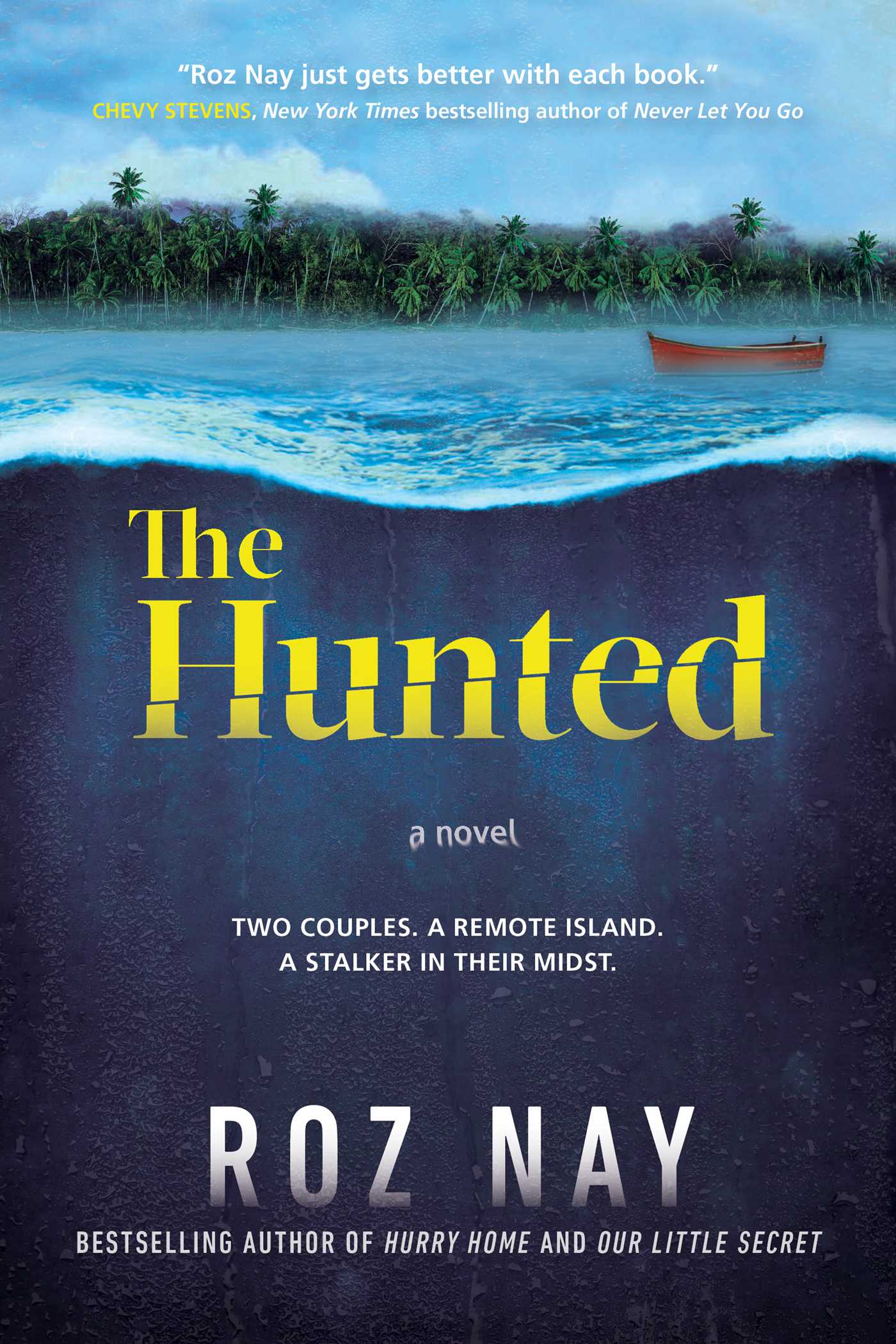
The Hunted – Roz Nay

I was hooked from the very start of Canadian writer Roz Nay’s novel The Hunted.

A hand over my mouth wakes me, the skin of it tinny with metal and salt.

“Stevie,” he whispers, his voice hoarse. “It’s not safe here. You’re not safe.”

Stevie and Jacob are high school sweethearts who have left their small-town Maine home in search of adventure and respite from the death of Stevie’s grandmother, a loss that meant that she is out of a job and a place to live. Now, at twenty-four, they’ve landed in Africa, where Jacob has taken a job as a dive instructor at GoEco, which is located on an island south of Zanzibar.

Stevie is clearly on tenterhooks and her first few days in Africa do nothing to settle her nerves. Nothing is like it is back home. On her first night at a hostel, another traveler tells her that “You can’t trust anyone.”

Then they meet Leo and Tasmin, a beautiful British couple. We know Leo isn’t to be trusted because he is the other narrator.

They seemed new. Vulnerable. I have to admit, I felt an almost immediate fondness for them both.

It’s interesting to read a cat and mouse thriller when the cat is identified so early on; you’re always waiting for the other shoe to drop. As the novel moves on, we get to learn a little bit about both Leo and Stevie — seems they both have some carefully guarded secrets.

Although things sort of fell apart for me once the foursome arrived in Rafiki and the machinations seemed a little over-the-top, I still enjoyed the read.

This is my second novel (Our Little Secret) by Nay. I will definitely continue to read what she writes.

Horrid – Katrina Leno

There was a little girl 
Who had a little curl 
Right in the middle of her forehead. 
And when she was good, 
She was very, very good, 
But when she was bad, she was horrid. 

You’re familiar with the nursery rhyme, right? Well, so is Katrina Leno and she puts it to excellent use in her YA horror novel Horrid. (And look at that fantastic cover!)

Jane and her mother, Ruthellen, have left their lives in Los Angeles and driven across country to Bells Hollow, Maine. Neither of them particularly want to be there, but they have no choice: they have no place else to go. Ruth’s has inherited North Manor, “a large colonial-style mansion with three gables at the front and four white columns supporting a white-railed balcony.” The issue is that the house is dilapidated and creepy, looking like “one big tetanus trap.” Still, Jane and her mother are hoping for a fresh start and a place to heal from their personal tragedy.

Ruth gets a job and Jane resumes her senior year, where she meets and befriends Susie and Alana. School is school and Jane doesn’t have any issues until she encounters Alana’s cousin, Melanie, who seems to dislike her on sight. Jane isn’t interested in drama and besides, Melanie has troubles of her own, including an older sister who is very ill.

North Manor’s reputation as the “creep house” is well-deserved. Lights come on before there is electricity. Jane sees a shadow in an upstairs room. Marbles roll across the floor. The smell of roses is so strong, Jane feels choked by it. There are sounds that Ruth says are just the house settling, but they sound like footsteps to Jane.

In all the usual ways, Horrid is a straight-up haunted house story. And an unsettling one, too. But there’s more going on in Leno’s book than just things that go bump in the night. Jane is tortured by her father’s death and her blind-rage temper, which only he seemed able to subdue. The house seems to exacerbate Jane’s anxiety and when she discovers a decade’s old secret, well things get really interesting.

I really enjoyed reading Horrid. Jane was a sympathetic character and the ending was not YA – all – is – well – in -the – world, which I actually really appreciated. Loads of fun.

Harrow Lake – Kat Ellis

Lola Nox is the daughter of acclaimed horror film director Nolan Nox. It’s just been the two of them since Lola’s mother, Lorelei, disappeared without a trace. Lola likes to think that nothing can spook her, but one night she comes home and discovers her father lying in a pool of blood. As he recovers, Lola is sent to Harrow Lake to stay with her maternal grandmother.

Harrow Lake is where her parents met and also the place where Nolan filmed his most famous movie, Nightjar. It’s a weird town which depends on its celebrity for revenue, hosting a week-long festival each summer to give fans of the film the opportunity to check out the locations. The man who picks Lola up at the airport tells her to “never go into Harrow Lake woods on a moonless night, or the trees might mistake you for one of their own.”

All sorts of weird things start happening to Lola in Harrow Lake. First her suitcase disappears and she has to go around town dressed in the costumes her mother wore in the movie. There’s no cell service or working landline. The townsfolk are strange, although she does meet Cora and Carter, a brother and sister whose mother was once friends with Lorelei. If things are off-kilter for Lola, they’re even more wackadoodle for readers.

Harrow Lake is haunted by Mister Jitters. Cora tells Lola that

Mister Jitters lived alone out in the woods with no family, no friends – kind of an outcast nobody wanted to know unless they were in the market to buy what he was selling, you know? He hid his moonshine in the underground tunnels that run all around the lake, but he got caught in a cave-in when the land shifted in twenty-eight.

Apparently Mister Jitters survived by eating human flesh “so he started hunting for people to drag back to his lair to eat.” This legend is legitimized by the fact that every so often, people go missing in Harrow Lake.

There’s a lot going on in Kat Ellis’ book. Family drama and secrets, repressed memories, and imaginary friends who may not be all that imaginary are just a few of the elements that ramp up the tension. It’s a lot, I have to admit, and some of the time I wasn’t even sure I knew exactly what was going on. Lola is a character to root for, though, and the book is definitely a fun read if you are a fan if things that literally go bump in the night.

Heartbreak Homes – Jo Treggiari

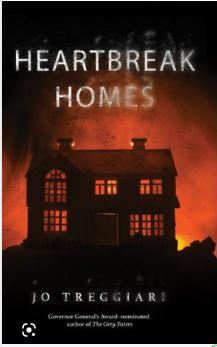
The “Heartbreak Homes” referenced in the title of Nova Scotia – based YA author Jo Treggiari’s (She is also co-owner of the fabulous Block Shop Books in Lunenburg), latest novel is an upscale housing development that went belly up leaving only the model home finished. This is where the story starts, at a blow-out party hosted by Malcom “Mal” Bradley, whose father was the developer of Heartwood Homes. The “Heartbreak” comes from the fact that the project went bankrupt and many people lost their money and their livelihood.

The story’s three narrators all attend the party. Frankie goes with her best friend Jessa, who has recently started hanging out with the cool kids and has a crush on Mal. Martin goes because he is desperate to reconnect with his old friends, friends he lost because his father had invested his (and others’) money in the project and lost it all, necessitating a move across town and a change of schools for Martin. Cara is there with her gang of three other girls to steal. They are homeless and desperate for food and items they might be able to sell in order to make their lives slightly less awful.

These three characters are there when a horrible crime takes place. In fact, it is Martin and Frankie who discover the body of a classmate and from there the novel’s locked-room structure (everyone’s a suspect) keeps you turning the pages lickety-split. This is a story that, like One of Us Is Lying, tests the allegiances of these characters as they try to figure out who the culprit might be. All three of these kids are sympathetic, likeable, and believable. I was particularly taken with Cara; her circumstances are awful and she does her best to look after the other girls she ‘lives’ with.

All I ever wanted was a home. For the ground to settle under my feet long enough for me to put down roots. Instead, for the last fourteen days, we’d been colder, wetter, and hungrier than ever.

Strangely, the book’s title also relates to the heartbreak found in all three of the these characters’ homes – or lack thereof. Frankie lives with her grandparents, who do not seem to understand her or even, at times, really like her. Martin’s father drinks too much and home is no longer a safe and warm place. Cara doesn’t have a home at all, has been – along with her friends – in and out of foster homes or without a safe place to call home for as long as she can remember.

While Heartbreak Homes is definitely a mystery, complete with the requisite red herrings and plot twists, it is also an interesting commentary on homelessness, family, responsibility and loyalty. I loved spending time with these characters and if the mystery itself unraveled just a little too neatly, it hardly matters. This is a great book.

The Swap – Robyn Harding

This is another one of those books with an intriguing premise, a strong start and then, I dunno, about half way through it all starts to fall apart, but because you’ve already invested a chunk of time, you sort of feel obligated to see it through.

Canadian author Robyn Harding’s domestic thriller The Swap is the story of three women whose lives intersect in Hawking, a small town on an island off the West Coast (I pictured Salt Spring Island). Lo is a seventeen-year-old high school student; Freya is a beautiful Instagram influencer married to a disgraced but drop-dead-gorgeous NHL hockey player, and Jamie and her husband have recently moved to Hawking to escape a personal tragedy.

For Lo, life couldn’t be more boring. She hates school; she hates her classmates; she hates her life.

My life was exceptionally boring. I had no friends, no hobbies, no extracurricular activities. I did, however, have a lot of chores.

Lo lives with her unconventional family on a hobby farm. When she’s not looking after the animals or helping her mother pickle and can food from the garden, she’s walking through the woods or along the beach taking photographs, the one thing she feels she’s pretty good at. When Freya shows up at Lo’s high school with a flyer advertising pottery classes, Lo feels something akin to excitement.

Even through the crowd in the hallway, I could tell she was somebody. There was no way I could have known then that she would come into my life and change it, change me, but I felt a magnetic pull toward her, like I had to meet her. It was destiny.

Lo signs up for Freya’s pottery class and thus begins a dysfunctional friendship between the two. Freya starts confiding in Lo, and Lo feels that the two have an impenetrable bond, that is, until Jamie enters the picture. Jamie lacks confidence and, like Lo, she basks in Freya’s attention. What neither of these two seem to realize is how toxic and manipulative Freya is. It’s only after Freya orchestrates the swap of the title (I won’t bother spoiling you here, although the book cover and blurb gives it away), that these relationships really start to crumble.

My problem with The Swap is that none of the characters are likeable or sympathetic except, strangely, Max, Freya’s husband. And sure, there are lots of twists and turns, but I didn’t believe in a single one of them. Yes, it was easy to see how Lo might be manipulated; she’s had a relatively sheltered life. The story just didn’t work for me, although it was certainly easy enough to turn the pages.

The Nowhere Child – Christian White

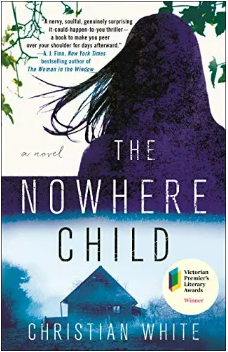
Thirty-year-old Kim Leamy is just living her life in Melbourne, Australia when James Finn, an accountant from Manson, Kentucky approaches her with some startling news. He believes Kim is actually Sammy Went, a girl who was kidnapped from her family’s home in Manson twenty eight years ago. He offers enough proof that Kim believes him, and so she heads to the States to meet the family she never knew she had.

Christian White’s debut novel The Nowhere Child follows Kim’s journey into her unknown history, but also offers readers a glimpse into her family around the time that she originally went missing. There’s her parents, Jack and Molly, already struggling to hang on to their crumbling marriage; there’s her sister, Emma,13, and brother, Stuart, 9. And there’s The Church of the Light Within, a group not a cult, an important distinction, who “worshipped by handling venomous snakes and scorpions. If rumours were to be believed, they also drank strychnine, spoke in tongues […], drank blood and worshipped the Devil.” Jack, who had been raised in the church, has been drifting away from it, but Molly has been embracing it with new-found fervor, especially after the disappearance of her daughter.

The Wents have all been keeping secrets from each other, but their distress over Sammy is legitimate. It seems as though she disappeared into thin air. Manson’s town sheriff, Chester Ellis, is flummoxed and the reader will be, too.

The Nowhere Child is reminiscent of another book I read recently, Never Look Back. That book also dealt with someone discovering something about their identity that they hadn’t known. I really enjoyed The Nowhere Child. Kim was a likeable protagonist and there were some truly creepy moments in this book because cults! snakes! an old, abandoned grist mill where if you write a person’s name on the wall they disappear! It all makes for page turning fun with a final twist that was both clever and believable.

Never Look Back – Alison Gaylin

I love a good thriller – a book that keeps me turning the pages long after my bed time. There are certain things I look for in a thriller: believable characters that I can root for, plausible plot, good writing, a few twists and turns to keep me guessing, suspense. It’s not too much to ask is it?

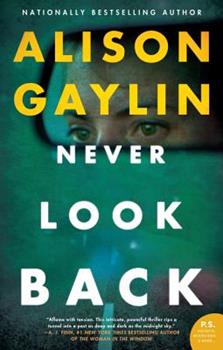
Alison Gaylin is a new-to-me writer and for my first outing I chose Never Look Back. This is the dual-timeline story of April Cooper, a teenager who is on the run with her boyfriend Gabriel LeRoy. Together they are known as the Inland Empire killers. In the present day, Quentin Garrison is a podcast producer pursuing a story about these killers because his mother’s sister was one of their victims. His podcast series is called Closure, and that is what he is looking for.

April and Gabriel were thought to have died in a fire at the Gideon compound (a doomsday cult), but a phone call from a source leads Quentin to Renee and Robin Diamond, a mother and daughter on the East Coast.

What do all these people have in common? Secrets. There are loads of them in Never Look Back.

Gabriel is keeping secrets from everyone, including his husband Dean. Renee is keeping secrets from her daughter. In letters to her unborn baby, April reveals secrets she is keeping from Gabriel.

Gaylin’s book is inspired, in part, by Charles Starkweather, 18, and Carol Ann Fugate, 13. In 1958, Charles and Carol Ann killed eleven people, including Carol Ann’s stepfather and mother and then went on the run. This crime was made into a popular movie called Badlands, starring Martin Sheen and Sissy Spacek. I remember watching it as a teenager and really loving it.

Although Never Look Back doesn’t quite add up to the sum of its parts, I was wholly invested in the story and if you are looking for a page-turner with lots going on, you could certainly do a lot worse.

Messiah – Boris Starling

Boris Starling’s debut, Messiah, is a straight-ahead police procedural about a team of Scotland Yard detectives tasked with finding the person responsible for a series of gruesome murders.

Detective Superintendent Red Metcalfe has a reputation for being able to get into the minds of killers and so he’s in charge of putting together a team of officers to figure out whodunnit. Red “wants people who spark off each other because they think in different ways,” and that’s how he comes up with Clifton (who’s “good enough to be Red’s successor one day”), Beauchamp (“because going into one of these cases without a female point of view is like having one hand tied behind your back”), and Warren whom he picks with the flip of a coin.

It soon becomes apparent that Red and his team are not hunting your garden-variety serial killer. Although there is one similar detail between the crimes (the killer cuts out the victim’s tongues), the cops can’t find any other link between the victims and as the bodies pile up, Red gets frustrated. Worse, there is a total lack of physical evidence at the crime scenes.

The investigation in present days is supplemented with details about Red’s past, which includes a terrible decision Red had to make as a university student. The flashbacks provide some context and help us to understand Red’s single-mindedness.

I haven’t read enough police procedurals to know how Messiah compares. (Heck, I am not even sure if this is a police procedural except that it really is all about these cops trying to catch the killer.) Still, I really enjoyed this book. It was unfussy, gory, and straight ahead entertaining (if messy crime scenes and psychopathic killers are your jam.) Apparently there’s a television series and I bet it would be awesome…even knowing whodunit.