Until It’s Over – Nicci French

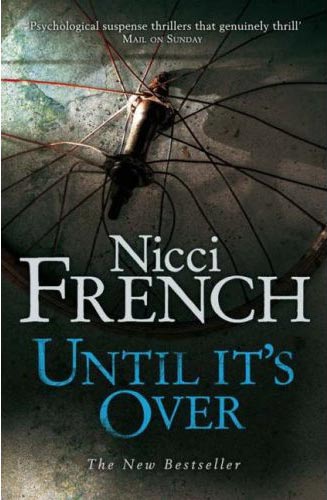
I can honestly say I’ve been a Nicci French (husband and wife team, Sean French and Nicci Gerrard) for over a decade, but I may have to quit them after reading Until It’s Over.

Astrid Bell is in her early 20s and works as a bike messenger in London. She lives in a huge house with university pals Pippa and her former boyfriend (and owner of the house) Miles. They share the space with Mick, Dario, Davy and Owen. They’re a family, in a sense.

Until It’s Over opens with an accident. Astrid is riding home from work and is almost at her house when someone opens their car door and Astrid goes flying off her bike. The woman in the car is a neighbour and she’s mortified at the accident she’s caused. Astrid is unhurt except for minor cuts and bruises. But later, the woman turns up dead. And hers is just the first murder connected to Astrid Bell.

Until It’s Over is supposed to be a mystery. About two thirds of the way through, though, the narration changes. Instead of following Astrid’s first person narration, we suddenly find ourselves in the killer’s head. I guess this was so we could understand their motivation. Um. The killer is Crazy.

Nicci French is usually such a dependable author -books that are  page turning, psychologically complex and fun. Until It’s Over was none of those things. I didn’t believe in (or care about) any of the characters. It wasn’t suspenseful. I often felt myself shaking my head in disbelief at the way characters interacted each other in a sort of oh please way.

I think if you’ve never read Nicci French – you absolutely should. But don’t read this. Read Killing Me Softly (which remains my favourite) or The Safe House.

Never Tell A Lie – Hallie Ephron

I guess I have been spoiled by Thomas H. Cook, who never fails to amaze me with his layered and intelligent mysteries. Hallie Ephron’s debut novel Never Tell A Lie, while not horrible, wasn’t all that the praise had promised.

Ivy and her handsome husband, David, are hosting a yard sale at their Victorian home. Ivy is hugely pregnant and she’s nesting like crazy, trying to rid the house of years of accumulated junk – most of which belonged to the previous owner. She is approached by a woman, Melinda, with whom she went to high school. Melinda used to play in Ivy and David’s house as a child and she asks if she can see it once more. David offers to give her a tour and Melinda disappears. Sounds pretty fishy, eh?

What follows is a by-the-numbers mystery where Ivy and David must fight to prove their innocence and everything is suspect. The plot unravels at a pretty quick pace but it’s a clunker. Puzzle pieces turn up relatively easily and lock into place without too much effort and even Ephron’ s attempts to toss the reader some plausible red herrings are only mildly diverting.

Ultimately a book like this depends on the reader’s investment in the character. Ivy isn’t unlikable; she actually manages quite well considering she’s nine months pregnant. She’s resilient and smart and figures out the mystery of Melinda’s disappearance quite handily.

I just didn’t care.

8/365

Too Close to Home – Linwood Barclay

Linwood Barclay has been compared to Harlan Coben. I’ve only read a couple Coben novels and they were okay. Too Close to Home is okay, too. But just okay.

Jim Cutter used to drive the mayor of Promise Falls around. The mayor’s a bit of an ass and Jim’s just not the kind of guy to put up with his shenanigans. Now he owns a lawn care company, but the book makes it clear that Jim’s way too smart for the job. His wife, Ellen, organizes a big literary festival for the local college, the president of which is a literary phenom- except for the youth part and the fact that he’s only written one book.  Jim and Ellen have a teenage son, Derek.

The action of Barclay’s novel starts straight away. There’s no simple way to explain it: Derek is hiding at the next door neighbour’s house when they’re all shot and killed. Instead of fessing up to being an almost-witness, he acts like he was somewhere else. Jim tries to figure out why anyone would kill the Langleys, but then comes to realize that perhaps the Langleys weren’t the intended target after all.

It’s a convoluted plot, people. Maybe consumers of this type of story like it that way and despite the fact that Barclay’s ducks do end up in a row by the conclusion, it all seemed – well –  a little silly to me.

I did like Jim Cutter, though. He isn’t perfect, that’s for sure, but he isn’t a pushover either. He is smart and tenacious and often quite funny – especially in his dealing with the smarmy mayor.

I’m not a literary snob. I like a rollicking good suspense thriller as much as the next guy who likes suspense thrillers…but Too Close to Home just didn’t quite do it for me. I have another Barclay novel on my tbr list and I’ll certainly get to it at some point…but I’m not in any hurry.


The Cloud of Unknowing – Thomas H. Cook

It was bound to happen sooner or later;  my first Cook novel to elicit a lukewarm reaction. That’s not to say it was horrible; I don’t actually think it’s possible for Thomas H. Cook to write a horrible novel. The Cloud of Unknowing was a bit of a bust for me, though.

David and Diana Sears were raised by their brilliant but schizophrenic father.  Now they are adults and they carry all the baggage from that often difficult childhood. David is a married lawyer with a teenage daughter. Diana is also married, with a young son who suffers from mental illness. We meet David as he sits in an interrogation room at the local police station. Diana’s young son, Jason,  has drowned and Diana blames her husband, Mark.  More than blames him; Diana thinks Mark has murdered their son.

The Cloud of Unknowing cleverly weaves David’s deposition  and the backstory necessary to make Diana’s story both believable and suspect. David is, as many of Cook’s protagonists are, an average man – honest and hard working.  This novel has less to do with the mystery surrounding  Jason’s death, and more to do with David’s feelings of helplessness as Diana’s fears about Mark grow and as she pulls other people into her orbit.

I can’t fault Cook’s writing. As always, I turned the pages quickly. The Cloud of Unknowing  just didn’t have either the emotional payoff or the clever twist I’ve come to expect from Cook’s novels.  My ho-hum feelings about this novel in no way undermine my deep admiration for Cook’s work. I intend to read every single one of his novels: I love him that much.

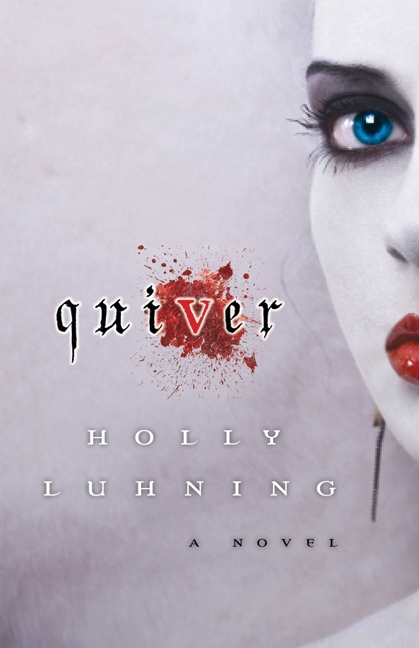
Quiver – Holly Luhning

Saskatchewan native Holly Luhning  has written a compelling novel based on the shocking life of the Hungarian Countess, Elizabeth Bathory.  Bathory, who was born in 1560, earned her shocking reputation for having tortured and killed over 600 young girls so that she might bathe in their blood and thus retain her youthful beauty.

Luhning’s novel, Quiver, is a creepy crawly book that follows Danica, a young foresnic psychologist, who has moved to London with her artist boyfriend, Henry, to work at Stowmoor, a Victorian hospital for the criminally insane. Danica’s patient is Martin Foster, a young man incarcerated for murdering a young girl as a tribute to Bathory.

Danica’s fascination with Bathory grows when a woman from her past, the  beautiful and duplicitous Maria, comes back into her life. Maria, it seems, has discovered Bathory’s private diaries and as she translates them and begins sending the horrific snippets to Danica, Danica’s life starts to shift.

We’re all, to some degree at least, train-wreck fascinated by the heart of darkness.  Danica’s morbid curiousity about Bathory (and the translated diary entries are not for the weak-stomached, believe me!) is complicated by her attraction/repulsion to Maria. Maria is impossibly beautiful and crazy-cool. I didn’t trust her at all, but I could see Danica’s attraction. There was something sinister about her and always an undercurrent of sexual attraction, too.

Quiver races along like the best thrillers, but it also has something compelling to say about art and that 15 minutes of fame so many of us seem to desperately crave.

Revenge by Mary Morris

Revenge is the story of Andrea Geller,  an artist who teaches at a small college in Hartwood. Andrea has gained some notoriety for a collection of art she once showed at a gallery in New York, but now her work has stalled.  She’s also struggling with the recent accidental death of her father. She’s having an affair with a married man.  All in all, Andrea’s a bit of a mess.

She happens to live across the street from Loretta Partlow, a highly successful novelist. Although Partlow had been required reading in high school, Andrea isn’t much of a fan until her stepmother mentions loving Partlow’s novel  What If? So Andrea revisits her work, the novels and essays on gardening and the poems. She becomes sort of obsessed with Partlow and contrives ways to bump into her.

Revenge is the rather odd story of the friendship which develops between Andrea and Loretta. Andrea enters into the relationship thinking Loretta might use her writing skills to exact a sort of revenge on her stepmother, but her scheme is only incidental to the story. Revenge is not a thriller, exactly, but you do race along its bizarre trajectory hoping for answers which never come.

That’s not to say that I didn’t like Revenge. Morris is a fine writer and I look forward to reading more of her work (and, in fact, I have Acts of God on my tbr shelf). This is, however, one of those books that seems to be promising one thing and then delivers something entirely different.

Ultimately, Morris has written a story about two rather quirky and self-centered women who need each other… until they don’t.

Instruments of Night by Thomas H. Cook

There’s a really great interview with mystery writer, Thomas H. Cook, in the September ’09 issue of January Magazine. In the article Ali Karim asks the very question that puzzles me every time I finish one of Cook’s novels. Why is this man not enormously famous? I mean, perhaps he is famous in mystery circles – but even if you’re not a fan of the genre, I think you should still give Cook a go.

I picked up Instruments of Night on Friday night and read about 30 pages. It was late when I started and so eventually my eyes gave out. On Saturday I picked it up again and didn’t put it down until I finished – with a gasp, I must add – the book.  I stumbled on Cook totally by accident three or four years back. I picked up, at a second hand bookstore, his novel Breakheart Hill and read these lines: “This is the darkest story I ever heard and all my life I have labored not to tell it.” Hooked. 

Instruments of Night is the fifth novel I’ve read by Cook. It’s the story of writer Paul Graves, a man who has spent his career writing about the horrible dance between serial killer and sadist Kessler (and his accomplice, Sykes) and the man who has spent his career chasing him, Detective Slovak. Instruments of Night operates on more than one level, though. Graves has almost completed the 14th installment of his series when he is invited to upstate New York to meet with Allison Davies, mistress of an estate known as Riverwood. Fifty years ago, Allison’s best friend, Faye, was murdered on the grounds and now Allison wants Paul to “imagine what happened to Faye. And why.”

But that’s not all. Paul Graves is a tortured man. His own past is filled with ghosts, horrible ghosts. He is a beautifully nuanced character and I particularly admired the glimpse we got into his head as a writer. Perhaps Cook was revealing a little bit about himself there, I don’t know, but Paul’s imagination allowed him to write scenes, and adjust them as needed, on the fly. Using this technique, he attempts to solve the question of who killed Faye.

The way Cook juggled the three threads of this story: the mystery of Faye’s death, the stand-off between Kessler and Slovak and the past that is creeping up on Paul is nothing short of amazing. But Cook is an accomplished writer. And this is literature. Truly. Page-turning, white-knuckling, horrifying literature. In every book I’ve read by him, I’ve been amazed at how complex his characters are and Paul is no exception.

If you haven’t read Cook yet, I beg you to give him a go. He’s fabulous!

The Bright Forever by Lee Martin

Lee Martin’s novel The Bright Forever has restored my faith in fiction. After a long drought, The Bright Forever accomplished what all good novels should: it held me spellbound. It is beautifully written, has a cast of damaged and damned characters and is almost impossible to put down.

Nine-year-old Katie Mackey goes missing one hot July night in small-town Indiana. She’s the youngest child of Patsy and Junior Mackey. Junior is a man about town; he owns the glass factory. Katie and her older brother, Gilley, are not spoiled rich kids, though – they are smart and kind.

The Bright Forever is told from the viewpoints of Gilley, Mr. Dees (the bachelor math teacher who is helping Katie improve her math skills that hot summer) and Raymond and Clare, a couple of misfits who live on the other side of town, close to Mr. Dees. Occasionally, the story drops into 3rd person omniscient, allowing us to see how the town is reacting to Katie’s disappearance. These transitions are handled effortlessly and the various voices are distinct and original. Each perspective adds to the story’s central mystery – what happened to Katie – but also allows us to see how fragile and broken these people are.

It’s clearly early on that Mr. Dees and Ray are the prime suspects in this case, but what the reader isn’t suspecting is their complicated complicity and the way their story unfolds. Suffice to say – there is more than one victim in this story.

The Bright Forever is remarkable – it moves at a suspenseful clip and yet, ultimately, it’s a tragedy.  A worthy read, indeed.

The Trade Mission by Andrew Pyper

I hate it when a book flummoxes me. I hate it when I feel outsmarted by a book, too. Andrew Pyper’s novel The Trade Mission is probably one of those books which deserves to be read twice: once for the story and once for the deeper philosophical issues that I knew were there, but which somehow eluded me. Mostly, anyway.

Jonathan Bates and Marcus Wallace are childhood friends who have become dot com millionaires for their invention of something called Hypothesys.

“We feel that Hypothesys is something that is truly going to change the way we conduct our lives,” explains Wallace to investors gathered in Brazil. “It’s not another Internet site…Hypothesys helps you make the best decisions of your life.”

Ironically, when it comes to making moral decisions with real consequences, Wallace and Bates are left to their own devices. While playing tourist on the Rio Negro, deep in the Amazonian jungle, they (and their companions Elizabeth Crossman, their interpreter; Barry, their managing partner and Lydia, their European counsel) are kidnapped by pirates. What follows is a strange combination of violence and soul searching.

The Trade Mission is narrated by Crossman and she’s in a unique position; as the only one of the party able to speak the language she can embellish or omit.  She also seems to love and hate Wallace in equal measure.  Truthfully, he isn’t particularly sympathetic. His relationship with Bates is eerily sexual and he often seems smug about his intellectual prowess. As for Crossman herself, she isn’t the most accessible of characters and I have to admit that her role, when the story finally starts to unravel, seems a bit of a cheat. The novel’s section After was too sentimental for me, especially coming after the horrors the characters experienced.

Pyper’s a terrific writer. I’m a fan. I liked his novel Lost Girls, which I read several years ago. But I remember feeling somehow unsatisfied after reading that novel, too.  The Trade Mission is billed as a ‘novel of psychological terror.’ Sure, some of it was squirm inducing, but it wasn’t a page-turner in that ‘oh my God, what’s gonna happen next’ way.

Thus the flummox. And the am I missing something. Still worth a read, though.

Dismantled by Jennifer McMahon

I was so excited to be given this book which had arrived at the bookstore where I used to work. The manager there knew I was a huge fan of McMahon’s novel Promise Not to Tell, and so she passed this along. Dismantled is the story of the Compassionate Dismantlers, four art students: Tess, Henry, Winnie and the charismatic Suz. The Compassionate Dismantlers believe that “to understand the nature of a thing you have to take it apart.” What they really believe, it seems, is that you can ruin someone’s career and set fires and manipulate lives for your own personal gain. At the end of their post-graduation summer in a cabin by the lake, Suz is dead and the remaining Dismantlers go their separate ways. Flash forward ten years. Henry and Tess are unhappily married and have a 10 year old daughter, Emma. Winnie has had her own struggles with mental illness. A simple act by Emma sets off a chain of events with far reaching consequences.

Dismantled was a big disappointment for me and it truly pains me to say that because I loved Promise Not To Tell and encouraged everyone I know to read it. For me, there was just too much going on. Was Dismantled a novel about a failing marriage, infidelity, the nature of art, childhood fears, imaginary friends, ghosts – real and imagined? Was it a mystery? Was it a ghost story? Was it a novel about revenge?

Honestly, I really struggled to finish Dismantled and only kept going because I thought maybe the end would justify the rest.  I didn’t like any of the characters and worse, I didn’t care about any of them.

Read Promise Not to Tell instead.