Crazy Beautiful – Lauren Baratz-Logsted

crazyMy arm rises toward my face and the pincer touch of cold steel rubs against my jaw.

I chose hooks because they were cheaper.

I chose hooks because I wouldn’t outgrow them so quickly.

I chose hooks so that everyone would know I was different, so I would scare even myself.

That’s Lucius Wolfe. He’s 15 and the new kid at school. He and his younger sister, Misty, and his parents had to move because Lucius got in the middle of a bomb making experiment gone wrong and blew himself — and most of his house — up. Now he’s got hooks for hands. Why was Lucius making a bomb, one might ask? Ask away — you’re not going to get any real insight from Lucius other than a vague “I was practicing to do harm, somewhere, sometime, maybe.”

I hear the dog alarm go off in the same instant I become aware of the first morning light in my room. I like rising early, like sleeping with the blinds open, because I’m scared of the dark.

In the dark, almost anything can happen.

That’s Aurora Belle. She’s 15 and also the new kid at the school. She and her father moved because Aurora’s mom had recently died of cancer and her dad thought it was time to change the scenery. Aurora is beautiful and smart and perfect…and immediately popular at school.

On the bus on the first morning  (and what are the chances, eh?) Aurora and Lucius’s eyes meet and wowza. But it’s even more than that for Lucius; he decides to become Aurora’s Gallowglass. It means ‘foreign soldier’ but to Lucius it is “the greatest personal protection service you can think of all rolled into one person.”

Aurora doesn’t really strike me as the person who actually needs protecting. She’s absorbed almost immediately into the school’s who’s who and soon thereafter wins the lead in Grease (which, unbelievably, Lucius has never even heard of).

Still, there is Jessup Tristan (and by now the names are starting to be as irritating as the characters), school douche-bag, and a couple of superficial girls and Nick Greek, the security guard who frisks Lucius after he sets off the alarm going through the school’s metal detector. It’s an embarrassing moment for Nick, but then it’s all made well when the 15 year old boy and the 22 year old security guard become fast friends and Lucius actually helps Nick reconsider his career path. I kid you not.

If Lucius didn’t have hooks for hands and a slightly suspect psyche, Crazy Beautiful would be nothing more than an adequately written YA novel.  Take away those hooks and Lucius’s raison d’etre and you’ve got…nothing. Seriously. At a mere 193 pages there’s no time to really develop the characters or their relationships.

Boy sees girl on the bus and falls instantly in love.

Girl sees boy on the bus and “there was an instant connection.”

We’re on page 28.

And what are the chances, when the plot twist comes — separating these two ‘damaged kids’ — that Aurora knows exactly what Gallowglass is?

As it turns out, pretty damn good.

Give this one a miss.
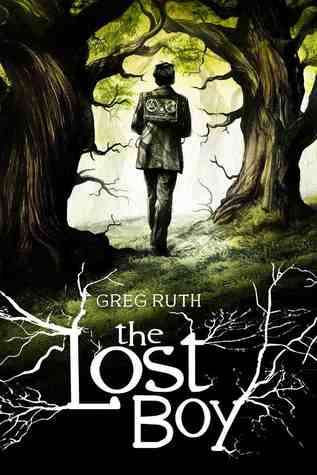


The Lost Boy – Greg Ruth

lostboyGreg Ruth has a successful career as a writer and comic book artist and has worked for Dark Horse Comics, DC/Vertigo and even illustrated Barack Obama’s picture book Our Enduring Spirit.

I saw The Lost Boy sitting on a shelf at Indigo and thought it looked and sounded interesting and as I am always on the hunt for graphic novels to add to my small but growing collection, I added it to my shopping bag.

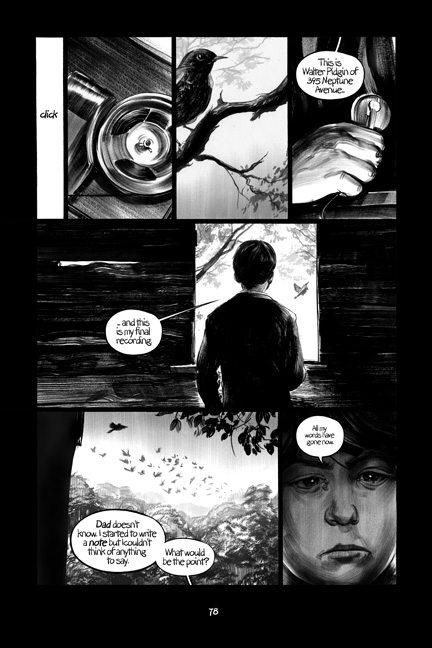
The Lost Boy is the story of Nate who moves to a new town and a new house with his parents. His father tells him that he gets to choose any room he wants and upon a desultory inspection of the rooms upstairs Nate finds an old tape recorder under a loose floor board. Even more strange, there’s a note with his name on it which simply says: Find him.

The tape recorder belongs to Walter Pidgin and when Nate presses play he hears the voice of Walter, a boy about the same age as Nate.

“These are the facts,” Walter’s voice says. “Six dogs and three cats have gone missing in the past ten weeks. The pattern is too deliberate to be coyotes.”

Walter tells his tape recorder that something ‘unnatural’ is at work in Crow’s Woods and it turns out he’s right.

lostboy2 When Nate meets Tabitha, a girl down the street, she’s able to tell him that Walter went missing many years before and when the ‘otherworld’ starts encroaching on the real worl, Nate and Tabitha decide that they need to go into the woods to find out just what happened to Walter.

I found myself getting confused by the players – and maybe that’s because there’s this complicated world which is unveiled by talking dolls and bugs. Cool, but a perhaps too convoluted for one reading. I liked the art in The Lost Boy better than I liked the story, actually – although the story had a lot of potential.

Nevertheless, a worthy and intriguing additiong to my classroom library.

The Missing Girl – Norma Fox Mazer

missing girlIt’s a total fluke that I am writing my review of Norma Fox Mazer’s last novel, The Missing Girl, on the anniversary of her death. She died on October 17, 2009 and although she was a very well-known and highly regarded young adult novelist, The Missing Girl was my introduction to her writing. In a career that spanned over 40 years, Mazer wrote over 30 books including Newbery Honor Book, After the Rain and National Book Award Finalist A Figure of Speech.

The Missing Girl is the story of the five Hebert sisters: Beauty, Mim, Faithful, Fancy and Autumn. They live with their out of work father, Poppy, and slightly air-headed mother, Blossom, in Mallory, New York.  Beauty, the eldest at 17, dreams of graduating high school and fleeing Mallory.

When she left Mallory, it would be for Chicago, which she had first heard about from Mr. Giametti, her seventh-grade language arts teacher who gre up there. She was going to a place where no one knew her, a place where she could become whoever it was she was meant to be…

The Hebert family dynamics would actually be quite enough to make The Missing Girl a compelling read, but Mazer had something else in mind.

If the man is lucky, in the morning on his way to work, he sees the girls. A flock of them, like birds.

Slight of build, stoop shouldered, wearing a gray coat, a gray scarf around his neck against the cold, his wire-rimmed glasses set firmly on his nose, minding his own business, he could be any man, any respectable, ordinary man.

But there is nothing ordinary about this man. He is watching the sisters carefully, biding his time, waiting for the perfect moment. The reader knows it’s coming. The girls are unaware. They have their own issues and petty grievances with each other. Their lives are chaotic and slightly ramshackle.

What struck me about The Missing Girl was the quality of the prose and the very authentic voices of the characters. Employing first, second and third person points of view, Mazer manages to create compelling lives for all the girls and without anything gratuitous makes their “admirer” a creepy predator.

Mazer said she came to write The Missing Girl via a series of short stories about the Hebert sisters which she wrote for various anthologies. It wasn’t until she lost her daughter to cancer in 2001, though, that she settled in to write this novel. “Her death was unbearable,” Mazer said,” “but of course I bear it. I must. Yet below the surface of my life, her loss remains unbearable and will always remain so.

“I still do not understand this fully, but it seems to me that after her death I was compelled to write about something hard, difficult – you might call it unbearable – and to name that ‘something’ with the three words that name my grief, my loss, my sorrow: the missing girl.”

Hemlock – Kathleen Peacock

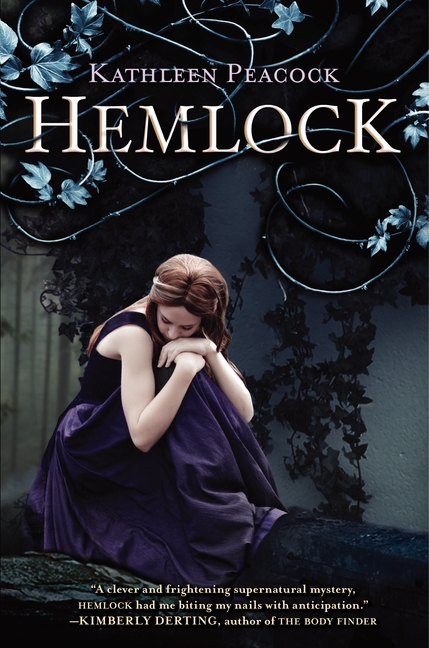
HemlockSo this rarely happens to me. The other night, after I turned my light off, I couldn’t turn my brain off and so I stared at the shapes in my room until 1 a.m.. Then I turned my light back on and raced through the final 100 or so pages of Kathleen Peacock’s debut novel, Hemlock.

Seventeen-year-old Mackenzie ‘Mac’ Dobson lives with her cousin, Tess, in the small town of Hemlock.  Her close knit circle of friends, Jason, Kyle and Amy, have recently been reduced by one: Amy was found dead in an alley, victim of a werewolf attack.

Those pesky werewolves, always maiming and eating.

Mac is suffering from very disturbing dreams brought on, she believes, by a guilty conscience. Amy had called her the night she’d died, but Mac had blown her off so she could study. But her grief and guilt are compounded by other issues: her growing feelings for her best friend, Kyle; Jason’s increasingly erratic behaviour after the death of his girlfriend, Amy, and the arrival of the Trackers, specialized werewolf hunters. On top of all this, Mac decides she is going to figure out what really happened to Amy on the night she was attacked.

There’s a lot going on in Hemlock – the town and the book. Here’s what I liked:

– I liked the fact that the whole werewolf thing just ‘is’. Werewolves exist, let’s move on. In Peacock’s version of the lore, anyone  who is scratched or bitten by a werewolf (at least those that survive the attack) become infected with lupine syndrome. Those people are captured – where it is possible to find them – and sent to rehabilitation camps. (I immediately thought of the Nazis rounding up the Jews and whether this comparison was Peacock’s intention or not, it actually works on all sorts of levels.)

– I also liked how there were werewolf supporters, sort of a ‘live and let live’ faction, which means that anyone who shares this view is also in danger of persecution, thus upping the stakes for a whole bunch of other characters. Mac is decidedly on the fence about this issue:

…I knew not all werewolves were good. Some of them did attack and kill people. And one of them had killed Amy. But Charles Manson, the kids from Columbine, that guy with the Kool-Aid – regs did horrible things to each other, too.

– I liked how propulsive the narrative was. I think Peacock really excelled at moving things along, especially when it came to fight scenes, or scenes where the wolves transformed from human to wolf.

– I liked Peacock’s sense of humour. Sometimes the dialogue made me chuckle.

But here’s my problem. Werewolves.

werewolf2I have no problem with fantasy worlds built around creatures of the night. I have a healthy imaginary life which involves virile vampires. Trust me, I get it. But I don’t get werewolves. There’s nothing sexy about them. Or particularly sympathetic, even. (Yeah, I know, they didn’t ask for this life.)

I was invested in Mac’s quest to find out the truth about Amy. I was less invested in her love triangle, a sort of Bella, Edward, Jacob thing. There was something contrived about it that just didn’t work for me. Bottom line: I didn’t care about them. Jason’s a douche. Kyle is in full-on push pull mode. Both have their reasons; all will be revealed, but I never settled into a space where I wanted her to be with either particularly and that’s a problem in a paranormal romance.

And I felt like there was perhaps a tad too much going on in the opening book of a trilogy. Love. Duplicity. Politics. Family issues. Murder and Werewolves. All the pieces click together neatly by the end though and will leave fans howling for Hemlock‘s sequel. Thornhill.

thornhillI have had the pleasure of ‘meeting’ Kathleen Peacock – virtually. She graciously agreed to speak to students at last year’s Write Stuff workshop. We linked Kathleen via the Internet and had Riel Nason, author of The Town That Drowned with us at the venue and both authors talked to the participants about the perils and rewards of writing. It was really exciting for me and for the students, too. How often do you get to talk to published writers? Kathleen is funny and smart and honest in person – well, you know what I mean. She’s also geeky, which appeals to me. I predict she has a long and successful writing career ahead of her.

Anna Dressed in Blood – Kendare Blake

Anna Dressed in Blood[1]I love the cover of Kendare Blake’s YA novel Anna Dressed in Blood. And I loved the first 200 or so pages of the book, too. And then – not so much. Of course, the first clue that things might have the potential to go south was Cassandra Clare’s ringing endorsement. But okay – I was ultimately willing to overlook that. The plot fell apart for me…and the characters…and it just felt like a hot mess by the end.

But in the beginning…

Cassio ‘Cas’ Theseus Lowood kills the dead. He’s got this cool athame (a double-edged daggar) and his dead father’s blood connection to these things that go bump in the night. Cas and his mother (who sells occult supplies on the net) travel from place to place so that Cas can put the dead to rest.  Cas is just 17 but he’s already “seen just about every variety of spook and specter you can imagine.”

Cas and his mother are en route to Thunder Bay, Ontario where the particularly vicious ghost of sixteen-year-old Anna Korlov ‘lives’ in a crumbling Victorian house. Anna’d had her throat slashed on her way to a school dance in 1958 and now she’s been known to haunt her house, wearing the white dress she’d had made for the dance only now covered in blood – hence the name ‘Anna dressed in blood’.

Cas is uneasy about this one from the start, but other things don’t go his way either. First of all – he’s usually able to fly under the radar, but not in Thunder Bay – where he quickly makes friends (and enemies) which necessitates him ‘coming out’ about his ‘calling.’ Sound familiar. Don’t worry – the one-girl-in-all-the-world ‘s name will be dropped before it’s all over.

Blake does create some creepy-crawly fun

Her feet drag horribly along like she can’t use them at all. Dark, purplish veins cut through her pale white skin. Her hair is shadowless black, and it moves through the air as though suspended in water, snaking out behind and drifting like reeds. It’s the only thing about her that looks alive.

She doesn’t wear her death wounds like other ghosts do. They say her throat was cut, and this girl’s throat is long and white. But there is the dress. It’s wet, and red, and constantly moving. It drips onto the ground.

Blake has set herself a difficult task; she has to make Anna both menacing and sympathetic and I think she manages, for the most part. That success comes, partly, from the fact that Cas is a likeable narrator: smart and  resilient. Since we see Anna through Cas’s eyes, we can empathize with her story – which is told via a brief seance-like flashback. Blake had my full attention up until then because that’s about when Cas starts to realize that his feelings for Anna aren’t strictly professional.

And then the kissing starts and – um – how do you kiss a ghost? I would have much preferred a heaping helping of angst to go along with my horror.

Blake further complicates the story with the introduction of the creature who had killed (aka eaten) his father and then the story just sort of falls apart…leading us to the inevitable sequel.

The ingredients for a terrific novel are all here. Blake’s writing is propulsive and straight forward. I think there’s just too much going on: a Dean Winchester-esque hero, wannabe Scoobies, a family friend who sounds suspiciously like Rupert Giles, ghosts aplenty, and a star-crossed love affair that isn’t quite believable.

Too bad – there was so much early potential.


Paper Towns – John Green (with a shout out to John Hughes)

If you are a person of a certain age, you probably have fond memories of John Hughes’ films. Even though I was already in my early 20’s when he started producing arguably the best teen movies ever – I was still young enough to see myself in the characters he committed to celluloid.

Sixteen Candles is my all-time favourite Hughes film, for reasons which will be apparent to anyone who has ever seen the film. I still watch it occasionally and it still makes me laugh and it breaks my heart a little now that Hughes has died.

Yes, you can argue that Jake Ryan isn’t perfect – he did let an underage, unlicensed driver take his very drunk girlfriend home in his father’s Mercedes, but it was the 80’s and, come on,  Jake Ryan is pretty damn dreamy. Also, who didn’t see some part of themselves in the other characters on the screen: Molly Ringwald’s slightly awkward Samantha Baker, Anthony Michael Hall’s loveable dork. Everyone you ever went to high school with is lovingly represented in this flick and in Hughes’ other teen masterpieces, Pretty in Pink, The Breakfast Club,  and Ferris Bueller’s Day Off. 

I would posit that John Green is this generation’s John Hughes and I hope Mr. Green will consider that a compliment because it is certainly meant as one.

Last year because everyone and their dog was reading The Fault in Our Stars I did, too. That was a reading experience I will never forget – curled in the fetal position on my bed at 2 a.m., laughing then crying, then laughing again. That is the experience I want my students to have.

PaperTowns2009_6AThe only other John Green book I have in my classroom library is Paper Towns and I just finished it yesterday. (Trust me, I’ll be rectifying the lack of Green books post-haste.) Paper Towns received rave reviews and the Edgar Award (a prize awarded by the Mystery Writers of America) and it’s totally deserving of both.

Quentin Jacobsen is just weeks away from graduating from high school when his next door neighbour Margo Roth Spiegelman shows up at his window in the middle of the night. Although Quentin and Margo had been childhood friends, they’d drifted apart as they’d gotten older and now, in Quentin’s eyes at least, Margo is this exotic and beautiful creature, but not necessarily his friend.

Margo Roth Spiegelman, whose six-syllable name was often spoken in its entirety with a kind of quiet reverence. Margo Roth Spiegelman, whose stories of epic adventures would blow through school like a summer storm: an old guy living in a broken-down house in Hot Coffee, Mississippi, taught Margo how to play guitar. Margo Roth Spiegelman, who spent three days traveling with the circus – they thought she had potential on the trapeze.

The stories, when they were shared, inevitably ended with, I mean, can you believe it? We often could not, but they always proved true.

Quentin’s best friend, Ben, describes Margo as “the kind of person who either dies tragically at twenty-seven, like Jimi Hendrix and Janis Joplin, or else grows up to win, like, the first-ever Nobel Prize for Awesome.”

Anyway, Margo needs Quentin’s help. She also assures him that this will be the best night of his life. Quentin is a guy who generally plays by the rules, so his decision to help Margo is slightly out of character for him. Nevertheless, he helps Margo carry out a list of tasks, some of them vengeful and some of them contemplative and he is indeed changed by the experience. Which is why when Margo suddenly disappears, he is compelled to follow the breadcrumb trail of clues she’s left behind.

Paper Towns is a clever mystery for sure, but that’s not the only reason to admire the heck out of it. What I love about John Green is the way he writes dialogue. His characters are smart and funny and honest-to-goodness people. In the same way that John Hughes made his characters painfully awkward or awesome or self-deprecating or ironic, Green’s teens are whole and fragile and super smart and laugh-out-loud funny.

And they think thinky-thoughts. The fact that Paper Towns is set in Orlando, Florida (John Green’s hometown) is significant. Margo says “you can see how fake it is…It’s a paper town. I mean, look at it Q: look at all those cul-de-sacs, those streets that turn in on themselves, all the houses that were built to fall apart.”

Quentin’s journey to find Margo makes him question not only everything he thought he knew about her, but also everything he believes about himself and Green does a great service to his characters (and the young adults who will be reading this book) by not giving us pat answers.

So – read John Green. Watch John Hughes. Through their eyes you’ll see teenagers at their worst…and their best. And it’s all beautiful.

Story of a Girl – Sara Zarr

storyofagirlSara Zarr’s debut novel Story of a Girl kept me turning the pages far past my bedtime – a sure indicator of its quality. I read before bed and most nights I’m lucky if I manage a couple dozen pages, but last night I settled in early and once I started, I couldn’t stop.

Story of a Girl begins with sixteen-year-old Deanna Lambert’s admission that she “was thirteen when my dad caught me with Tommy Webber in the back of Tommy’s Buick, parked next to the old Chart House down in Montara at eleven o’clock on a Tuesday night. Tommy was seventeen and the supposed friend of my brother, Darren. I didn’t love him. I’m not even sure I liked him.”

Deanna had been parking with Tommy for a year before she’s finally caught, but her dad’s discovery of her in a compromising position casts the reality of her life in a harsh light. Now her dad can barely look at her. And when the novel opens, at the end of sophomore year (that’s grade ten here in Canada), it’s clear that the story of her tryst with Tommy is still the topic du jour in her small hometown of Pacifica, a sea-side suburb of San Francisco. At least pretty much everyone at Deanna’s high school knows about it – or some version of it. The only people who don’t care are her two best friends: Jason, a boy she’s known forever and Lee, a girl who moved to Pacifica after the incident.

Story of a Girl takes place during the summer between sophomore and junior year. Deanna’s strained relationship with her dad causes her to daydream about leaving home and living with her older brother Darren, his girlfriend, Stacy and their infant daughter, April. Currently they live in the basement. Stacy and Deanna’s dad don’t get along. In fact, Deanna’s household is pretty dysfunctional and so Deanna quickly finds work at a local pizza dive…where, it turns out, Tommy also works.

What I loved about this book was how realistic it seemed. Everyone judges Deanna for a decision she made when she was thirteen, but it isn’t until she comes into contact with Tommy again that she figures out why she always went off with him. And forgiving him – and herself – also allows her to empathize with her father.

…I imagined us through his eyes – his family, sitting in a pink kitchen: his tired wife, who never complained; his son who looked exactly like him; his daughter, who used to be the baby, his baby girl; and now April, his grand-daughter, who had a whole life in front of her, with no real mistakes in it yet. Could he look at us someday, I wondered, maybe today, and not be disappointed? Could he see us, and himself, for who we really were?

Story of a Girl is a beautiful book because, although it is Deanna’s story, no one’s life is lived in isolation. This is a book about family – the family given to us by  biology and the family we choose. The path to adulthood is thorny and it’s good to have some people who are on your side.  There are no villains in this book. Even Tommy, douche that he is, is probably trying to fill in the gaps in his own life. The thing is, we carry our mistakes with us and as Deanna’s boss at the pizza place, Michael, tells her: “…don’t mistake a new place for a new you.”

Big love for this book.

Never Fall Down – Patricia McCormick

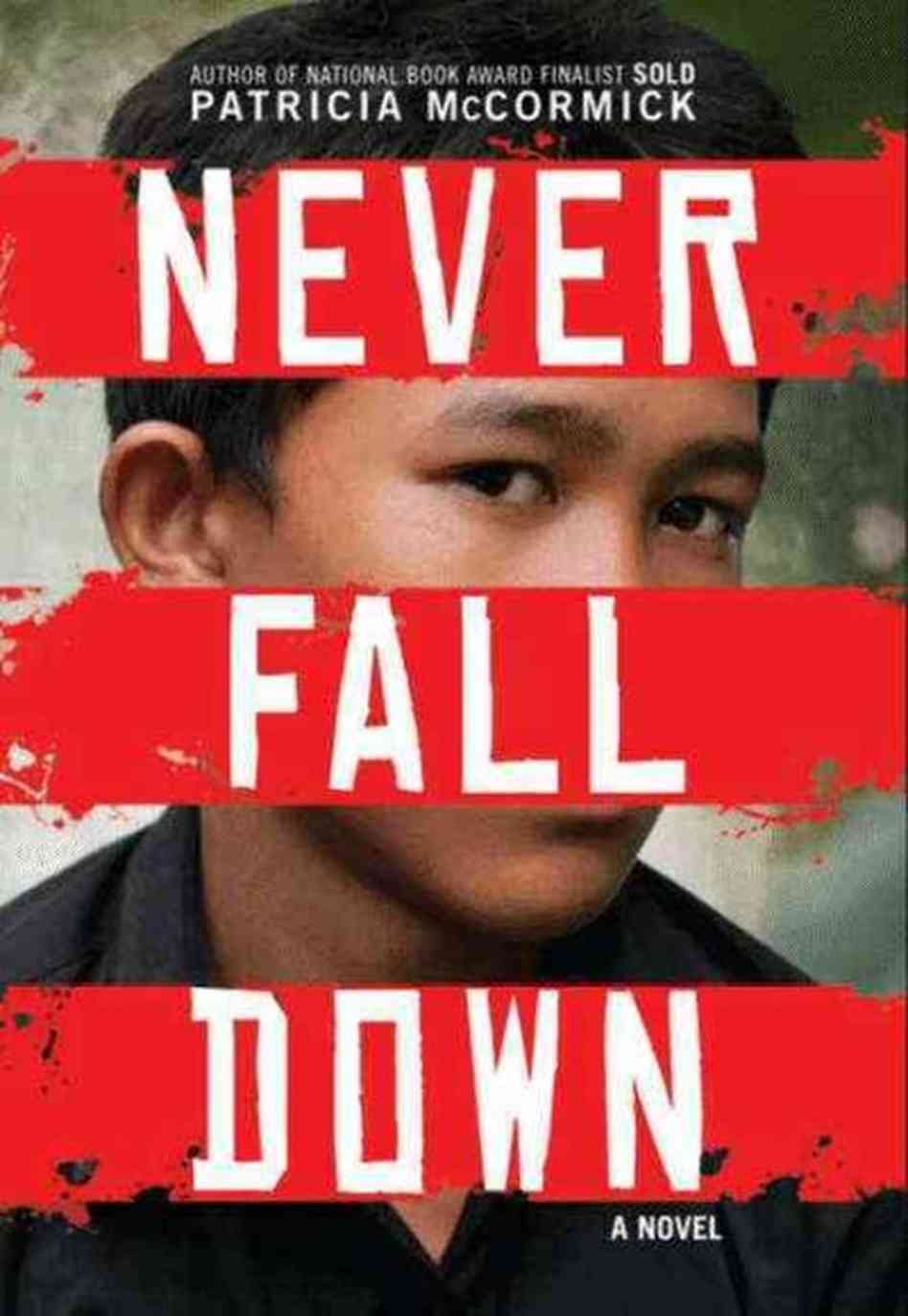
neverfalldown Arn Chorn-Pond, the young narrator of Patricia McCormick’s novel Never Fall Down, finally escapes Cambodia and  makes it to the safety of Thailand sometime in the spring of 1979.  At the very same time, I was getting ready to graduate from high school. I knew nothing of the Khmer Rouge and their violence – or if I did, I don’t remember. Reading Arn’s story has reminded me again of the priviledged life I’ve lead and of the absolute power of literature to crack open the insulated world in which we often live.

Arn is just eleven when the Khmer Rouge, a radical Communist regime, and an offshoot of the Vietnam People’s Army, sweeps through Cambodia displacing people and separating families. Arn has lived a relatively happy life up until then. He says, “At night in our town, it’s music everywhere. Rich house. Poor house. Doesn’t matter. Everyone has music.”

When the army blows through town, it’s exciting. Arn says, “…I think this is the most exciting thing to happen here. Real Americans coming. Real airplane.” But that excitement doesn’t last. Soon Arn, his aunt and his siblings (four sisters and one brother) are marching out of town with everyone else. And then the real horror begins.

And this book is horrific.

McCormick spent two years interviewing Arn and then  made the choice to tell his story as a novel because “like all trauma survivors, Arn can recall certain experiences in chilling detail; others he can only tell in vague generalities.”  It’s no wonder his mind has decided to compartmentalize; the atrocities he’s witnessed are almost unbearable.

But Arn does bear them. He survives the separation from his family, the endless work in the rice fields, the starvation, illness, walking miles and miles through the heat. He makes himself indespensible by learning to play an instrument, but even that doesn’t save him from witnessing the Khmer Rouge’s atrocities against men, women and children.

And then, even more horrible, Arn suddenly finds himself with a gun in his hand, fighting with the very people who have held him captive for more than three years. Never Fall Down is a survival story because Arn surely does that.

McCormick makes the decision to tell this story in Arn’s distinctive sing-song voice and it’s a wise choice. We see everything though his eyes and he is a truthful and unflinching narrator.

One night the girl next to me at dinner, she dies. She dies just sitting there. No sound. Just no breathing anymore. All of us, we eat so fast, no one even see this girl. Very quick, I take her bowl of rice and keep eating.

I guess we can never really know what we’re capable of until we are put in the situation where our limits might be tested. Arn was a remarkable boy and he has turned into a remarkable man, a champion for humanitarian causes around the world and the winner of many international prizes. Never Fall Down is a must read book.

This video explains  what happened during that period.

I also highly recommend the movie, The Killing Fields.

Endangered – Eliot Schrefer

endangeredWhen my 14-year-old son saw that I was reading Eliot Schrefer’s novel Endangered he rolled his eyes and said, “Mom, our teacher tried to read us that book last year and no one liked it – not even her.” Connor is a voracious reader and we have often read and enjoyed the same books so I have to admit that I was skeptical as I started this book.

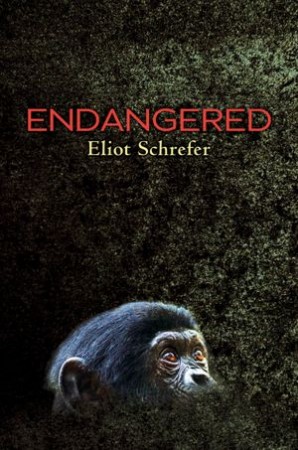
Fourteen-year-old Sophie is visiting her mother in the Democratic Republic of the Congo (DRC). Her parents  are divorced and she has been living with her father in Miami since she was eight, but it’s the summer holidays and so she is visiting with her mom at the bonobo sanctuary her mother runs in Kinshasa. Bonobos are a member of the ape family and they are endangered. Bonobos, as it turns out, are our closest relatives, “sharing over 98.7 percent of our DNA.” Adult bonobos are often killed for food; babies are kidnapped and sold on the black market. It is just such an encounter that starts Sophie’s story.

The little ape sat down tiredly in the dirt and lowered his arms, wincing as his sore muscles relaxed. I kneeled and reached out to him. The bonobo glanced at his master before working up the energy to stand and toddle over to me. He leaned against my shin for a moment, then extended his arms to be picked up. I lifted him easily and he hugged himself to me, his fragile arms as light as a necklace.

Sophie’s mother is none-too-happy when her daughter arrives at the sanctuary with the bonobo. Not because Sophie rescued the bonobo, but because she didn’t follow the proper protocol and that could cause more trouble down the road. But Sophie has fallen in love with the little bonobo she names Otto and their relationship sustains them through the difficult times ahead.

In the beginning I found Endangered a little didactic. Admittedly, I knew nothing about bonobos and even less about the scary situation in the DRC, but the way the information was relayed to the reader – via Sophie – just didn’t feel organic. Thankfully, Schrefer didn’t spend a lot of time instructing us.  When the Congo’s president is assassinated and rebels flood into the area Sophie’s peaceful existence at the sanctuary crumbles.  That’s when things get really interesting.

Sophie is a remarkably resilient character. Despite the fact that she has been leading a relatively privileged life in the States for the past six years, she hasn’t forgotten where she came from. As she and Otto travel through the jungle and up the Congo river to find her mother (who had left just before the coup to take some bonobos to an island release site), my heart was really racing. I mean, this war (despite being fictional) is based on decades of bloody conflict and although Schrefer stays away from the truly graphic, one only has to use their imagination to imagine the atrocities Sophie and Otto encounter on their way.

And don’t even get me started on the subject of Sophie’s bond with Otto. If even half of what transpires between them is true, bonobos are beyond remarkable; they’re us.

Con, honey, I respectfully disagree with your assessment of this book.

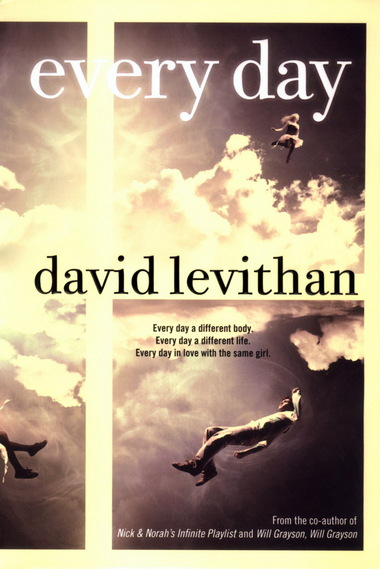
Every Day – David Levithan

16BLEVITHANWhat if every day you woke up in someone else’s body? You are you, but also them; you have access to their memories, but also retain your own. This is A’s predicament in David Levithan’s clever and emotionally resonant YA novel, Every Day.

I don’t know how this works. Or why. I stopped trying to figure it out a long time ago. I’m never going to figure it out, any more than a normal person will figure out his or her own existance. After a while, you have to be at peace with the fact that you simply are. There is no way to know why.

Dispensing with the prickly question of how this works (or doesn’t) early on, Levithan dumps the reader into A’s life on Day 5994. He is 16.  Today he is in Justin’s body.  Justin’s not a particularly likeable guy and A figures that out pretty quickly. He admits: “I know I am not going to like today.”

A’s ability to access information from each person he inhabits allows him to live each day with relative ease, plus he always has an escape hatch because he knows that he will wake up as someone else the next day. Even if he wakes up in the body of an idiot, he knows it’s not forever.  Justin is a bit of an idiot and that wouldn’t be such a big deal if it weren’t for Rhiannon. She’s Justin’s girlfriend.

…there’s something about her – the cities on her shoes, the flash of bravery, the unnecessary sadness – that makes me want to know what the word will be when it stops being a sound. I have spent years meeting people without ever knowing them, and on this morning, in this place, with this girl, I feel the faintest pull of wanting to know. And in a moment of either weakness or bravery on my own part, I decide to follow it. I decide to find out more.

Thus begins A’s relationship with Rhiannon. And as you might imagine, there’s nothing typical about it. There’s nothing typical about Every Day period.

A has spent his entire existence trying to keep himself separate from the person whose body he inhabits. His feelings for Rhiannon complicate his life in ways too numerous to mention; suffice it to say that every day becomes a challenge to see her, but first he somehow has to convince her of the truth of his strange reality.

In one sense, Every Day works as a terrific page-turner: will A and Rhiannon find a way to be together despite their terrific obstacles? After all one day A could be in the body of a hunky football player and the next he could be an overweight teenage girl. Will Rhiannon love him back despite his outward appearance? What is love anyway?

But I think this novel also works hard to be something more and in that way I think it will probably speak to teenagers everywhere. It allows us to inhabit the bodies of confident, beautiful teens and also depressed teens who wish themselves harm. We hang with straight teens and gay teens, teens with parents who smother them and parents who trust them. Each scenario allows Levithan the opportunity to show the reader his tremendous capacity for empathy. And it also allows us to see A  – despite his lack of corpreal form – as the embodiment of what it means to be human.