The Savage Garden – Mark Mills

savagegardenIt’s 1958 and 22-year-old British student Adam Strickland has been given the opportunity to study a Renaissance garden at the Villa Docci in Tuscany. Of course, he jumps at the chance. Signora Docci will soon be leaving her home in the care of her son, Maurizio, but until she goes she knows the garden has some secrets to give up.

Mark Mills’ historical mystery The Savage Garden is a slow, thoughtful and complex puzzle of a book that begs you to pay attention. Adam arrives in Tuscany and “In almost no time he had fallen under Villa Docci’s spell.” The garden in question was built as a memorial to Flora Bonfadio. Her husband Frederico Docci had built the estate and then added the garden after her premature death at just 25.

The memorial garden at Villa Docci sat firmly within this tradition, and although it couldn’t match its eminent counterparts at Villa di Castello, Villa Gamberaia and Villa Campi for sheer size and grandiosity, it stood out for its human dimensions, its purity of purpose, the haunting message of love and loss enshrined in its buildings, inscriptions, and groupings of statues buried in the woods.

It is hard not to be caught up in Adam’s story, especially if you have spent any time at all in Italy. Interactions with the locals and with Signora Docci’s family, including her lovely granddaughter, Antonella, offer Adam both distraction and cause for concern: not all the pieces of the family’s history quite add up.

Although The Savage Garden isn’t a ‘page-turner’ in the strictest sense of the word (the novel’s pace is relatively slow and the nods to Greek mythology and Italian history were probably mostly lost on me), I still felt wholly invested in Adam’s story. Signora Docci is delightful and I enjoyed their relationship. I also really liked Adam’s older brother, Harry. He’s a sort of irreverent character, someone at odds with Adam’s more scholarly personality and while Harry certainly seems to rub Adam the wrong way, his arrival in Italy breathes fresh air into Adam’s hot and insular  life. There are two mysteries at Villa Docci, and Adam is keen on solving them both.

It’s  worth the effort to tag along.


My Husband’s Wife – Jane Corry

By the time I got to page 100 of Jane Corry’s debut novel My Husband’s Wife, I felt like it myhusbandswifewas too late to abandon it even though I didn’t like any of the characters. I just don’t get why this book garnered so much praise. Geesh, Parade even compared it to Gone Girl! 

Lily is a brand new solicitor in London. She’s also newly married to Ed, an artist. Theirs was a whirlwind romance, and I am not joking. They married about two weeks after meeting. Lily has some dark secrets in her past, though, and she is hoping that this marriage will help her move on.

Her first professional job is to meet with Joe, a guy serving time for scalding his girlfriend to death. Yes, you heard that correct. Joe is an odd man, but Lily finds herself strangely attracted to him.

Then there’s Carla, a nine-year-old, who lives with her single mother. They are Italian, which is apparently cause for much ridicule…in London…in 2000. Carla is picked on mercilessly by the other kids, has no friends and is not even cared for by the teachers at her school. She is a strange child, no question. Her path crosses with Lily’s because they live in the same apartment complex. Soon Lily and Ed are looking after Carla when Carla’s mother is “working” (code for meeting her married lover).

One of the issues I had with My Husband’s Wifeis that there is SO much going on. There’s Joe’s case. There’s Carla’s sad little life. There’s Lily’s precarious marriage to Ed. There’s her secret past.  And then the novel flashes forward twelve years.

Carla returns to London from Italy where she’s been living with her mother and grandparents. She is bent on revenge for some imagined slight. She reconnects with Lily and Ed; she thinks she is owed a great deal of money because of a painting Ed did of her as a child. Lily and Ed now have a son, Tom, but he has Asperger’s and is too difficult to handle, so they’ve shipped him off to live with Lily’s parents in Devon. Lily is now a well-respected lawyer because of what happened with Joe. Her marriage, however, is less successful. And she still has her dark secrets.

It’s not that I couldn’t keep up with all the plot’s machinations, it’s more like I just didn’t care about them and that has less to do with the plot points and more to do with the characters. Not a single one of these people were sympathetic (perhaps with the exception of Lily’s parents) or even all that believable.  I felt like I was being told a story, rather than experiencing events as they unfolded.

Just a huge disappointment…and yet I did finish it, so I guess that’s something. And I suspect I am in a very small minority of readers who didn’t like this book.

The Window – Amelia Brunskill

Amelia Brunskill’s YA novel The Window follows teenage narrator Jess as she tries towindow come to terms with the unexpected death of her twin sister, Anna. Although the sisters were identical, they were also complete opposites. Anna was outgoing and popular; Jess is solitary and, some might say, a bit strange.

Anna’s body is discovered by her mother “underneath her window: eyes closed, not moving.” The police determine that she’d been sneaking out and fallen to her death accidentally.  But none of that makes sense to Jess who recalls that night

Had Anna seemed upset? I didn’t think so. If anything, she’d seemed calmer than she’d been in a while, more peaceful. Happy, almost shining with it, like she had a secret. A good one.

Anna’s death pushes Jess way out of her comfort zone. She’s aware that she’s not necessarily like other teens and notes “My parents used to think there was something wrong with me.” Numerous visits to doctors, and not the kind who checked her physical health, don’t yield any answers, at least not to the reader. It does make Jess an unreliable narrator, which suits this story quite well because she just doesn’t understand where her sister was going and why she didn’t know about it. These are girls who used to share everything, or at least that’s what Jess thought.

…I thought I’d understood her too. Thought I’d known everything about her. But I kept going back to the policeman’s questions: if she’d seemed upset recently, if she’d had a boyfriend. I’d said no to both, without even thinking I could be wrong.

Brunskill’s story is a mystery the builds steam as it goes along. There’s a former best friend who moves away and won’t talk to Jess; there’s a suspicious relationship with a authority figure; there’s whispered rumours; there’s a recovered phone. As Jess becomes more certain that Anna’s fall is part of a bigger story, she also slowly starts crawling out of her social shell. Perhaps it’s because she’s playing Nancy Drew, but she does make friends along the way.

The Window is a clever novel about the damage of secrets and family. It’s well-written and would certainly appeal to readers who enjoy a strong female protagonist, and a few well-placed twists and turns.

The Roanoke Girls – Amy Engel

Sometimes I can’t resist the three for $10 bargains at Indigo. Just because a book finds its way onto the bargain shelves doesn’t mean it’s a dud. Case in point: My Sunshine Away  I managed to snag a handful of bargain copies for my classroom library and I was thrilled to be able to offer it as a choice for my grade 12 students this year. That is an amazing book.

RoanokeAnd then there’s The Roanoke Girlsby Amy Engel. Can’t remember when I bought it or how long it’s been languishing on my tbr shelf, but I started reading it and finished reading it in just a few hours because it has ALL THE THINGS I love in a book.  (Lots of other reviewers loved all the things, too, because this book received lots of well-deserved praise.)

Lane Roanoke is fifteen when a terrible tragedy brings her to small-town Kansas to live with her grandparents, Yates and Lillian, and her cousin, Allegra, who is also fifteen.  She knows very little about these people. Her mother left the family home as a teenager and never returned because her life there was a “nightmare.”

Lane is mesmerized by the family home

Roanoke had clearly started out as something resembling a traditional farmhouse – white clapboard, wraparound porch, peaked dormers. But someone had tacked on crazy additions over the years, a brick turret on one side, what looked like an entirely new stone house extending from the back, more white clapboard, newer and higher on the other side. It was like a handful of giant houses all smashed together with no regard for aesthetics or conformity. It was equal parts horrifying and mesmerizing.

The house is symbolic of the labyrinthine Roanoke secrets.

Her cousin Allegra is alternately  moody and loving, and Lane is never quite sure which version she’s going to get. Her grandmother is mostly distant. Her grandfather “was fiercely handsome. …If charisma was power, my grandfather was king.”

The Roanoke family has a long history of loss. Yates’s two sisters are gone, so are his daughters. Until Lane returns to Kansas, Allegra has been the only Roanoke girl. It is a special designation, Lane comes to discover.

The novel toggles back and forth between ‘Then’ (Lane’s fifteenth summer) and ‘Now’, which happens eleven years later when Lane gets the call that Allegra is missing. Yates begs Lane to return to Roanoke. Despite her reservations, the pull of family is strong and Lane finds herself back in Kansas. Her return puts her back in contact with Tommy, Allegra’s on again – off again teenage boyfriend, now a cop, and Cooper, “still the most beautiful person” Lane has ever seen. It’s a toxic mix and makes for absolutely riveting reading.

What happened to Allegra? What happened to all the Roanoke girls? That’s the central mystery in the book. Actually, you’ll learn  the what pretty early on and it’s an explosive family secret.

This book had all the things I loved: great writing, a compelling main character who is damaged, but fierce and smart, a never-ending air of menace and unease, a hot, broken guy and a lot of twists.

LOVED it.


The Family Upstairs – Lisa Jewell

familyupstairsJust when I thought nothing was going to really distract me from this Covid-19 craziness, I dove into Lisa Jewell’s novel The Family Upstairs. I am a Jewell fan to begin with and I usually have a couple unread books by her on my shelf…you know, in case of a reading emergency. I think this pandemic qualifies and, Holy Smokes, did this book ever deliver.

There are three separate narratives in this novel. There’s Libby, a twenty-five-year-old kitchen designer who lives in St. Albans, a commuter suburb just north of London. On her birthday, she receives notice that she has inherited a house in Chelsea, an extremely desirable London neighbourhood. (And by desirable I mean the house is worth millions…of pounds.) The thing is, the house comes with some baggage…including three dead bodies.

That’s Henry Lamb’s story to tell. He grew up in that house with his parents and younger sister. His father was “the sole beneficiary of his own father’s fortune” and his mother was “a rare beauty.” When Henry is eleven and his sister nine, their lives begin to unravel. First of all, Mr. Lamb has squandered the family fortune and then Birdie Dunlop-Evers and her partner, Justin,  arrive.

It all happened so slowly, yet so extraordinarily quickly, the change to our parents, to our home, to our lives after they arrived. But that first night, when Birdie appeared on our front step with two large suitcases and a cat in a wicker box, we could have never guessed the impact she would have, the other people she would bring into our lives, that it would all end the way it did.

The third story belongs to Lucy, a woman we meet in Cote d’Azure where she is living rough with her two young children, Marco and Stella. With no money, and no passport, Lucy must make a difficult choice to protect her children and save herself.

What do these three very distinct and separate stories have to do with each other? Obviously I am not going to tell you, but let’s just say this…I literally could NOT put this book down. Jewell’s trademark is writing twisty plots filled with secrets dying to be revealed. The added bonus is that she’s a great writer and her characters are always believable. Sometimes with books that depend on plot twists, characters get short shrift. Not when Jewell writes them. I happily followed the three separate story threads, trying to race ahead to see if I could figure out how they all belonged together.

The Family Upstairs has everything I love in a book: great writing, an unreliable narrator, sinister characters, secrets galore and a not-too-tidy ending. Story perfection – pandemic or not.

Highly recommended.

Where the Crawdads Sing – Delia Owens

Delia Owens’s debut novel Where the Crawdads Sing has the distinction of being the where+the+crawdads+singbook we discussed at my book club’s first ever virtual meeting. It was chosen for our March meeting, but of course those plans were canceled due to Covid 19. I had started the book and then put it aside. When we decided to meet virtually, I picked up the book again and read it straight through. It’s kinda un-put-downable.

The novel opens in 1969 with the death of Chase Andrews beloved son of one of the town’s most influential families, and although this death (was there foul play?) is significant, this is really Kya’s story, which begins in 1952.

Kya Clark is the ‘Marsh Girl’. She lives in a rundown shack outside of Barkley Cove, a small town on North Carolina’s coast. Kya, just six when the novel opens, lives with her older siblings and her parents. Hers is a life filled with the wonders of the natural world, a joy she shares with her brother Jodie, who is 13. One day “she saw her mother in a long brown skirt, kick pleats nipping at her ankles, as she walked down the sandy lane in high heels.” Her mother has left the marsh before “But she never wore gator heels, never took a case.”  Her mother doesn’t return, and “over the next few weeks, Kya’s oldest brother and two sisters drifted away too, as if by example.”  Then Jodie, her closest companion, unable to endure their father’s drunken rages any longer, leaves, too.

From a very young age, out of necessity, she learns how to live in harmony with the world around her and the isolation doesn’t bother her until one day she meets Tate Walker out on the water. Tate proves to be a balm to her loneliness and over the years, as he teaches Kya to read and they explore the coastline, they fall in love. Even though it might not seem realistic because Kya lives alone in a shack without running water or electricity – she is, in fact, a wild child in every sense of the world – it’s actually a relationship that makes sense. Tate, too, cares deeply about the natural world, and sincerely cares about Kya.

Kya proves herself to be a resilient, resourceful and incredibly sympathetic character. Owens takes her time with Kya, allowing us to understand her life. Tate, too, is well drawn. Chase is little more than a caricature, which I suppose doesn’t really matter in the whole scheme of things.

Owens writes beautifully about the natural world, which makes sense considering she is a wildlife scientist. It’s impossible not to be totally immersed in Kya’s secret world. Kya understands that “Marsh is not swamp. Marsh is a space of light, where grass grows in water, and water flows into the sky.” Her observations about nature and her place in it are downright beautiful.

Some readers will likely be thrilled by the novel’s final twist. I wasn’t so fussy about it, but who cares, really. There’s a reason everyone and their dog has been talking about this novel. It’s pretty damn awesome.

Highly recommended.


Allegedly – Tiffany D. Jackson

allegedlyFifteen-year-old Mary, the protagonist of Tiffany D. Jackson’s debut YA novel Allegedly, lives in a group home in Brooklyn. She has a tracking device on her ankle, no friends except for her boyfriend, Ted, and a reputation for being ‘psycho.’ How did she earn that reputation? When Mary was nine she killed a three-month-old baby named Alyssa who was in Mary’s mother’s care. Well, she allegedly killed Alyssa.

Everyone in the house knows what I did. Or thinks they know what I did. No one asks though, because no one really wants to hear how I killed a baby. They don’t even want to know why I killed a baby. They just want to pretend they know for knowing’s sake.

Before she came to live in the group home, she was in a state facility with adults. She was mostly mute and mostly locked up in solitary confinement. Now, with a little more freedom, she is desperate to make something of herself. She wants to write the SAT, not as ridiculous as it sounds because she is extremely clever – everyone says so. Although she doesn’t really have any positive adults in her life (the two women who look after the group home are awful, as are the other girls who live there; her mother is self-centered zealot and has mental health issues; the court appointed counselor who visits once a week is ineffective ), Mary is determined to get an education.

This is a novel that looks at all the ways that the system fails young people who might find themselves on the fringes of society. Mary tells her own story (one of physical, emotional and sexual abuse)  without self-pity. Too young to articulate what might have actually happened on the night Alyssa died, Mary did as her mother instructed and kept her mouth shut. When she finds herself pregnant, and realizes that there is no way that the state will allow her to keep her baby, she has something to fight for.

When Mary finally finds a couple champions for her corner including a lawyer willing to investigate her claims that she’s not guilty and a teacher willing to help her prepare for the SATs, it’s hard not to root for Mary. And it’ll be hard not to turn the pages either despite the often gruesome subject matter.

Allegedly is my second novel by Tiffany D. Jackson. I read and enjoyed her book Monday’s Not Coming last year. Her work is definitely worth checking out.

Off the Shelf – Dystopian Fiction

tbr

So, we’re all trapped inside for the foreseeable future and I have been preparing for this for many years by hoarding books. I have enough unread books on my shelves to keep me reading for the next decade.

If you haven’t already dipped your toes into dystopian literature – maybe now’s the time to start since we seem to be living in a dystopia.

Dystopian literature is a form of speculative fiction (a genre of fiction that encompasses works in which the setting is other than the real world, involving supernatural, futuristic, or other imagined elements) that began as a response to utopian fiction, which is a term coined by Sir Thomas More in 1516 with his book Utopia (Greek for no place). So we have come to understand a utopia as a perfect world – clearly not the world we are currently living in.  Dystopian literature explores the dangerous effects of political and social structures on humanity’s future. When the structures that are meant to keep us safe start to break down, we are heading into dystopian territory.

According to Masterclass.com, the central themes of dystopian novels generally fall under these topics:

  1. Government control
  2. Environmental destruction
  3. Technological control
  4. Survival
  5. Loss of individualism

If you are interested in seeing how authors imagine a future world, there’s lots of great titles out there.

Margaret Atwood is considered one of the very best writers of dystopian literature and her novel The Handmaid’s Tale is widely regarded as one of the great dystopian novels. After  some sort of environmental disaster, America has reorganized itself into a patriarchy where women are basically used as baby-makers. This novel is 35 years old, but it certainly rings true today and although I can’t say that I am huge Atwood fan, this novel is probably required reading. The sequel The Testaments was co-winner of the Booker prize last year. One Atwood book I did enjoy was Oryx and Crake, which is another book that makes you think Atwood must have had a crystal ball. It’s the first book in a trilogy about a guy named Snowman who is – seemingly – the last person alive on earth. The landscape has been devastated, there’s no food and scientists have created scary genetic mutations.

Another masterpiece of dystopian literature is Stephen King’s novel The Stand. The National Post just published an article titled “Stephen King’s The Stand (1978) is either the perfect distraction from COVID-19 or too eerily accurate to consider” The article’s author, Calum Marsh says The Stand is “an engrossing, sweat-inducing, eerily plausible 1,400-page epic about the inception and spread of an extremely deadly global pandemic, kick-started inside an underground biological testing facility in the Mojave desert and sent hurtling in all directions across the world with irrepressible speed.”

The Stand is about  a deadly strain of influenza has ravaged America killing most of the population. The American government tries to cover it all up…and the fun begins.

The Stand is considered King’s masterpiece, but I have never been able to finish it – and I would consider myself a King fan…just there’s a lot of characters to keep track of in the beginning, but maybe now’s the time to give it another go because from all accounts it’s totally worth it…and hey, I’ve got the time.

The Girl With All the Gifts– M.R. Carey is a great book if zombies are your thing…and,17235026 really, what’s more dystopian than a zombie novel. In this book ten-year-old Melanie is kept caged up with a bunch of other kids because they are flesh eaters. This is happens after some horrific event in England. This is actually quite a philosophical novel which asks questions about what makes us human…and how we react to catastrophe. I am not a zombie girl, but I really liked this book. Total page-turner.

And then I have a couple titles for young adult readers:

Monument 14 – Emmy Laybourne – an environmental disaster forces brothers Dean and Alex to hole up with the other kids on their school bus in a huge superstore.

The Knife of Never Letting Go– Patrick Ness – one of my absolute favourite series about a kid named Todd who lives in a world without women and where everyone can hear everyone else’s thoughts.

Ashes– Ilsa Bick 17-year-old encounters a post environmental disaster world filled with flesh eating teens and blurred morality

These are all first books in a series, which would definitely keep your teens reading.

I wonder if  part of the appeal of  reading dystopian fiction doesn’t have to do with the extreme nature of the stories? I mean, did you ever imagine you’d be confined to your house or have to follow arrows when you go to the grocery store? I don’t miss shopping; I miss my friends and my family. Dystopian fiction capitalizes on the fears of the characters and the readers and encourages them to make choices that will benefit the whole community. Perhaps some really good things will come out of Covid 19.

Looking for more great reads in the dystopian category?

Vulture’s Pandemic Reading List

Oprah’s List of the Best 20 Dystopian Novels of All-Time

Happy reading.

Stay safe.

Miss You – Kate Eberlen

Well, one positive side effect of  Covid-19 (or ‘the ‘rona’ as we call it in my house) is that I missingyouactually have the time to tackle some of my longer books — you know, the ones that you keep putting off reading because it feels like such a time commitment and time is definitely at a premium during the school year. And, really, what do we have right now besides loads of time?
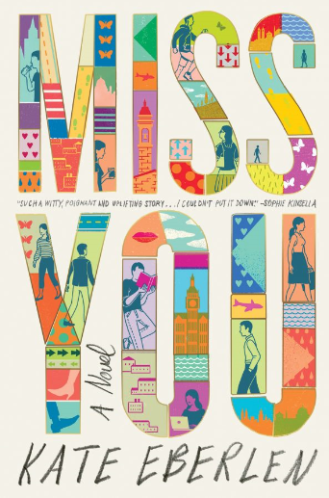
Miss You is British writer Kate Eberlen’s debut novel and it tells the stories, in two first person narratives, of Tess and Gus. The novel opens in  Florence; Tess is with her best friend, Doll, and Gus with his parents. They are both 18. They have a couple teensy encounters, but the sort of casual meetings you would have with a stranger. Their paths do not cross again for sixteen years. The story is really about what happens in those sixteen years.

Tess returns from her holiday excited to attend university in London. A family tragedy prevents this, and she has to ditch her plans to look after her fourteen-years-younger sister, Hope. Gus returns from his holiday and does, in fact, head off to university in London. He looks at the opportunity to escape the crushing weight of his parents’ expectations (they want him to be a doctor) and grief (Gus’s older brother, Ross, had died in a skiing accident at Christmas.)

Miss You is really a book about all the little things that can happen to you over the course of a lifetime (or part of a lifetime, at least.) We watch Tess and Gus morph from slightly awkward teens to adults in their twenties. They make mistakes in their personal lives and relationships that have consequences, and in that way they are incredibly relatable. I actually really liked both of them and spending time in their worlds was a true pleasure.

And that makes the next bit hard to say: I wasn’t a real fan of the ending. I mean, we know all along that Gus and Tess are meant to end up together — even though their initial meeting didn’t even allow them to exchange names or seem all that significant. Perhaps we are expected to buy into the notion that Gus and Tess weren’t ready for each other at eighteen. Fair enough. Their individual experiences over the next sixteen years shape them into stronger, more compassionate people, sure. My issue doesn’t really have anything to do with that. Nor does it have to do with the fact that it’s essentially fate that brings them back into each other’s orbit in, you guessed it, Italy. I think my problem was that from the moment they figure out who the other is, they’re both ALL IN. And, of course, if it’s fate, it’s fate. There’s no fighting it. And I have a romantic’s bleeding heart, trust me. It’s just, Eberlen took such care with their individual stories that their reunion should have been  — I don’t know  — something more than it was.

Nevertheless, I thoroughly enjoyed this novel. I love Italy, and time spent there was a delight. I loved these characters. They were human and impulsive and delightful. Probably everyone else on the planet would find their eventual union deserved and perfect. Not disagreeing. I just wish it had been allowed a little bit more breathing room.

Still, a perfect book to settle into.


My Dark Vanessa – Kate Elizabeth Russell

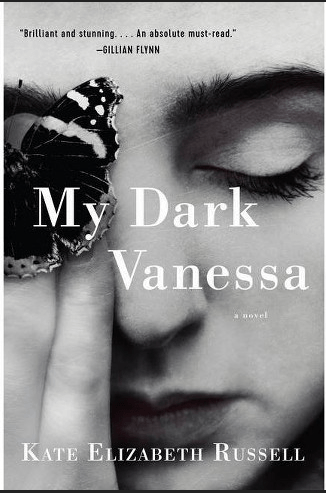
vanessaI finished Kate Elizabeth Russell’s debut novel My Dark Vanessa a couple days ago, but I had to let it sit with me before I made any attempt to write about it. It tells the story of a relationship that develops between fifteen-year-old Vanessa and her English teacher, Jacob Strane, who is 42.

Jacob Strane is an imposing teacher at Browick, a boarding school in Maine, “gleaming white clapboard and brick.” When the novel opens, Vanessa is returning to Browick for her sophomore year. Her freshman year was a disaster, ending in a shattered relationship with her best friend and roommate, Jenny.

A bit of a loner, Vanessa is immediately taken with Mr. Strane. It’s kind of hard to miss him.

He has wavy black hair and a black beard, glasses that reflect a glare so you can’t see his eyes, but the first thing I notice about him – the first thing anyone must notice – is his size. He’s not fat but big, broad, and so tall that his shoulders hunch as though his body wants to apologize for taking up so much space.

Encouraged by her faculty adviser, Vanessa joins the creative writing club and starts spending more and more time with Strane. He encourages her writing, talks to her like an adult, shares books and poetry with her (including, unsurprisingly, Lolita) and begins the slow and careful grooming process, which ultimately leads to their sexual relationship.

My Dark Vanessa is a difficult book to read on a lot of levels. For one, I am a teacher and Strane’s abuse of Vanessa’s trust is despicable. He manipulates her in ways that are apparent to us, but not to her. At one point he tells her “I want to be a positive presence in your life…Someone you can look back on and remember fondly, the funny old teacher who was pathetically in love with you but kept his hands to himself and was a good boy in the end.”

In some ways, Vanessa is aware of her own power over Strane. After this admission she “becomes someone somebody else is in love with, and not just some dumb boy my own age but a man who has lived an entire life, who has done and seen so much and still thinks I’m worthy of his love.” But even this seeming self-awareness is coloured by the fact that he has groomed her; it would take a very mature and confident person to see through Strane’s flattery and gaslighting.

The novel jumps back in forth covering the period of time when Vanessa is at Browick, in 2000, and then seven years later and seventeen years later. Vanessa revisits her relationship in light of allegations that Strane had been inappropriate (to put it mildly) with another student, possibly more than one.  It’s the beginning of the #MeToo movement, after all. The book captures how this relationship has completely derailed her life and coloured all her subsequent relationships. Even though Strane is repulsive, Vanessa seems unable to disconnect.

I wouldn’t say My Dark Vanessa was an enjoyable read, but it is compelling. It’ll make you feel squicky,  and it will frustrate you, but I don’t think you will be able to stop turning the pages. I think it’s a very accomplished debut.

There is some controversy surrounding the book. This article in The Guardian offers a comprehensive look at some of it.