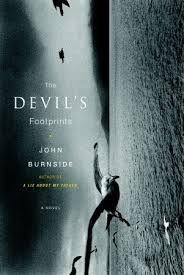
The Devil’s Footprints – John Burnside

devilAlthough John Burnside is a prolific and award-winning writer (he is one of only two poets to have been awarded both the T.S. Eliot and Forward Poetry prizes for his collection, Black Cat Bone and in addition to over a dozen volumes of poetry he has written non-fiction, novels and a screenplay), The Devil’s Footprints is my first encounter with him.

Michael Gardiner has lived in Coldhaven, a seaside town in northern Scotland, his whole life. His parents were distant, creative people: his father a well-known photographer, his mother a painter. They were outsiders when they came to the village, but it’s the only home Michael has ever known and he lives in the house where he grew up with his wife, Amanda.

When The Devil’s Footprints begins, Michael is considering the deaths of Moira Birnie and her two young sons. Michael had a brief relationship with Moira back when he was nineteen and the circumstances of their deaths troubles Michael. He also wonders why Moira’s 14-year-old daughter, Hazel, was spared. But The Devil’s Footprints is not a mystery.

Burnside effortlessly weaves past and present, illuminating his solitary childhood and the fact that he was mercilessly bullied by Moira’s older brother, Malcolm.

“I always walked to and from school alone. I didn’t have a best friend, I didn’t really have friends at all,” Michael recalls.

As an adult, Michael doesn’t appear to have any friends, either. The reader learns little about his relationship with Amanda, a woman to whom he’s been married for about a decade. Michael doesn’t have to work because his father’s death has left him financially independent. Amanda “liked her job and insisted on going every day, full-time, even though we didn’t need the money.” Michael’s view of his marriage from a strangely impassive perspective. He notes “We had quickly passed the stage in a marriage when being together counts for much” and he knew what Amanda wanted from him was “stability.”

The thing of it is, Michael seems decidedly unstable, especially after he becomes  fixated on Hazel. There are all sorts of Nabokov comparisons to be made in their relationship; Michael makes them himself. But it isn’t until he packs his bags and spirits young Hazel away that the reader starts to understand the huge knot of grief Michael has been carrying around with him.

Did I like The Devil’s Footprints?  I think it’s a book that does an admirable job of reaching into the dark heart of one character. The writing is, understandably, poetic. I am glad that I read it.

The Lantern – Deborah Lawrenson

lantern If you’ve ever been to Provence, I suspect you’ll recognize the lush and aromatic landscape Deborah Lawrenson describes in her novel The Lantern. I’ve never been, but after reading this gothic romance, I’d love to go.

…the lavender fields, sugar-dusted biscuits, wild-flowers in meadows, the wind’s plainsong in the trees, the cloisters of silver-flicking olives, the garden still warm at midnight

The Lantern is two stories in one, stories that share Les Genevriers, an abandoned house in southern France. In one story we meet Benedicte, the youngest of three children who grows up in the house back when it was a working farm. In the other we meet Dom and an unnamed narrator, who is affectionately called ‘Eve,’ who have recently purchased Les Genevries with a view to restoring it to its former glory.

Eve is a twenty-something translator who meets Dom, a forty-something composer, in Switzerland, in a maze – which is prescient, as her life suddenly becomes a tangle of wrong turns and dead ends. She is instantly smitten with him and he seems to return the affection. When they return to London, Eve says “I tried to play it cool. So did he. But we both knew.” Their whirlwind romance eventually takes them to France and Les Genevries.

That summer, the house and its surroundings became ours. Or, rather, his house; our life there together, a time reduced in my memory to separate images and impressions: mirabelles – the tart ornage plums like incandescent bulbs strung in forest-green leaves; a zinc-topped table under a vine canopy; the budding grapes; the basket on the table, a large bowl; tomatoes ribbed and plump as harem cushions; thick sheets and lace secondhand from the market, and expensive new bed covers that look as old as the rest; lemon sun in the morning pouring through open windows; our scent in the linen sheets. Stars, the great sweep of the Milky Way making a dome overhead. I have never seen such bright stars, before or since.

Sounds romantic, eh? But it’s also isolated and when Dom starts to behave strangely and Eve starts to smell things and see things that aren’t actually there, The Lantern  crosses over into gothic territory. There’s also, as it turns out, an ex-wife whom Dom doesn’t want to talk about and a real estate agent in the local town who does. The plot thickens.

Then there’s Benedicte. She lives her whole life at Les Genevries. Her story, and that of her blind sister Marthe and malevolent brother, Pierre, weave throughout Eve’s narrative and make up some of the “many stories about the place.” As an old woman living in Les Genevries, Benedicte becomes convinced that she is being haunted. She sees her brother, Pierre, “standing, waiting expectantly in front of the hearth, silent, as if his intention was perfectly clear.” And then he is gone. Benedicte has never believed in ghosts, but it is hard to deny that Les Genevries is full of spirits.

Lawrenson does a fabulous job of weaving together the stories of Eve and Benedicte, their connection to Les Genevries and of making Provence jump off the page. The novel is creepy, clever and compelling and a lot of fun to read.

Highly recommended.

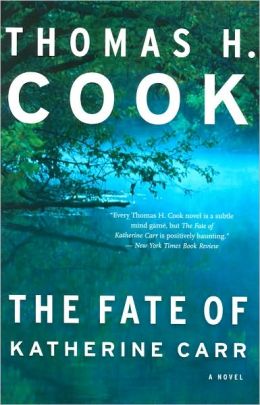
The Fate of Katherine Carr – Thomas H. Cook

katherine carrThe Fate of Katherine Carr is the story of things lost and found. George Gates is a former travel writer who now writes features for the local paper and spends his evenings drinking scotch at his neighbourhood bar. He’s a broken man, but no wonder: his eight year old son, Teddy, had been taken off the street on his way home from school, murdered and the murderer had never been caught. That was seven years ago, but George hasn’t recovered. He was supposed to pick Teddy up at the bus stop and hadn’t because he’d been trying to write the perfect sentence. He’s consumed with guilt.

One night at the bar, George runs into Arlo McBride, a retired police detective. Over drinks, Arlo tells George about the one missing person’s story which has stayed with him because it was never solved.  She vanished, Arlo tells George,  “like she cut a slit in the world and stepped through it into another one.”

George is intrigued. Before he’d retired from travel writing, he’d spent the bulk of his career writing about places where people had disappeared. Creepy places like Saipan, where Japanese parents – fearing American soldiers – had hurled their children and then themselves from the cliffs. He suddenly finds himself investigating what might have happened to Katherine. As it turns out, Katherine was also a writer and she left behind a handful of poems and a story which Arlo provides to George.

During the course of his ‘investigation’ George meets Alice Barrows, a twelve-year-old with progeria, a disease which causes premature aging. At first, Alice is just a potential subject for a story, but their relationship quickly becomes more profound. Alice is alone in the world and so is George. She is interested in mysteries and George is soon sharing  Katherine’s story with Alice.

Thomas H. Cook is one of my favourite writers. I’ve said it before and I’ll say it again – he writes literary mysteries. They’re page-turners, to be sure, but they are beautifully written, too. The characters are complicated and, more often than not, damaged. George is particularly sympathetic. As a parent, I can only imagine how horrific it must be to lose a child to a monster, but to live daily with the guilt of not being where you said you would. Cook ups the ante every single time.

The Fate of Katherine Carr works on many levels. Narratively, it’s a story within a story within a story. Emotionally, it’s hard not to be moved by George’s never-ending grief or Alice’s own sad fate. Some might argue that nothing much happens, but I respectfully disagree. While Cook might not write blood and guts thrillers, and while his endings might not leave all the loose ends tied in a neat bow – I think he writes fantastic books for careful and thoughtful readers.


Firefly Rain – Richard Dansky

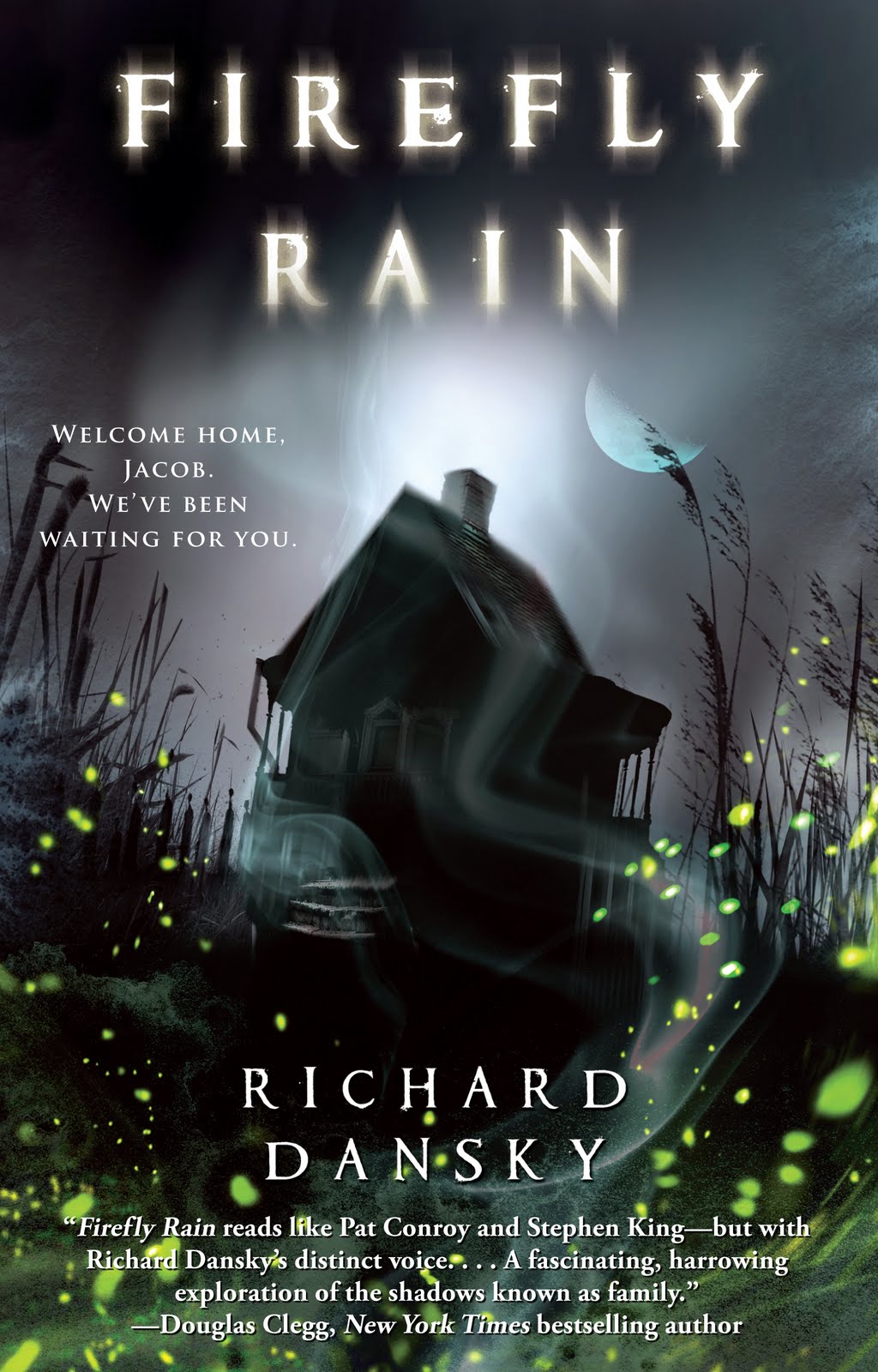
firefly rain Not to be confused with Firefly Lane, Richard Dansky’s debut novel Firefly Rain is about the prodigal son coming back to his childhood home in some back woods town in North Carolina – although he just calls it ‘Carolina.’ His business in Boston has failed, his parents are dead, but the old homestead is just waiting for him.

So, yeah, Jacob Logan goes home to Maryfield. His childhood isn’t quite as he remembered it. For one thing, the fireflies he used to catch on his property now don’t seem to want to come onto Logan land – they stop just at the border of his property and if they cross onto it, they die. For another, his house is creepy – doors open and bang shut; toy soldiers turn up where they shouldn’t be. Carl, the old guy who Jacob has been paying to look after the property after his parents died, is weirdly antagonistic. Then someone steals his car.

Firefly Rain is supposed to be scary. In fact, Publishers Weekly called it “Disturbing…remarkable” and Library Journal called it “Classic horror…a tightly paced tale of mystery and terror.”

I call it hokum.

Nothing was scary about this book. At all. Except perhaps the way the characters spoke.

“I need someone down here whom I can trust,” Jacob says to his friend Jenna. “I’m spooked Jenna, spooked bad, and I need someone who can watch my back until I can get my head screwed on straight.”

Then there’s the scene where Jacob chases his stolen car up and down a dirt road until he finally collapses in the ditch. In his slippers. In the rain.

And then there’s the convoluted denouement – where all the men of Maryfield show up on the property because of some wacky promise they made to Jacob’s mother.  I didn’t really get it…but by then, I didn’t really care.

Life After Life – Kate Atkinson

life-after-life-“What if we had the chance to do it again and again, until we finally did get it right? Wouldn’t that be wonderful,” says Teddy to his big sister, Ursula, the unusual main character of Kate Atkinson’s even more unusual novel Life After Life.

Ursula is born  in February, 1910. She dies and is born again. And again. Attempting to piece these multiple lives into any sort of coherent order is damn near impossible so I suggest you don’t even try. It’s far easier to just be with Ursula as she is born, grows up and then grows up again, each time encountering different possibilities based on life’s many variables. The reader is dropped into Ursula’s life at different points, just as she seems to be. Ursula hits the ground running, and eventually – with a little bit of attention paid –  so does the reader.

Ursula is a fine character with which to spend your time. She was “born with winter already in her bones” and when winter comes around again she “recognized it from the first time around.” It is through her eyes we see her parents: her perfect and beloved father, Hugh and her slightly snippy mother, Sylvie. When she is born she already has two older siblings, Maurice and Pamela, and then her arrival is followed by Teddy and James. The siblings and their parents live at Fox Corner, an English estate. Her lives and deaths flow almost seamlessly together, darkness falls and she is no more until she is again – still with the same family, still Ursula.

I don’t pretend to understand the novel’s finer points (it would take at least another reading), but I can say this: Life After Life clocks in at almost 500 pages and it was a joy to read. Sometimes Ursula makes choices which are ultimately detrimental to her well-being. One bad decision tips the balance and causes her life to spin out of control.  It’s only human to wonder how things might have been different if only… Other times her life is better, but not perfect. People suffer and die. World War I and then II upset the status quo.

There is a part of Ursula’s conscious that recognizes that her life seems to be on repeat. Her mother tells her it’s déjà vu, “a trick of the mind.” Dr. Kellet introduces her to the word “reincarnation” when she is just ten. But explanations are not necessary for Ursula or the reader. And although not every version of her life is a joy to read about, each one is as compelling as the next. Perhaps Ursula knows instinctively that ” If there’s no great glorious end to all this, if nothing we do matters… , then all that matters is what we do. ‘Cause that’s all there is. What we do. Now. Today. ” (Thanks for that quote, Joss Whedon! From the Angel episode “Epiphany.”)

It might be interesting to consider that Atkinson is also playing with the notion of novelist as God. Of course a novelist really does have the opportunity to make anything they want to happen to their characters happen. They don’t however, under normal circumstances, make every scenario occur in the same novel. If this was an experiment for Atkinson, it paid off in spades. The writing is beautiful. Ursula is everything you’d want in a protagonist; the minor characters are compelling and each and every one of Ursula’s lives offers something of value to careful readers.

Highly recommended.

The Ice Cream Girls – Dorothy Koomson

icecreamTold in the alternating voices of Serena and Poppy, The Ice Cream Girls, by British writer Dorothy Koomson, is part suspense novel and part family drama. Koomson expertly weaves the story of two teenaged girls accused of murdering their history teacher, Marcus  Halnsley. They’re called ‘the ice cream girls’ because of a photograph of the pair wearing bikinis and eating ice cream. Their story, and their relationship with Halnsley,  is anything but sweet, though.

We meet Serena at the moment when her husband, Evan, proposes to her for the second time. We meet Poppy as she leaves prison, where she has been incarcerated for the past twenty years. These are two women, one black and one white, who might have never met if it hadn’t been for Halnsley.

We meet him through Serena first who says that “all the girls said he should be a film star because he was good-looking.” Serena doesn’t really like him at first because he was “always picking on me.” But when Mr. Halnsley starts to take a special interest in her, Serena feels singled out and special. Halnsley convinces her she could excel at History and offers to give her private lessons. It isn’t long before he crosses the line. It’s a simple (although inappropriate gesture) at first, but it’s easy to see how easily Halnsley manipulates fifteen-year-old Serena.

I walked home instead of getting the bus and along the way, I kept reaching up to touch my face. His touch had been so gentle and soft. And the way he said he wanted to take care of me made my stomach tingle upside down every time I ran it through in my head. He wanted to take care of me. That must mean I was special. Someone as clever and grown-up as him thought I was special.

Just a few short weeks after Halnsley has convinced Serena that he loves her, he meets Poppy. It’s clear, of course, that he’s a predator and that both Serena and Poppy are vulnerable despite the fact that they come from decent families. For the next couple of years the girls share the man who alternately abuses them and plays them off against each other – all the while convincing them that he loves them.

The story requires some finesse and Koomson does a terrific job of layering all the bits together. There’s a lot the reader wants to know. Why did Poppy go to prison, for example, and not Serena? Serena went on to college, met and married Evan (a doctor) and now lives in suburban bliss with her two children. Of course, behind the scenes she’s a hot mess. Every night before bed she has to hide all the knives.

The dinner knives are safe but the sharp ones, the ones that can do serious damage, seem to be missing in action. Admittedly, that’s my fault: I hid them last night, and I can’t quite remember where.

Things aren’t much better for adult Poppy, either. She arrives home to her parents only to discover that her father isn’t speaking to her, can’t even look at her and her mother

managed to sit down at the same table as me for more than three seconds. She didn’t make herself a cup of tea, so I knew she wasn’t staying, but it was a start. She actually came into the kitchen and didn’t immediately walk out again.

Poppy is intent on finding Serena and getting her to admit that she is actually responsible for Halnsley’s death and while their reluctant reunion dredges up all sorts of bad memories, it also allows the women to finally have a chance at exorcising the ghost of Halnsley, a man whose hold on them has poisoned their lives long after his death.

Great book.


My Ideal Bookshelf – Thessaly La Force & Jane Mount

myidealbookshelf1_grande My son gave My Ideal Bookshelf to me for my birthday back in May.  It’s one of those books that is both a pleasure to read and a pleasure to look at. The premise was to ask 100 plus people (writers, designers, chefs, artists, photographers) about their ideal bookshelf.  In other words:

Select a small shelf of books that represent you – the books that have changed your life, that have made you who you are today, your favourite favourites. You begin, perhaps, by walking over to your bookshelf and skimming the spines on the top shelf. You pull down a handful that you remember loving; you grab a couple that you read over and over again. Some you know just by the colour of their dust jackets. One is in tatters – it was passed down by your mother – and it’s dog-eared and carefully held together by tape and tenderness. The closer you look, the trickier the task turns out to be.

You got that right. But before I talk about what I did with My Ideal Bookshelf let me just point out how much fun this book was to read. Although I don’t know everyone whose bookshelves were included, it didn’t matter. If you are a book lover, you are naturally drawn to other people’s bookshelves. You know it’s true. If I am in someone’s house, their bookshelves take precedence over anything else. I must snoop. It’s futile to resist the siren call of the books.

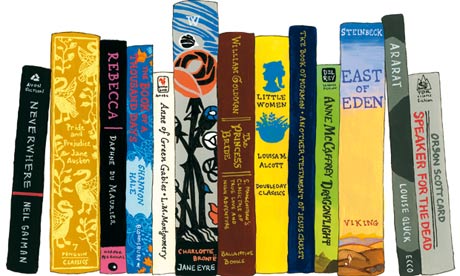
I read My Ideal Bookshelf cover-to-cover. Each person’s shelf is artistically recreated by Jane Mount. For example, this is Stephanie Meyer’s shelf:

meyer

Each shelf is accompanied by a personal reflection. Meyer offers this insight into her choices:

These books contain threads of what I like to write about: the way people interact, how we relate to one another when life is beautiful and horrible. But these books are greater than anything I could ever aspire to create.

None of the commentaries explain the person’s entire collection, but each  offers a glimpse into that person’s reading life.  For example, book designer Coralie Bickford-Smith says “The written word means so much to me. If I design a cover that gets people to pick up a book, then I’ve done my job. I want the younger generation to fall in love with books like Jane Eyre again.”  Interior designer Tom Delavan offers this: “Books are the very best kind of decoration, really. There are two types of books, the ones you read and the ones you have on your coffee table. Both make a space feel like home – you spend time with them, they have meaning for you, and they actually look good, too.” Writer Dave Eggers says “These are the books that crushed me, changed me when I first read them, and to which I have returned many times since, always finding more in them.”

Book lovers always have something to talk about. Always. My Ideal Bookshelf is like a beautiful conversation. With pictures.

I liked the book so much that I thought it would be really cool to ask my students to build their own ideal bookshelves and then write an essay to talk about their reading lives.  There’s a handy template at the back of the book (and it’s also available on their blog). As the school year winds down, this is a great way to have students reflect on the books they’re read – not only during their time with me, but for as long as they’ve been reading. We just got started on Friday, but it was so much fun to walk around and see what had made students’ lists. (When I saw that my Turkish exchange student had Donna Tartt’s The Secret History on her list – we both shared a moment of squealing delight.)

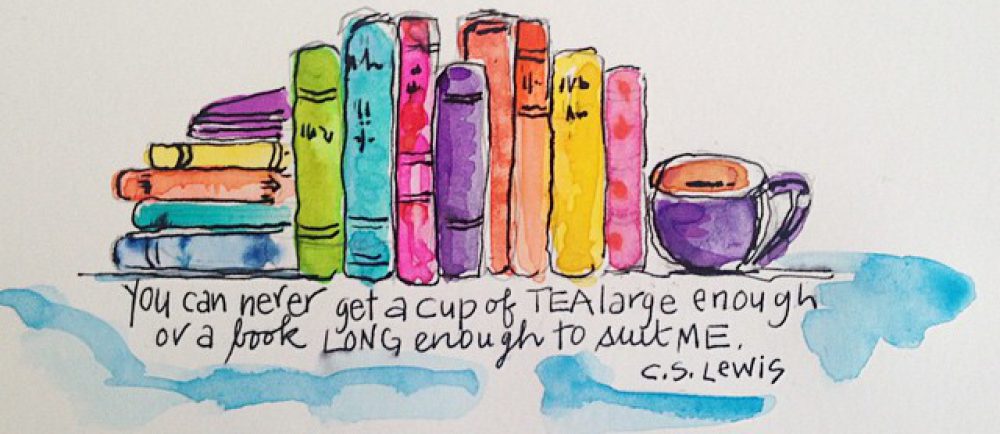
I wanted to take up the challenge, too. I’m going to cheat, though, and do a YA bookshelf and another bookshelf – although there may be some cross-over titles. I am no artist, but here’s what I came up with.

idealbookshelfya

It wasn’t easy to come up with these titles…and I left off a dozen more…so I am looking at this like it’s a snapshot of my YA reading life…including both books that I  read when I was a teenager and younger  (Jane Eyre, A Little Princess, A Tree Grows in Brooklyn, That Was Then, This Is Now and Anne Frank: The Diary of a Young Girl all fall into that category. I read them between 35-40 years ago!) and more recent reads. The thing they all have in common is that I loved them and the characters that inhabit the pages have stuck with me.

My Ideal Bookshelf would make an excellent gift for any book lovers on your list.

I’d love to hear about your ideal bookshelf!

The Raft – S. A. Bodeen

raftRobie, the fifteen-year-old protagonist of S.A. Bodeen’s YA novel The Raft has been back and forth between Hawaii and the island of Midway dozens of times. She lives there with her research scientists parents, but when the novel opens she’s visiting her aunt in Honolulu. When her aunt is unexpectedly called to work on the mainland, Robie isn’t bothered about being alone. She’s used to it and knows how to look after herself.

Looking after yourself on 2.4 square miles of island, as it turns out, is different from looking after yourself in downtown Honolulu. Unfortunately Robie gets accosted on the street one evening — nothing serious — but it spooks her and she decides to take the cargo plane home. Unfortunately, phone and Internet service is spotty on the island and so Robie isn’t able to let her parents know she is coming home. Even more unexpectedly, the plane hits bad weather and goes down. Only Robie and the co-pilot, Max, survive.

This novel is terrific. Like, couldn’t-put-it-down terrific. Robie is resilient and smart and is able to cope with her circumstances better than people twice her age. The raft she floats in leaks, there are sharks in the water — and not much else. It’s impossible to imagine that Robie will make it, but she does.

I don’t want to say too much about the things Robie endures. Once you start reading The Raft you’ll find out pretty quickly because you won’t be able to stop turning the pages. I should also mention that Bodeen slips some compelling stuff about ocean and bird life, conservation and pollution into the mix and it all feels necessary and organic. Robie is at home in this environment and knows “more about ocean fish and seabirds than most post-graduate researchers.” It’s a good thing, too.

Bodeen’s prose is straightforward and Robie’s voice is authentic. In a moment of prescience she remarks: “Lately it seemed there were a lot more days when my life felt less  like luck and way more like suck.”

I’m not one for survival stories, really, but I enjoyed Robie’s tremendously.

Highly recommended.


The Rosie Project – Graeme Simsion

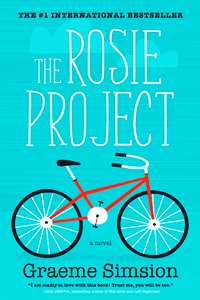
rosieIt’s easy to see why Graeme Simsion’s debut novel The Rosie Project was such a huge hit with readers all over the world. It’s one of those books with easy to like characters, a straightforward story and just enough quirk to make it stand out from the pack.
Don Tillman is a scientist in the Genetics department at an unnamed university in Melbourne, Australia. It’s clear from the book’s opening pages that while Don clearly has a super-sized brain, he also has some issues which have prevented him, thus far, from finding a suitable partner. Thus, the Wife Project.

Don’s two friends Gene and Claudia try to help with Don’s project, but Don felt their assistance was lacking. Their approach “was based on the traditional dating paradigm, which I had previously abandoned on the basis that the probability of success did not justify the effort and negative experiences.”  He eventually writes a sixteen-page questionnaire that he hopes will sort the wheat from the chaff.

Don describes everyone he meets by telling us their Body Mass Index and by the time he tells us that he is “thirty-nine years old, tall, fit and intelligent, with a relatively high status and above-average income” and that he should be “attractive to a wide variety of women. In the animal kingdom, I would succeed in reproducing” we know for sure that Don is somewhere on the Autism spectrum.

According to Autism Canada

Autism Spectrum Disorder (ASD) is a complex neurobiological condition that can affect the normal function of the gastrointestinal, immune, hepatic, endocrine and nervous systems. It impacts normal brain development leaving most individuals with communication problems, difficulty with typical social interactions and a tendency to repeat specific patterns of behaviour. There is also a markedly restricted repertoire of activity and interests. Individuals on the autism spectrum tend to have varying degrees and combinations of symptoms

All things considered, Don does pretty well in the world. Where he struggles is with human interaction. So when Rosie blows into his life, ostensibly looking for someone to help her discover the identity of her biological father, Don’s ordered world is thrown completely off-kilter. That’s when the fun really starts.

There are several laugh-out-loud moments in The Rosie Project, and it is fun to watch socially challenged Don and prickly Rosie work their way towards each other. It’ll make a great movie.


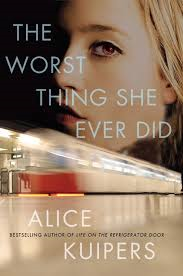
The Worst Thing She Ever Did – Alice Kuipers

worstthing Sophie releases the details of the worst thing she ever did through journal entries and this turns out to be a blessing and a curse in Alice Kuiper’s second YA novel, The Worst Thing She Ever Did. It’s a blessing because we get to hear Sophie’s authentic teenage voice and a curse for the same reason. Teenagers are, by definition, insular and of course no where is this made more apparent than in the pages of a teenager’s diary.

Sophie is keeping this journal at the request of her therapist, Lynda, who tells her that “Writing in here will help you remember.” Sophie doesn’t want to remember, though, and The Worst Thing She Ever Did  takes its own sweet time revealing what it is Sophie is so desperately trying to forget. I’m not suggesting that Sophie’s tragedy is not worth the effort, just that Sophie often teeters on the edge of coming across more like a petulant child than the survivor of a horrific act of violence.

But maybe that is part of what would make this story so compelling to young adults. I think they will recognize themselves in the pages of Kuiper’s novel. Here is a girl who is living her life. Her sister, Emily, is home from art school and Sophie doesn’t varnish their sibling relationship. Sometimes Emily really pisses her off. Sometimes Sophie feels like Emily is the favourite child. Mostly though, Sophie misses her older sister and it is clear that something horrible and unspeakable has happened.

Sophie’s mother is coping with the loss as badly as Sophie is, but the two of them don’t talk about it. In fact, sometimes they “circled each other like cats.” Sophie pretends not to hear her mother crying. There is no joy in the house they share.

There’s no joy for Sophie at school, either. Everything is different. “Everything going on around me – the others, the noise, the ring of the bell to get to class – was so loud it gave me a headache.” Sophie’s best friend, Abigail, has moved on.  Sophie tries to navigate the aftermath of the tragedy (which is only alluded to until almost the end of the novel) and work her way through being a teenager with varying degrees of success. There’s school to contend with and fractured friendships and boys – one boy in particular – and her mother. All of these elements would have been enough for a YA novel and a half, but Kuipers ups the ante here.

If some of the reconciliations seem a tad trite at the novel’s end (I wasn’t really fussy about the subplot concerning Abigail), they don’t really detract from the story’s larger theme: healing takes time. Kuiper’s is a lovely writer and although my feelings about The Worst Thing She Ever Did are similar to my feelings about 40 Things I Want To Tell You, I still think Kuipers is worth checking out.