You Are Here – David Nicholls

As I age, my desire to read straight-up frothy romances has waned. Sure, I used to love them: hot boy meets hot girl and sexy fun times ensue. But now? Boring. Give me the characters who have lived a life and are neurotic, flawed, cynical, searching, hopeful…human. Bonus if they’re past 30. (Extra points if they’re past 40.)

I love David Nicholls. His outstanding novel One Day introduces us to Emma and Dexter on the eve of their graduation from university, but then follows them for the next twenty years. (If you have not watched the incredible series on Netflix, I highly recommend it. It’s perfection.) Us follows Douglas and Connie, a couple whose marriage is disintegrating after twenty years, just as they are about to head off on a European vacation with their 17-year-old son. Sweet Sorrow is Charlie and Fran’s story. They meet at sixteen while participating in a production of Romeo and Juliet, but their story is told from a future vantage point complete with the requisite melancholy.

Nicholls’ most recent novel You Are Here is the story of 38-year-old copywriter, Marnie, and a high school geography teacher named Michael who is 42. Marnie is divorced and lives a relatively solitary life in London. She used to have an active social life, was “A nice addition to the group if not the core, well liked if never adored or idolised.” Now all her friends are married and having babies and Marnie feels like “perhaps this was natural, this falling away.” Nevertheless, Marnie does admit that she is lonely. Michael and his wife, Natasha, are separated and Michael resists all efforts to shake off the lethargy. Instead of staying in the house they shared, where she had “left enough of her possessions to keep it comfortable but he could never quite escape a feeling that something had gone missing”, Michael walks. A lot.

Although Michael and Marnie are unknown to each other at the beginning of the book, they do have one common friend, Cleo. When Michael turns down one too many invites because he will be walking, she insists that she’ll come, too and bring other people. Thus, Michael, Marnie, Cleo and company set off to hike from one side of England to the other (well, at least, that’s Michael’s intent; the rest are only going to walk for three days.)

Initially Cleo had thought to match Marnie up with Conrad, “perhaps the most handsome man” Marnie had ever seen. The woman she’d invited for Michael cancelled at the last minute and so you can see where this is going to go from miles away….and miles is just how long it’s going to take for Marnie and Michael to really see each other…to let their guards down and trust themselves and each other.

Trust me, it’s the journey not the destination that matters in this one. It’s filled with flirty banter, heartfelt revelations, and beautiful descriptions of the English countryside. This book will make you want to plan your own ramble and open yourself up to the possibility of love.

Another winner by one of my favourite authors.

All the Colors of the Dark – Chris Whitaker

Chris Whitaker’s novel We Begin at the End is one of the best books I’ve read in the last few years and so when I heard that he had a new book coming out I purchased it as soon as it was available. (Sadly, it’s a flimsy paperback with a stupid unremovable “Read with Jenna” sticker on it. ) Not only did I race out to purchase All the Colors of the Dark, but I started reading it almost immediately. The weather cooperated, too; I got a rainy Saturday with nothing much to do and so I didn’t stop reading until just after 2 a.m. when I turned the final page (595 of them!)

Patch and Saint meet as kids. They’re both outsiders in their small town of Monta Clare, Missouri. Patch lives with his single mother, Ivy, who has barely been able to keep it together; Saint lives with her grandmother, Norma. Their friendship sustains them for many years and is the central relationship in the novel.

At the beginning of the story, Patch rescues another local girl, Misty, from a man who clearly intends to do her harm. He has admired Misty from afar and when he encounters them in the woods, he recognizes that something is not right.

Patch desperately looked around for anyone at all. Anyone who could handle this, who could ease the responsibility, the acute burden of seeing a girl in trouble.

He has no choice but to act, and he does, and it changes the trajectory of his life.

When Patch disappears, Saint lets nothing stand in her way until she finds him. But he is not the same person he was and as the details of what happened to him emerge, it also reveals a dogged determination to get to the truth.

I can’t say any more than that.

This is an epic story because it takes place over many years. It is also a story that moves swiftly. There’s a lot of dialogue in this story and so despite its length it almost begs to be read in one sitting. I think Whitaker’s super power is his characters. I loved Saint and Patch, who are revealed to us through their actions and their dialogue. But they are not the only characters to love. There’s Chief Nix, Norma and Sammy, too. I felt like I knew and cared for each and every one of them.

There’s not a lot of exposition here. (Honestly, this would make a terrific series and given the author’s connection to Jordy Moblo, I’ve got my fingers crossed.) But there is a compelling mystery and some heart-stopping moments. In fact, there’s a lot going on in this book and while the conclusion wasn’t as punch-you-in-the-gut as We Begin at the End, I finished feeling very satisfied. And as a person who generally falls asleep relatively early, the fact that I had to stay awake – in fact, couldn’t fall asleep even after I finished – to find out what happened to these people I had fallen in love with should tell you everything you need to know about All the Colors of the Dark.

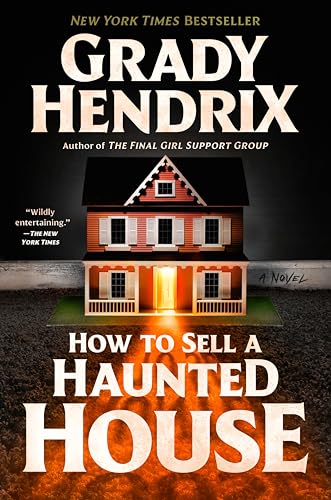
How to Sell a Haunted House – Grady Hendrix

Louise and Mark are estranged siblings who are forced to find a way to work together in an effort to clean out their parents’ house. That’s the starting point for Grady Hendrix’s novel How to Sell a Haunted House.

Louise and Mark squabble over everything, including how they should deal with the contents of the house: Mark calls it “junk”; Louise is more sentimental. It isn’t until things start to get, well, weird, that the siblings discover they have more in common than they realized.

When Louise arrives in Charleston, she discovers that Mark has already arranged for Agutter Clutter to come and cart away all the stuff their parents, Nancy and Eric, have accumulated over the years–and it’s a lot of stuff. Well, it’s a lot of puppets and dolls. That’s because Nancy was a puppeteer with “a Christian puppet ministry”. Neither of the siblings is really a fan and one puppet in particular makes “Louise’s skin crawl.”

Pupkin was a red-and-yellow glove puppet with two stumpy fabric legs dangling down from his front and two little nubbin arms. His chalk-white plastic face had a big smiling mouth and a little pug nose, and he looked out of the corners of his wide eyes like he was up to some kind of mischief. His moth and eyes were outlined in thick black lines and he wore a bloodred bodysuit with a pointed hood and a yellow stomach […]he looked like he’d crawled straight out of a nightmare.

How to Sell a Haunted House is often funny, and also violent and creepy (and this will be especially true if dolls and puppets make you uneasy). And, then, like in the other Hendrix books I have read (My Best Friend’s Exorcism, The Southern Book Club’s Guide to Slaying Vampires), it also offers a deeper look at something more meaningful and real than just straight-up scares. (I didn’t find this book particularly scary, although it did, on occasion, make me squirm.)

This book tracks the emotions attached with grief (each section of the book is named after one of the five stages), the unresolved feelings you’re left with when you lose someone unexpectedly, and the notion that when your loved one is gone, all you have left –if you are lucky — are the people you have shared the journey with. If you are really lucky, that is a sibling.

Super enjoyable read.

I Did It For You – Amy Engel

The fact that I sprung for a hardcover copy of Amy Engel’s (The Roanoke Girls, The Familiar Dark) latest novel I Did It For You should tell you that I am a fan. I am so sad that it wasn’t as good as her previous novels – which I LOVED.

Fourteen years after Eliza and her boyfriend Travis were shot in a local park, Eliza’s younger sister Greer comes home to Ludlow, Kansas. Bad things happen in Kansas, apparently. (It’s the place where the Clutter family - made famous in Truman Capote’s iconic book In Cold Blood – were killed in 1959.)

Greer has a love-hate relationship with Ludlow. On the one hand, her childhood besties Ryan and Cassie are there (Ryan has recently returned home following his divorce; Cassie had never left). On the other hand, she has a strained relationship with her parents. Her father is an alcoholic and her mother buried her grief in relentless cleaning. Why come home now, when she has made a life for herself in Chicago? Well, that’s because two more kids are dead. Greer is convinced that these deaths are connected to her sister’s murder even though the person responsible for Eliza and Travis’s deaths, Roy Mathews, was caught and executed.

In an effort to uncover the truth, Greer teams up with an unlikely person: Dean Mathews, Roy’s older brother. Together, they try to figure out Roy’s motive for killing Eliza and Travis because while Roy admitted to killing them, he also said he didn’t really know them and so the crime doesn’t make sense to either Greer or Dean.

Maybe if I hadn’t read The Roanoke Girls or The Familiar Dark first, I would have liked I Did It For You more than I did. I read a lot of thrillers, and this one stacks up just fine against many of them. But I was really hoping for the sucker punch The Familiar Dark offered or the dark family secret hidden in the depths of The Roanoke Girls. For me, this just didn’t have the same emotional depth as those two books. That said, the last third of the book definitely outpaced the first two thirds and while I suspected one thing, I was surprised by another revelation. So, not a total miss – really not a miss at all, just not as good as I’d hoped.

Tom Lake – Ann Patchett

It’s 2020, the scary beginning of Covid, when Ann Patchett’s latest novel Tom Lake opens. Lara and her husband, Joe, and their three adult daughters Emily, Maisie, and Nell are hunkered down on the family’s Michigan cherry farm. The girls have asked Lara to tell them the story of how she came to date Peter Duke, a famous actor. Emily, the eldest and the child who intends to stay on the farm, has long believed that Peter Duke is her father and it has caused quite a bit of friction between her and her mother over the years.

Lara’s story really begins when, in high school, she and her best friend, Veronica, are roped into helping at a community theatre casting call for a production of Thornton Wilder’s Pulitzer Prize winning play Our Town. Although she was really only there to take the names of those who’d come to audition, Lara ends up auditioning herself and lands the part of Emily, a role which is to change her life. Later, at college, she plays the part again and as she remarks “Luck was everything.” A Hollywood producer, there to see his niece in the role of Mrs. Gibbs, is enamoured with Lara’s portrayal of Emily and thinks she’d be perfect for a movie he’s casting. That opportunity leads her to Tom Lake, a summer stock theatre in Michigan where she will reprise the role of Emily for a third time. This is also where she meets Peter Duke, or, as everyone calls him: Duke. He’s playing Mr. Webb, Emily’s father, even though he is only four years older. Everyone could see that he was destined for greater things, though.

This is a story about falling in love with Peter Duke who wasn’t famous at all. It’s about falling so wildly in love with him – the way one will at twenty-four – that it felt like jumping off a roof at midnight. There was no way to foresee the mess it would become in the end, nor did it occur to me to care.

Almost from the moment that they meet, Lara and Duke are a couple and their summer together is one that changes the course of Lara’s life. Lara’s daughters think they know (most of) the story, but she parcels out the narrative, editing and obfuscating because “There was always going to be a part of the story that [she] didn’t tell Joe or the girls.”

Honestly, I will read anything Patchett writes. Even if I didn’t know anything about Our Town, I would have loved this story of a mother and her daughters, of first love and the devastation it can leave in its wake, of friendships and marriage, of family. But because I am very familiar with Wilder’s play, which is really about some of the very same things Patchett writes about, I found this book extra meaningful. Wilder once said that his play was about finding “a value above all price for the smallest events in our daily life.” Much of the action of Patchett’s novel takes place on the family cherry farm where mother and daughters spend their days picking fruit. In the evenings, they share dinner, conversation, and movies. Covid made the circumstances perfect for this sort of thing because where were you going to go and what else were you going to do?

Tom Lake is a quiet novel but that is not to say that you won’t be swept along by these characters and their story. Like Lara’s daughters, I wanted to know what became of Peter Duke and there were some other surprises in this novel, too.

Outstanding.

None of This is True – Lisa Jewell

Lisa Jewell’s most recent novel, None of This is True, could have been ripped straight from the true-crime headlines. And just like a true-crime podcast or documentary, Jewell’s book is totally binge-able.

Alix Summer, a successful podcaster who lives a polished life with her successful husband, Nathan, and her two young children in a tony London neighbourhood, meets Josie Fair, a part-time seamstress with two adult children and a husband, Walter, who is old enough to be her father. Their meet cute happens at a local gastropub, not the sort of place Josie would normally be dining, but it is her 45th birthday and she wanted, for once, to do something special. Turns out, it is also Alix’s 45th birthday.

This incidental meeting seems momentous to Josie, so when she accidentally on purpose runs into Alix again she confesses that she doesn’t “break free of the past now, then when will [she]?” She wants to tell her story and Alix is looking for another project. Josie and her messed up life seems like the answer to her creative prayers.

It doesn’t take long for Josie to start becoming full-on obsessed with Alix’s house and the casual elegance of her life. She asks Alix to help her buy new clothes. She takes small, inconsequential things from the Summers’ home, which she visits regularly because Alix’s podcast studio is in the back garden. She captivates Alix with the story her relationship with Walter, which began when she was 13 and he was 42, and of a daughter who ran off at 16. Another daughter, Erin, never comes out of her bedroom. It is clear that Josie’s life is messed up.

Or is it?

As with all of Jewell’s really great books – you really won’t know what to believe…or in this case – who to believe. The book’s structure is comprised of podcast recordings, Netflix documentary transcripts and chapters told from both Josie and Alix’s point of view. It makes for easy reading; I read it in two days. Like the media it mimics, None of This is True is easily consumable, a big bowl of buttered popcorn that’s fun to eat but not exactly life-sustaining.

The Quarry Girls – Jess Lourey

Jess Lourey (Unspeakable Things, Bloodline) has written another fast=paced thriller ripped straight from the headlines. Literally. In her Author’s Note, Lourey says of her childhood home in Minnesota: “Three killers were on the loose in Saint Cloud when I was growing up. Only two have been caught.”

In The Quarry Girls, best friends Maureen, Brenda and our narrator, Heather, are coming of age in Pantown, a suburb of Saint Cloud, in 1977. Pantown was

built by Samuel Pandolfo, an insurance salesman who in 1917 decided he was going to construct the next great car manufacturing plant in good old Saint Cloud, Minnesota. His twenty-two-acre factory included fifty-eight houses, a hotel, and even a fire department for his workers. And to be sure they made it to work come sleet or snow, he ordered tunnels dug linking the factories and the houses.

One day, while playing hide and go seek in the tunnels, Heather and Brenda see something they aren’t supposed to see. When a local girl who is just a little bit older than they are goes missing, the teens begin some sleuthing of their own. It turns out that not everyone in Pantown is to be trusted.

There are all sorts of nefarious characters in this book including local boys Ricky and Ant and a new guy, Ed who

was way too old to be hanging out with high school kids, even a brain-fry like Ricky. […] Ed was exciting and terrifying and so out of place. His greased black hair and leather jacket against the soft, pastel Pantowners shopping behind him reminded me of a sleek jungle cat let loose in a petting zoo.

Even Heather’s parents, a mother who spends most of her time in bed and whose moods are unpredictable and a father, the local D.A. who is hardly never home, don’t seem all that reliable. Heather’s story is as much about the journey to adulthood as it is about what dark deeds are happening in Pantown.

And – an added bonus – so many references to the 1970s, the period of time in which I was coming of age. Heather’s friend Claude looks like Robby Benson. Getting dolled up meant an extra slick of Kissing Potion. Phones operated on a party line. Smokie and the Bandit was on the big screen. All these little nods to the period were just so much fun.

The story itself is fast-paced, well-written and I couldn’t put it down.

If I Forget You – Thomas Christopher Greene

Coming on the heels of You Made a Fool of Death With Your Beauty, Thomas Christopher Greene’s 2016 novel If I Forget You confirmed what I already knew: I like my romance novels to be a little less fantastical. If I Forget You is my fourth novel by this author (The Perfect Liar, The Headmaster’s Wife and Envious Moon) and I think it is fair to say that he is one of my favourite writers.

This novel introduces us to Henry and Margot. Margot is as WASPish as can be (her father is a soft-drink kingpin; her mother lunches) and Henry is the son of Jewish immigrants. Their paths first cross in 1991at Bannister College, where they are both students. Margot’s father is a college benefactor; there is a building named after him. Henry arrives on a scholarship. The two meet after a poetry reading (Henry is the poet and a talented one) and are immediately smitten. More than smitten.

…she knows that tonight she will kiss him and that soon she will sleep with him and she also knows, more broadly, that if she doesn’t want to fall in love with him, she needs to decide that now.

The novel opens in 2012. Henry, a poet and lecturer at NYU, sees Margot – for the first time in 20 years – on the street in Manhattan. When their eyes meet, “the face Henry sees travels to him from a lifetime ago.” Instead of speaking to him, though, she runs away. It is from this point that their story unspools – toggling between their college days and this point in the present. Lives lived and all that.

Greene’s novel is filled with tenderness. The choices these characters make or, in some instances, are forced to make, inform their lives. Despite how young they are when they first meet, it is clear that Henry and Margot’s feelings for each other are sincere and deep, but as Henry remarks “The more you love someone, the more that person will eventually break your heart.”

Margot is also introspective. She is married to the bland but kind Chad, and has two almost adult children. Her son, Alex, causes her to get “nostalgic for the time of life he is occupying” although “part of her hates herself for this, the always looking back.”

If I Forget You is a quiet novel filled with joy and melancholy and hope. I loved both main characters and how, while their lives were filled with missteps, they managed to find each other again.

Highly recommended.

The Secret History – Donna Tartt

Published in 1992, Donna Tartt’s debut novel The Secret History is an astounding accomplishment. I read it for the first time shortly after it was published and I remember it making such a huge impression on me. It was a book that sort of stuck in my brain even though, over the years, I forgot the details of what it was about. I often recommend it to students and this summer my son Connor – who read the book, at my urging, when he was 13 or 14 – suggested we do a re-read. I did; he did not.

The book’s narrator, Richard Papen, recalls his time at Hampden College, a small liberal arts college in rural Vermont. (Many critics say it’s based off Tartt’s alma mater, Bennington.) The novel opens dramatically

The snow in the mountains was melting and Bunny had been dead for several weeks before we came to understand the gravity of our situation. He’d been dead for ten days before they found him, you know.

Richard has come to Hampden from Plano, California a place which has “created for [him] an expendable past, disposable as a plastic cup.” After beginning college in California, a fight with his parents leads him to Hampden where he hopes to study Greek, a subject for which he has an affinity. The only Greek tutor, Julian Morrow, is reluctant to accept Richard into his class. Julian tells him, “I have limited myself to five students and I cannot even think of adding another.”

Those five students soon become central to Richard’s life. There’s Edmund “Bunny” Corcoran, the twins, Charles and Camilla Macauley, Francis Abernathy and Henry Winter.

All of them, to me, seemed highly unapproachable. But I watched them with interest whenever I happened to see them: Francis, stooping to talk to a cat on a doorstep; Henry dashing past at the wheel of a little white car, with Julian in the passenger’s seat; Bunny leaning out of an upstairs window to yell something at the twins on the lawn below.

A chance encounter in the library offers Richard an invitation to this insular group and from there a front row seat to their complicated dynamics. The novel traces the shifting alliances, the pretentious ponderings and the copious drinking of this group of young academics. Oh, and there’s a murder and other dark deeds.

The Secret History is considered the grand dame of dark academia, although it wasn’t even really a thing when the book was published. Dark academia became a thing on Tumblr in 2015 and “is a genre of literature that literally revolves around academia or learning. Therefore, you will see that it is mostly set in educational institutions and follows the lives of students.” (Medium) TikTok has a trend for the aesthetic subculture of dark academia. (NY Times) For me, dark academia is a story that takes place on a college campus or at a boarding school, where students are concerned with the study of literature but there are also dark forces (not of the supernatural variety) at play. Wikipedia has a pretty good overview here.

When I read The Secret History the first time, dark academia didn’t exist, so it was interesting to read it this time and see all the qualities that I recognize now as being hallmarks of the category: an isolated, insular campus setting, a preoccupation with academia, toxic relationships, corrupted morality. I think inherent in dark academia is bildungsroman. It is certainly true that Richard is changed by the novel’s end – and not necessarily for the better.

My memory of my first reading of Tartt’s book is that it was exceptional. This is a literary novel which I would now describe as overwritten, but that is a stylistic choice. Tartt has penned two other novels, The Little Friend and The Goldfinch, which won the Pulitzer in 2014 and they all have this in common: Tartt loves language and she is a master of her craft.

This reading of The Secret History was a little bit more of a slog than the first time around considering I was waiting for the “big” things to happen. I also found the characters just a little bit precious and not of this world. For a book that is set in the 1980s – granted a lot more years ago now than it was when first written – Richard and company seem just a tad foolish. They dress in “starchy shirts with French cuffs” and Richard sometimes observes to his delight, Francis wearing pince-nez. I mean, really. Sometimes they speak as though they are from another planet. But perhaps all the pretention is the point. These are students in their early 20s, trying to make sense of their world but they are, perhaps, too clever for their own good.

If you haven’t yet read The Secret History, I highly recommend it. And if you are already a fan of dark academia, check out these titles:

If We Were Villains – M.O. Rio

Bunny by Mona Awad

The Girls Are All So Nice Here – Laurie Elizabeth Flynn

Babel – R.F. Kuang

Never Let Me Go – Kazuo Ishiguro

One of Us Is Lying – Karen M. McManus

The Broken Girls – Simone St. James

Vladimir – Julia May Jonas

The Family Remains – Lisa Jewell

Lisa Jewell has always been a dependable writer for me. I know I am going to get a well-written, page-turning, thrill of a book, usually with multiple narratives that somehow all dovetail together in a satisfying way.

The Family Remains is a stand-alone sequel to The Family Upstairs, a book that I absolutely flew through when I read it during the height of Covid. I honestly do not think that you could read this one without having read its predecessor, though, and truthfully I don’t think this one is necessary.

Siblings Henry and Lucy Lamb are the adult survivors of a traumatic childhood — their parents, Henry and Martina, fell under the spell of a con man, David Thomsen and a woman called Birdie Dunlop-Evers. I won’t say much more about that because that’s the story you really want to read. Lucy is the mother of three children, Libby, whom she had when she was a kid, Marco and Stella. Currently they live with Henry until they can move into the huge new house she’s recently purchased with her share of a giant windfall. Libby is about to head to Botswana to meet, for the first time, her father Phin (who just happens to be David Thomsen’s son and also lived in the house when all the shit went down in the first book.) Henry has always been obsessed with Phin, but hasn’t seen him in years, so he decides to tag along. Except Phin leaves Botswana and heads stateside, so Henry drops everything to chase after him. Honestly, it’s all sort of unbelievable and ridiculous. (And I hate to say that because I really do love this author.)

Seemingly unconnected to that narrative is another character called Rachel, a struggling jewelry designer who meets, randomly, Michael. After a whirlwind romance, the two marry and then that all goes to hell in a handbasket. Could not have cared less about her.

Finally, there’s Detective Inspector Samuel Owusu, the man tasked with finding the identity of a human skeleton which washes up onto the banks of the Thames. This discovery is the catalyst that is meant to kickstart this new chapter in the lives of these characters.

This story depends, I think, on an understanding of what came first because without it, this all feels like telling. In her acknowledgments, Jewell thanks the readers who begged her to write a sequel to The Family Upstairs. Perhaps some people felt like they needed to know what happened after the final pages of that book, but I was not one of them. I mean, I never feel like I waste my time when I read this author because I do really like her, but this book just didn’t work for me.

Try these ones instead: The Night She Disappeared, Invisible Girl, Watching You, I Found You, The Girls in the Garden