The Headmaster’s Wife – Thomas Christopher Greene

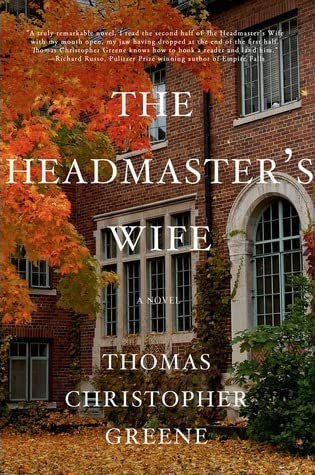
The Headmaster’s Wife is my second outing with Thomas Christoper Green. I read his headmaster's wifenovel Envious Moon almost a decade ago. The Headmaster’s Wife has been on my tbr shelf for quite a while, and I read it in one sitting.

Arthur Winthrop is headmaster/Literature teacher at Lancaster School, an elite boarding school in Vermont. When we first meet him, he’s walking through Central Park reminiscing about a time he’d visited the park with his wife, Elizabeth, and their young son, Ethan. That was years ago, though. Now “standing on the same path…he gives up trying to find this memory.” Instead, he disrobes and starts walking. “All that matters to him is the feel of his bare feet crunching wonderfully on the crusty snow beneath him.”

Of course he is scooped up by the police, and in the interrogation room he tells the story of Betsy Pappas, a young student in his Russian Literature class. At first, Arthur is attracted to Betsy’s mind, but soon he becomes almost obsessed with her. The novel tracks Arthur’s increasingly desperate attempts to woo and possess Betsy.

At the halfway point – after a wallop of a revelation – the story switches its focus to Elizabeth Winthrop. Her story, about being a student at Lancaster, fills in some backstory and allows a glimpse into her marriage to Arthur. It also allows us to meet, however briefly, the Winthrop’s son, Ethan, whose own story is the catalyst for some of the drama in their marriage.

I don’t want to spoil anything because one of the delights of this books (if you can actually call a novel about grief ‘delightful’) is letting the pieces of this puzzle click together in their own time. This is a book that sort of reads like a mystery, but isn’t that what life is at the end of the day? An unfathomable mystery.

Greene suffered a personal tragedy while writing this book. It’s highly worth reading his acknowledgments if this is something you generally skip when you read.

Highly recommended.

The Family Upstairs – Lisa Jewell

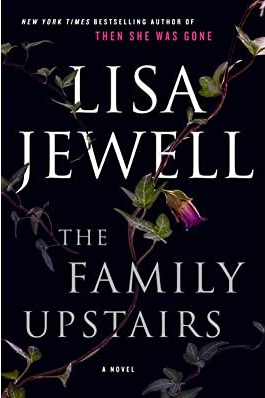
familyupstairsJust when I thought nothing was going to really distract me from this Covid-19 craziness, I dove into Lisa Jewell’s novel The Family Upstairs. I am a Jewell fan to begin with and I usually have a couple unread books by her on my shelf…you know, in case of a reading emergency. I think this pandemic qualifies and, Holy Smokes, did this book ever deliver.

There are three separate narratives in this novel. There’s Libby, a twenty-five-year-old kitchen designer who lives in St. Albans, a commuter suburb just north of London. On her birthday, she receives notice that she has inherited a house in Chelsea, an extremely desirable London neighbourhood. (And by desirable I mean the house is worth millions…of pounds.) The thing is, the house comes with some baggage…including three dead bodies.

That’s Henry Lamb’s story to tell. He grew up in that house with his parents and younger sister. His father was “the sole beneficiary of his own father’s fortune” and his mother was “a rare beauty.” When Henry is eleven and his sister nine, their lives begin to unravel. First of all, Mr. Lamb has squandered the family fortune and then Birdie Dunlop-Evers and her partner, Justin,  arrive.

It all happened so slowly, yet so extraordinarily quickly, the change to our parents, to our home, to our lives after they arrived. But that first night, when Birdie appeared on our front step with two large suitcases and a cat in a wicker box, we could have never guessed the impact she would have, the other people she would bring into our lives, that it would all end the way it did.

The third story belongs to Lucy, a woman we meet in Cote d’Azure where she is living rough with her two young children, Marco and Stella. With no money, and no passport, Lucy must make a difficult choice to protect her children and save herself.

What do these three very distinct and separate stories have to do with each other? Obviously I am not going to tell you, but let’s just say this…I literally could NOT put this book down. Jewell’s trademark is writing twisty plots filled with secrets dying to be revealed. The added bonus is that she’s a great writer and her characters are always believable. Sometimes with books that depend on plot twists, characters get short shrift. Not when Jewell writes them. I happily followed the three separate story threads, trying to race ahead to see if I could figure out how they all belonged together.

The Family Upstairs has everything I love in a book: great writing, an unreliable narrator, sinister characters, secrets galore and a not-too-tidy ending. Story perfection – pandemic or not.

Highly recommended.

Where the Crawdads Sing – Delia Owens

Delia Owens’s debut novel Where the Crawdads Sing has the distinction of being the where+the+crawdads+singbook we discussed at my book club’s first ever virtual meeting. It was chosen for our March meeting, but of course those plans were canceled due to Covid 19. I had started the book and then put it aside. When we decided to meet virtually, I picked up the book again and read it straight through. It’s kinda un-put-downable.

The novel opens in 1969 with the death of Chase Andrews beloved son of one of the town’s most influential families, and although this death (was there foul play?) is significant, this is really Kya’s story, which begins in 1952.

Kya Clark is the ‘Marsh Girl’. She lives in a rundown shack outside of Barkley Cove, a small town on North Carolina’s coast. Kya, just six when the novel opens, lives with her older siblings and her parents. Hers is a life filled with the wonders of the natural world, a joy she shares with her brother Jodie, who is 13. One day “she saw her mother in a long brown skirt, kick pleats nipping at her ankles, as she walked down the sandy lane in high heels.” Her mother has left the marsh before “But she never wore gator heels, never took a case.”  Her mother doesn’t return, and “over the next few weeks, Kya’s oldest brother and two sisters drifted away too, as if by example.”  Then Jodie, her closest companion, unable to endure their father’s drunken rages any longer, leaves, too.

From a very young age, out of necessity, she learns how to live in harmony with the world around her and the isolation doesn’t bother her until one day she meets Tate Walker out on the water. Tate proves to be a balm to her loneliness and over the years, as he teaches Kya to read and they explore the coastline, they fall in love. Even though it might not seem realistic because Kya lives alone in a shack without running water or electricity – she is, in fact, a wild child in every sense of the world – it’s actually a relationship that makes sense. Tate, too, cares deeply about the natural world, and sincerely cares about Kya.

Kya proves herself to be a resilient, resourceful and incredibly sympathetic character. Owens takes her time with Kya, allowing us to understand her life. Tate, too, is well drawn. Chase is little more than a caricature, which I suppose doesn’t really matter in the whole scheme of things.

Owens writes beautifully about the natural world, which makes sense considering she is a wildlife scientist. It’s impossible not to be totally immersed in Kya’s secret world. Kya understands that “Marsh is not swamp. Marsh is a space of light, where grass grows in water, and water flows into the sky.” Her observations about nature and her place in it are downright beautiful.

Some readers will likely be thrilled by the novel’s final twist. I wasn’t so fussy about it, but who cares, really. There’s a reason everyone and their dog has been talking about this novel. It’s pretty damn awesome.

Highly recommended.


We Are Still Tornadoes – Michael Kun & Susan Mullen

Yes, it was a million years ago, but I do remember that first year of university right after high school. Most of my friends went away, but I stayed home. This was before the Internet and way before long distance was cheap/free. How did we keep in touch? We wrote letters.

I was a big letter writer back in the day. I had a zillion pen pals and then when all my friends went off to university, I wrote letters. I miss letter writing because, while it’s not as immediate as sending an e-mail, it gives you the opportunity to think about what you want to say, to catalogue the minutiae of your life and allow your recipient to have a little time capsule of your thoughts and feelings. It’s kinda cool.

tornadoesThat’s what Scott and Cath do in Michael Kun and Susan Mullen’s epistolary novel We Are Still Tornadoes. Cath has gone off to Wake College in North Carolina, but Scott has stayed home. He’s currently working in his father’s men’s clothing store — a job that is the subject of much derision until it’s not.
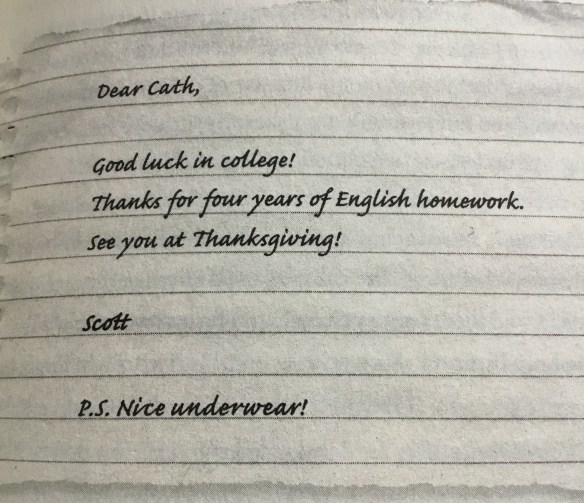
Cath and Scott have been besties since they were kids. They live across the street from each other and know each other, in some ways, better than they know themselves. Of course, this relationship comes with the requisite squabbles and misunderstandings, but mostly they are each other’s best and most loyal cheerleaders.


Their correspondence — which starts with the note Scott leaves in Cath’s suitcase — is  a joy to read. From these inauspicious beginnings, the two trade stories about their daily lives, their struggles to fit in or, in Scott’s case, figure out what he’s doing with his life. When things happen to them – good or bad – they turn to each other, as they always have. Cath meets new people; Scott longs for an old girlfriend; their lives, as lives often do, become more complicated.

tornadoes1

The novel takes place in 1982 – so just a couple years after I would have graduated from high school – and it is peppered with pop culture references (particularly musical) which I appreciated. Imagine talking about Thriller as if you were hearing it for the first time! Imagine going to see English Beat in concert!

I laughed-out-loud on more than one occasion, particularly at Scott (his sense of humour was totally my jam).

As for whether your parents are being weird, I don’t know how to answer that. The only time I ever see your mom is when she forgets to close the shade in the bathroom when she’s taking a shower, and even then it’s only if I feel like walking all the way over to my closet to get my binoculars, take them out of the box, walk back to the window, etc. It’s a whole production.

Ultimately, We Are Still Tornadoes is a coming-of-age story, but it is also a story about friends and how amazing it is to have one who, even when they let you down, always finds a way to pick you back up. I loved it.

Highly recommended.

The Fountains of Silence – Ruta Sepetys

Ruta Sepetys has a gift. Well, she has many gifts, to be fair, but I particularly admire her ability to write characters that absolutely lift off the page and linger in your imagination long after the last page has been turned.

At my high school, we introduce readers to Sepetys in grade nine, when we read Between Shades of Gray. I have yet to encounter a student, even  those who identify as non-readers, who doesn’t rip through that book, many reading way ahead of the class. In grade ten, when we introduce Salt to the Sea there are very few groans. Again, students quickly become wholly invested in the stories of the characters. When I read the final few pages out loud to my grade ten classes in the fall, I had to stop several times because I was so close to tears I couldn’t get the words out. That’s how you know these characters have become real to you, I guess: you care about their fate.

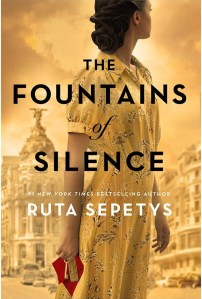
fountainsI was very excited to read Sepetys’s latest book, The Fountains of Silence, because I just knew that I was going to meet a new cast of characters to fall in love with, and I wasn’t wrong.

Daniel Matheson is almost nineteen when he travels to Madrid with his parents during the summer of 1957. His father is an oil tycoon from Texas, and his mother is originally from Spain. Daniel’s dream is to become a photo journalist, but his father disapproves. While Mr. Matheson does business, Daniel takes pictures, and in doing so he starts to see that sunny Madrid is one city to tourists and another to people who struggle beneath Francisco Franco’s yoke.

Ana works in the hotel and is assigned to help the Mathesons. Her story is one of poverty and struggle. Her father was executed and her mother imprisoned and “Her parents’ offense has left Ana rowing dark waters of dead secrets. Born into a long shadow of shame, she must never speak publicly of her parents. She must live in silence.”

Ana and Daniel feel an instant attraction to each other, but it’s the classic case of being from opposite sides of the social spectrum. There is so much Ana wants to say and can’t, and so much that Daniel doesn’t understand, but certainly will.

Although Ana and Daniel’s story is central to the plot, there are other compelling characters in this book, including Ana’s older brother Rafa and his childhood friend, Fuga; Ben, a seasoned journalist who takes Daniel under his wing, and Puri, Ana’s cousin who works at a local orphanage. Although Ana and Daniel will take up most of the space in your heart, all the characters you’ll encounter are compelling and interesting.

Once again, Sepetys has mined history to find her story. This one concerns the thousands of children who were stolen from their parents and adopted by more ‘suitable’ families. It also provides a window into the period of the Spanish Civil War and the years immediately following, when “Helpless children and teenagers became innocent victims of wretched violence and ideological pressure.”

Their stories deserve to be told and Sepetys does them, and us, a great service by telling them.

Highly recommended.


Before We Met – Lucie Whitehouse

86364353-FF33-4875-B41D-4A13891EA2B3When Hannah’s husband, Mark, doesn’t arrive home from a business trip as planned, Hannah is sent down a rabbit hole of lies. Sounds like every other thriller, right? I can happily say that Lucie Whitehouse’s novel Before We Met is a cracking good read that had me turning the pages way past my bed time.

Mark and Hannah met in NYC where Hannah had been living and working for an advertising agency. Mark was there on business, but when the relationship headed into serious territory they made the decision to return to London, the home base for Mark’s successful IT company.

When Mark doesn’t get off his flight and doesn’t answer his phone, Hannah starts to panic, but not in the ridiculous way some heroines in thrillers do. Even though she and Mark have only been married for eight months, she knows him. The novel flashes back to their introduction, via friends, and their courtship. Hannah had really believed that she’d spend the rest of her life in New York, perhaps alone, but Mark changes all that. Now, although she’s unemployed, she’s married to a charming, wealthy and handsome man.

When Mark finally does contact Hannah, with a story that is so crazy it’s almost plausible, Hannah does believe him. Kind of, sort of. But something just doesn’t add up for her and she starts poking around. She wants to make sure that “he hadn’t hidden [anything] to conceal evidence of money spent on hotels and dinners and presents for someone else.”

What I appreciated about Before We Met is that it was full of twists and turns that kept me changing my mind about what was going on, and I love that. I hate it when you can see the plot twist coming from a mile away and when the characters behave in a way that just isn’t realistic.  Hannah is no dummy and she doesn’t take  crazy risks to figure out what in the heck is going on. I was right there with her every step of the way.

So, if you are looking for a well-written page turner with an intelligent, sympathetic main character and a plot that’ll keep you on your toes, I highly recommend Before We Met. It’s a perfect book to curl up with on a cold winter’s night.

The Dutch House – Ann Patchett

dutchI think some authors could write about paint drying and it would be worth reading. Ann Patchett is one of those authors. The Dutch House  is the third book I’ve read by Patchett (Bel Canto, Commonwealth),  and it did not disappoint.

Danny and Maeve grow up in the Dutch House, a gorgeous jewel-box of a house in Elkins Park, a suburb of Philadelphia. The house seems to “float several inches above the hill it sat on.”  Danny and Maeve’s father, Cyril,  had bought the house as a surprise for their mother, Elna, but she didn’t like the house – or so the story goes – and left the family for parts unknown. When the novel opens, Danny and Maeve are 8 and 15 respectively, and being introduced to their father’s ‘friend’, Andrea and her two young daughters Norma and Bright. The arrival of Andrea into their lives changes everything for the siblings.

The Dutch House is not a linear story. It bounces back and forth through time, covering roughly fifty years. Not every writer could manage this sort of narrative as easily as Patchett does. Although the perspective is Danny’s, readers will come to know and love (or hate) many other characters, most notably Maeve, who is the centre of Danny’s world.

She taught me the proper way to hold a fork. She attended my basketball games and knew all my friends and oversaw my homework  and kissed me every morning before we went our separate  ways to school and again at night  before I went to bed regardless of whether or not I wanted to be kissed. She told me repeatedly, relentlessly, that I was kind and smart and fast, that I could be as great a man as I made up my mind to be. She was so good at all that, despite the fact that no one had done it for her.

When Andrea turfs them from their house, their lives are thrown into chaos. They find themselves parking in front of the Dutch House over the years, reminiscing about and redacting their past, never quite able to let go. In some ways, their lives are halted by this connection to a place.

Not much happens in the novel, but at the same time everything happens. Danny and Maeve’s  lives and relationship are the story,  which makes sense, really. As we’re waiting for our own plots to unfold, life is actually happening all around us. The bitter feelings Maeve clings to derail her life, but we don’t really understand that until her mother turns up out of the blue. Or we see what ends up happening to Andrea.

Patchett has written characters you will absolutely come to care about and given them lives which should remind us to care more deeply about our own, and the people we share them with.

Highly recommended.

A Lite Too Bright – Samuel Miller

A Lite Too Bright  is a crazy good debut YA novel by Samuel Miller.  I bought the book alitetoobrightbecause I loved the cover and it had lots of praise from media outlets, not other YA writers (I never trust those, really). I wish that I had read the novel in one or two sittings because it deserves that kind of attention, but I enjoyed the book anyway.

Arthur Louis Pullman III is the grandson of legendary author Arthur Louis Pullman I, whose novel A World Away, is a literary classic and required reading in most high schools, even though Arthur III never got around to finishing it.

Arthur has recently suffered some sort of crisis which requires him to come stay with his Uncle Tim and Aunt Karen in Truckee, “one of those places you go when you’ve thrown in the towel on doing anything extraordinary in your life.”  Arthur’s life has fallen apart, the details of which are only alluded too in visions of him crashing his Camaro into a body of water and feeling himself “floating, untethered by gravity.” Whatever has happened, he’s been removed from the scene of the crime in Palo Alto, perhaps in the hope that he can get himself sorted out.

There’s clearly some family dysfunction. Aunt Karen wants to send him off to some Christian wilderness camp. His father and brother are trying to figure out out to handle what is left of their father’s estate –  which has sustained the brothers but is now beginning to run out.

Arthur Louis Pullman III was something of a literary legend, a sort of Harper Lee-like character who only ever wrote one book, albeit a famous one. At the end of his life, he suffered from Alzheimer’s and he died a week after he disappeared from his home.  A Lite Too Bright follows Arthur I as he attempts to recreate his grandfather’s final week after he discovers what he believes is a clue left specifically for him.

Miller’s novel is an ode to writing, to family, and to living a full and complete life. It’s also a road trip novel, with a complex mystery at its core. Young Arthur is an engaging narrator, desperate to find his grandfather, not in the literal sense, of course, but to understand him, and as he embarks on this journey he discovers that other people are intent on getting close to Pullman Sr., too. As Arthur retraces his grandfather’s last steps, he also comes to terms with his own trauma.

Arthur’s  journey is well worth taking.

A Tree Grows in Brooklyn – Betty Smith

I have been wanting to re-read A Tree Grows in Brooklyn for a long time. It’s one of treebrooklynthose books from my childhood that has stayed with me and that I often recommend to students in my class, based solely on my hazy memories of having loved it. So, now, 45 years after reading it for the first time, I have finally finished spending some more time with one of literature’s most beloved characters, Frances (Francie) Nolan.

Betty Smith’s most famous novel tells the story of young Francie, who comes of age in Brooklyn during the early part of the 20th century. She is the daughter of Katie and Johnny, and older sister to Neeley. Francie’s entire adolescence is captured in Smith’s un-embellished prose (not to say that the writing isn’t beautiful, because it is). The Nolans are poor and they live in a time where every penny counts. Katie is a hard-working janitress and Johnny a singing waiter, when he can get some work (and he often cannot). He’s a beautiful, dreamy man, who mostly drinks. It’s impossible not to love Johnny who believes “how wonderful [it would be if] everything you talked about could come true!” Francie idolizes her father and, in some way, resents her mother.

When the novel opens, Francie is just eleven. Francie and her brother are already industrious children. She and Neeley

collected rags, paper, metal, rubber, and other junk and hoarded it in locked cellar bins or in boxes hidden under the bed. All week Francie walked home from school slowly with her eyes in the gutter looking for tin foil from cigarette packages or chewing gum wrappers. This was melted in the lid of a jar.

I remember, as a kid, being fascinated with how the Nolans stretched every single penny. How the pennies Francie earned by bringing her junk to the junkman gave her the privilege of going into a store and “What a wonderful feeling to pick something up, hold it for a moment, feel its contour, run her hand over its surface [because] her nickel gave her this privilege.” I probably read this book for the first time in the early 1970s and I remember feeling awed by the fact that Francie had nothing. Although my parents weren’t rich, we were always warm and fed and Francie’s sort of poverty was foreign to me.

But I think what makes Francie such a remarkable and beloved character is her resilience. And her capacity for hope. Although her circumstances were often dire, she is a girl who believes in limitless possibilities and isn’t afraid to work hard to achieve them. I admire that about her. As a kid, I loved that Francie was a reader and a writer because I loved both of those things, too. When Francie read she was “at peace with the world and happy as only a little girl could be with a fine book and a little bowl of candy and all alone in the house.”

A Tree Grows in Brooklyn is one of those books that captures a simpler time. It’s anecdotal in that sometimes we have little glimpses into the lives of other characters, and there are pivotal moments in Francie’s life that are beautifully rendered. It’s also a modern book, given when it was published (1943). In one instance, after Francie meets and falls in love with a young soldier, but declines to spend some private time with him, she asks her mother if she should have gone with the young man.

As a mother, I say it would have been a terrible thing for a girl to sleep with a stranger – a man she had known for less than forty-eight hours. Horrible things might have happened to you. Your whole life might have been ruined…. But as a woman…I will tell you the truth as a woman. It would have been a very beautiful thing. Because there is only once that you love that way.

Yes, the book is dated. Yes, there are moments of racism and sexism. But it is also a time capsule. It is a full-hearted look at a time and place that no longer exists and captures the life of a girl who, like a tree growing up through the cracks in cement, reaches for the light.


A Velocity of Being – M. Popova & C. Bedrick

Marie Kondo says that your possessions should spark joy.  She also says that about 30 books is the magic number. She and I would not get along. At all. Books are talismans and touchstones and time machines. I wish that I still had every book I ever owned, but we moved a lot when I was growing up and I’ve moved a lot as an adult and it’s just not possible to save everything. Still, like Stephen King, I believe in the “portable magic”of books.

So do the people in Maria Popova and Claudia Bedrick’s beautiful book A Velocity ofvelocity of being Being. They’ve gathered letters from a variety of well-known (and less well-known) artists, writers, thinkers, scientists, musicians and philosophers. These letters are addressed to young readers and each letter is accompanied by bookish art. It’s a win-win book for me.

Popova begins the book’s introduction this way

When asked in a famous questionnaire devised by the great French writer Marcel Proust about his idea of perfect happiness, David Bowie answered simple: “Reading.”

I couldn’t agree more. I have whiled away many wonderful hours with books. My love affair began early. Both my parents were readers and there were always books in my house. My mother read to my brothers and me from the time we were babies and I have very specific memories of her not being able to get through O. Henry’s story  “The Ransom of Red Chief” without breaking down in uncontrollable giggles. She loved Uncle Wiggly, too and Robert Louis Stevenson’s A Child’s Garden of Verse.

When I started reading on my own, I fell in love with the Bobbsey Twins and Trixie Beldon and Cherry Aames. I was really an equal opportunity reader. So reading A Velocity of Being is like being with my tribe. These are people who, like me, understand the particular joys of words words on a page. Their stories and recollections made me smile, laugh, tear up and nod my ahead in agreement.

For example, poet, essayist and naturalist Diane Ackerman writes “No matter where life takes you, you’re never alone with a book, which becomes a tutor, a wit, a mind-sharpener, a soulmate, a performer, a sage, a verbal bouquet for a loved one. Books are borrowed minds, and because they capture the soul of a people, they explore and celebrate all it means to be human. Long live their indelible magic.”

Rebecca Solnit, writer, historian and activist, reminds us that although “Nearly every book has the same architecture – cover, spine, pages – […] you open them onto worlds and gifts far beyond what paper and ink are, and on the inside they are every shape and power.”

And Helen Fagin, born in 1918, reminds us that “To read a book and surrender to a story is to keep our very humanity alive.”

All proceeds from the sale of A Velocity of Being will benefit the New York public library system. Really, everyone should have a copy. I can’t wait to share some of these letters with my students in the fall…and perhaps even have them write their own odes to reading.