The Elegance of the Hedgehog by Muriel Barbery

Several months ago Muriel Barbery’s novel The Elegance of the Hedgehog was chosen as the book for the bookstore reading group I lead. We have a sort of willy nilly way of choosing our books and this novel ended up on the top of the heap. When we came together to discuss it a month later, other than the woman who had thrown it into the pile, no one else had finished the book- including me. I got about halfway through…and I just really didn’t like the book at all. So imagine my dismay when the novel was chosen by my longstanding book club as our first novel for our new reading year! I had no choice but to finish the book.

So, I started again. And strangely, this time around, I didn’t find the book so grating. That’s not to say that I found it all that plausible, either. Still, I did manage to get through it.

Barbery’s novel tells the story of Renee, a concierge at an elegant apartment building in Paris.

I am short, ugly and plump, I have bunions on my feet and, if I am to credit early mornings of self-inflicted disgust, the breath of a mammoth. I did not go to college, I have always been poor, discreet and insignificant. (19)

Renee has, despite what she considers her considerable flaws, a deep and abiding love for literature, art and music. Seriously, the novel opens with a rumination on Marx – which is perhaps the reason why I didn’t groove to the novel straight away the first time around: I know nothing about Marx.

Paloma lives in the building with her parents and older sister. At twelve, Paloma is already sick of the world and everyone in it.

My parents are rich, my family is rich and my sister and I are, therefore rich….Despite all that, despite all this good fortune and all this wealth, I have known for a long time that the final destination is the goldfish bowl. How do I know? Well, the fact is that I am very intelligent. Exceptionally intelligent. (23)

The Elegance of the Hedgehog is about appearances. Renee is forever fearful about giving away her love of the finer things; after all, she’s just a concierge. Paloma,  is keeping a journal of profound thoughts and plotting her own death. And then into their lives comes a Japanese gentleman named Kakuro Ozu. He sees straight through these women, into their very heart of hearts and changes them in ways they might have never imagined.

This novel was a sensation in France. As with any translation, it’s important to remember that you are not reading it in its original form; something is bound to be lost in the translation no matter how good it is.

I have a feeling that when we discuss this novel tomorrow night, most everyone will have loved it. I didn’t love it (in fact I didn’t like the ending at all!), but I did see the novel’s charms- even though I often found the novel pretentious (all these mini-lessons on art and literature) and perhaps just a tad contrived.

Talking to the Dead by Helen Dunmore

talkingdead

The events of Helen Dunmore’s beautifully written novel Talking to the Dead take place during a blazing summer on the Cornwall coast. Nina has come to spend time with her sister, Isabelle, who has just given birth to Antony. It is a difficult labour and delivery and Isabelle is having a slow recovery.

You don’t look very alike, Susan said yesterday. I wouldn’t have guessed you were sisters. (29)

Susan has been hired to care for Antony while Isabelle recovers from the complications of Antony’s birth. Although the sisters are, as Susan notes,  unalike physically, they share the bond of family: an emotionally distant mother who worked as a potter, a drunkard father and the crib-death of their little brother, Colin.

They also share knowledge, perhaps suppressed, about the death of their little brother. It is during the hot days that follow that a family secret is revealed and Nina begins an illicit affair that sends shrapnel through the house Isabelle and her husband, Richard, have leased for the summer.

I’m a Dunmore fan. She’s a beautiful writer and much of the prose in this slim volume is breathtaking. So I am going to attribute the fact that I didn’t tear through this  novel (only 214 pages!) to the fact that I’ve had a serious case of book lethargy over the last few weeks. After all, like all of the Dunmore novels I’ve read – as literary as they are – this one has an element of psychological suspense. The pace isn’t fast though; information is revealed slowly, like veils pulled back one at a time. Under normal circumstances, this wouldn’t be a problem for me…like I say, I was in a bit of a slump.

If you haven’t yet read Dunmore, you really should.  She’s quite remarkable.

Dismantled by Jennifer McMahon

I was so excited to be given this book which had arrived at the bookstore where I used to work. The manager there knew I was a huge fan of McMahon’s novel Promise Not to Tell, and so she passed this along. Dismantled is the story of the Compassionate Dismantlers, four art students: Tess, Henry, Winnie and the charismatic Suz. The Compassionate Dismantlers believe that “to understand the nature of a thing you have to take it apart.” What they really believe, it seems, is that you can ruin someone’s career and set fires and manipulate lives for your own personal gain. At the end of their post-graduation summer in a cabin by the lake, Suz is dead and the remaining Dismantlers go their separate ways. Flash forward ten years. Henry and Tess are unhappily married and have a 10 year old daughter, Emma. Winnie has had her own struggles with mental illness. A simple act by Emma sets off a chain of events with far reaching consequences.

Dismantled was a big disappointment for me and it truly pains me to say that because I loved Promise Not To Tell and encouraged everyone I know to read it. For me, there was just too much going on. Was Dismantled a novel about a failing marriage, infidelity, the nature of art, childhood fears, imaginary friends, ghosts – real and imagined? Was it a mystery? Was it a ghost story? Was it a novel about revenge?

Honestly, I really struggled to finish Dismantled and only kept going because I thought maybe the end would justify the rest.  I didn’t like any of the characters and worse, I didn’t care about any of them.

Read Promise Not to Tell instead.

Testimony by Anita Shreve

Testimony

Explosive… Shreve flawlessly weaves a tale that is mesmerizing, hypnotic and compulsive. No one walks away unscathed, and that includes the reader. Highly recommended. – Betty-Lee Fox, Library Journal

Pretty much everyone has raved about Shreve’s latest novel, Testimony. I’ve been a Shreve fan since Eden Close, so I was looking forward to reading this book. The novel opens when Mike Bordwin, headmaster of Avery Academy, a private New England boarding school, views a tape depicting three of the school’s top basketball players having sex with  a female student who is clearly underage. While the story opens with Mike’s point of view, the novel flips back and forth allowing us to see how this event and its aftermath affects everyone concerned: the so-called victim, the three boys, their families and even members of the press called upon to report the event once the story is leaked from the school’s hallowed halls.

Shreve is  a talented writer and she manages to make individual characters come alive in this novel by employing third, first and even second person points of view. When the young girl speaks, she seems every bit like a fourteen year old, both naive and culpable. One  boy’s mother speaks in the 2nd person – perhaps to distance herself from the news that her son has done something reprehensible, inexplicable.

It may seem odd that the story’s inciting action is revealed in the novel’s opening pages, but as it turns out, the story unravels to reveal another event which contributes to at least one of the boy’s bad decisions. Silas’s story is heartbreaking and, for me at least, he  carried much of the story’s emotional weight on his shoulders.

We had an excellent discussion about this novel at Indigo’s book club. The ripple effect this event sends through the school and community- upsetting lives and relationships- was immensely powerful. In less confident hands, the novel might have slipped into tabloid sensationalism. Not for Shreve; she’s far too good a writer and Testimony is far too good a book.

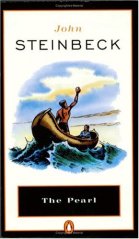
The Pearl by John Steinbeck

pearl

I taught The Pearl at summer school this year. Although I have read a couple other Steinbeck novels, I’d never read this one. It’s a great little novella to teach because of its simplicity and easily recognizable themes of greed and hope.

Kino and his wife Juana lead a simple life in La Paz, Mexico around 1900. Kino is a pearl diver, depending on the canoe passed down through the generations and his own work ethic.  He’s a man content with his lot in life because he appreciates what he has. When his infant son, Coyotito, is stung by a scorpion it sets off a chain of events that not only ruins Kino, but upsets the delicate balance of the natural world (if only metaphorically) and the community in which Kino had so happily lived.

The Pearl is an accessible novel. It gave us lots to talk about – do you need money and possessions to make you happy? Should you judge a man by the clothes he wears or his character? Is violence ever justified? Today’s teens often do think that money buys happiness and if ever there was a novel to disprove this assumption, The Pearl might well be it.

If I were just reading it for pleasure, though, I might have been disappointed. I’m not a gigantic fan of Steinbeck’s writing at the best of times (although he certainly deserves his place in that list of great American writers). The Pearl is simplistic and at times unrealistic (which likely has to do with the fact that it’s a parable which comes from the oral tradition of storytelling). As it teacher it offered me lots to work with; as a reader it was less enchanting.

The Kindness of Strangers by Katrina Kittle

Man, this was a hard book to read and, strangely enough, a hard book to put down. Katrina Kittle’s novel tells the story of widowed, Sarah, and her two sons, Danny, 10, and Nate, 16. Like many other novels these days, Kittle employs alternating viewpoints, allowing the story to be told (mainly) from Sarah and Nate’s points of view. And Jordan’s.

In fact, this is Jordan’s story. He’s a classmate of Danny’s. One day Sarah sees him walking along the road in the pouring rain and she stops to pick him up. He seems ill, more than ill and when he asks to stop at a service station port-a-potty to be sick, she does. Her mother senses are jangling like crazy and when she goes to check on him, she discovers that he’s collapsed with a hypodermic needle jabbed in his neck.

Jordan’s mother, Courtney, is Sarah’s best friend, but Jordan’s desperate act opens a dark door into his life and this story asks Sarah and the reader to step through it. The Kindness of Strangers is about the worst kind of abuse and it doesn’t shy away from the topic.  Sarah and her sons are barely recovered from the death of their husband and father when they are called upon to help Jordan. In some ways the social network depicted in this novel seems like a best-case scenario; Jordan has some caring adults in his corner, but to live in today’s world is to know that that is often just fiction.

Kittle does a terrific job of getting us into Sarah’s headspace: her horror over what her best friend has been accused of, her horror over what Jordan has suffered, her struggle to balance her own issues with the day to day business of running a house and business and looking after two sons.  She was equally adept at letting us see what motivates Nate, a character who is both flippant and incredibly mature. Finally, Jordan’s voice is heartbreaking; the mother in me nearly wept every time he spoke.

The main story of The Kindness of Strangers is bracketed with chapters from Danny.  I think I understand why his is the first and last voices we hear, but I don’t think losing those two chapters would have harmed the book in anyway.

Not everyone will be able to stomach this novel’s subject matter, but if you think you can, it’s a fantastic book about a very serious topic.

Envy by Kathryn Harrison

envy

I have mad love for Kathryn Harrison. I think she’s a beautiful writer and she often tackles difficult subjects, train wrecks from which you can not turn away.

Envy is the story of psychoanalyst Will Moreland. The landscape of his life is pitted with estranged relationships (his identical – save for the brother’s wine-stain birthmark – twin, Mitch); death (his young son, Luke, killed in a boating accident) and a strained sexual relationship with his wife, Carole (they still do it, but not face to face and Will isn’t allowed to touch her).  From these more-connected-than-you-think threads, Harrison weaves a story which is often funny, sometimes creepy, and slightly over-wrought (particularly near the end).

The novel opens as Will is about to return to his alma mater  for his 25th reunion. He’s clearly not interested in the majority of his classmates. He’s on the lookout for two people in particular: his brother, whom he hasn’t seen since he married Carole 15 years ago and Elizabeth, his college girlfriend.  His brother is a no-show. Elizabeth is there, but their reunion brings to the surface a disturbing revelation.

There are elements of Envy which revisit  some of the themes Harrison has used before in her work: sex used as power, grief, incest. It’s one of the reasons why I like her work so much- she’s practically fearless. Still, I didn’t love this book. I understand Will is traumatized by the death of his young son. I understand that as a professional in the mental health field he’s likely to be less astute about his own feelings and motives, but Envy (for me at least) suffers under the strain of too much plot. For instance, I liked Will’s dad, but do I care about his extra-marital relationship or his second career as a photographer. Not particularly.

And I didn’t like the ending all that much.  Some pretty devastating things happen in this novel, yet Carole and Will seem to move past it all almost effortlessly.  Since the book is told entirely from Will’s point of view, Carole’s feelings about the loss of her son, her struggles to carry on, her own traumatic experiences are exposed only in dialogue and only at the very end. On the other hand, Will examines and re-examines his feelings, sort of distantly and myopically, though. Sometimes I just wanted to see him as  a middle-aged man trying to do his best. And who, might I ask, is paying the least bit of attention to Samantha, the couple’s surving child?

Still, it’s Kathryn Harrison and I’ll take one of her books over just about anything else out there any day of the week.

The Story of Edgar Sawtelle by David Wroblewski

sawtelle

When B. pulled The Story of Edgar Sawtelle out of her bag at last month’s book club reveal there was a silent sigh of dismay. I know I felt it. Despite the fact that the book has garnered heaps of praise and was flying off the shelf at Indigo last summer, I had no desire to read it. When my friend said she was going to take it with her when she went to England with her mom I said: “Don’t do it; this book weighs a ton!”

As it turned out,  of the ten members of my book club I was (along with B.) the only person who read it. Er…finished it. One person got about half way through, a few others read 50-100 pages. The book is l-o-n-g…562 pages but lest you think I actually judge a book by its length, let me say that The Story of Edgar Sawtelle is very well written. I would have said that dog lovers would eat this book up- but this wasn’t the case with the dog lovers in my book club; none of them finished.

It’s hard to put my finger on exactly why I didn’t love this book in the way most others have- well, the critics at least, who have compared this book to Shakespeare, an “American Hamlet” even (Mark Doty). The book concerns the Sawtelle family, parents Trudy and Gar and their son, Edgar, who is born mute. They live on a farm in Wisconsin where they breed dogs known as the ‘Sawtelle’ dogs, remarkable because they can read Edgar’s signs. When Gar’s younger brother, Claude, returns to the farm Edgar’s idyllic life starts to unravel and when his father dies suddenly, Edgar’s grief is palpable. As Claude grows closer to his mother and assumes more of a role on the farm, Edgar becomes obssessed with proving that Claude had something to do with his father’s death.

Things don’t work out quite as Edgar plans though, and he leaves the farm, taking three ‘Sawtelle’ dogs with him. Eventually, though, he returns to the farm to confront his uncle – with dramatic results. (I actually thought the ending was spectacularly melodramatic.)

Why do some books work and others not so much? I can’t fault Wroblewski’s writing. In some ways I felt like he jammed the book with every possible theme, like maybe this debut might mark the beginning and end of his literary career. Ultimately, though, there was just too much ‘dog talk’ – sits and stays and day-to-day kennel business that just wasn’t of interest to me and, in some ways, diluted the book’s larger themes of revenge and love.  It wasn’t that I had a hard time reading the book…I just never really invested my heart in Edgar’s story.

Standing Still by Kelly Simmons

standing

I loved pretty much everything about Kelly Simmons’  novel Standing Still. It’s always a relief to read something you can be excited about after a couple of mediocre books. Standing Still is just a terrific book: part page-turner (there’s an intriguing mystery at this book’s core) and part meditation on marriage and family and the lives women leave behind in order to have those things.

Claire Cooper, mother of three young daughters, spends a lot of time alone because her husband, Sam, travels for business. One night someone breaks into her house and Claire finds him about to make off with one of her daughters. “Take me,” she tells the man. “Take me instead.”

The man does take Claire and over the week of her captivity the reader has access to   Claire’s thoughts about her children and husband, as well as to her growing relationship with her captor, a relationship that proves to be far more profound and moving than you might expect. Their relationship becomes one of intimacy and, dare I say it, friendship and I know there is probably some psychological explanation for what happens between kidnap victims and their abductors, but I don’t think that explanation would actually suffice in this case. Claire is carrying a lot of emotional baggage and for the first time in her life she is forced to confront some of it. It is her time with this unlikely ‘therapist’ that makes healing possible.

On top of all this human drama, Simmons is a beautiful writer. Claire is a fully realized character, fragile and brave. Her unnamed captor is equally interesting –  a scene towards the novel’s conclusion where Claire makes the observation that, sleeping next to him will be the last time she’ll ever feel this safe (232) is both ironic and heartbreaking.

I also really loved that Claire is a woman who is trying to reconcile motherhood and marriage with the fact that she was, once, a very successful career woman. I loved her wild past, her ability to fall in love with a man based on a single characteristic, her yearning for that simple pleasure once again.

This was a book I couldn’t wait to get to at the end of the day…and one I was sorry to finish even as I was racing to the end.

The Book of Negroes by Lawrence Hill

arts_lawrence-hill2

Everyone has been talking about Lawrence Hill’s novel The Book of Negroes for the past few months. When I worked at Indigo, it flew off the shelf; everyone wanted to read it. It’s one of those books – topical, controversial, well-written, award-winning  and with a central character that it is impossible not to admire. And I did  admire her, but  I didn’t love this book. I finished The Book of Negroes a few days ago and I’ve been trying to figure out what it was exactly that failed to inspire me to talk about it in absolutely glowing terms.

I am a child of the 70s. By that I mean, I was a teenager when Roots hit the small screen. Every night for however many nights that mini-series was on the tube, my family and I would gather around the TV, mesmerized and horrified by Kunta Kinte’s story. I haven’t seen it since, so I have no idea whether or not it holds up, but that story devastated me and made me ashamed, for the first time in my life, to be white. The Book of Negroes failed to reach me on some level.  Does that mean in the years since I’ve seen Roots I’ve just gradually become desensitized? God, I hope not.

Aminata Diallo, born in Bayo, West Africa, in 1745, is captured by slave traders when she is just eleven. We have barely settled into the rhythm of her life as a ‘free-born Muslim’ adored by her parents, before they are killed and she is captured. What follows is her life story. No question, it makes for fascinating, accessible and easy reading. But there was something missing for me, some emotional centre.

Aminita reaches America  after a long, brutal journey across the ocean. She is sold and quickly learns a new language and a new way of life. It is impossible not to admire her: she’s smart and resilient and tough. She has to be as she endures one tragedy after another.

And perhaps this is where I feel let down by the book: despite knowing Aminita’s story, I never felt like I knew her. In telling the story of her life, she relays the facts, all but stripping the emotion from them. The slightly unbelievable denouement, therefore, had little impact on me.

Should you read this book? Absolutely. Is it worthy of all the praise?  Yes, of course it is, because we should always be reminded that the struggle for equality is ongoing, that people still suffer because of their race or religious beliefs. Let’s face it, the world hasn’t really come all that far since Aminita’s day.

There’s a part of me that feels slightly guilty that I didn’t love it.  But I am glad I read it.