Living Dead Girl – Elizabeth Scott

living

Elizabeth Scott’s 2008 YA novel Living Dead Girl garnered a lot of praise when it was published. Voted Best Book by the American Library Association, Voya Editor’s Choice and Teen Reads Best book in 2008, among others, Living Dead Girl seemed to be on everyone’s radar when it came out. In 2008 I was just returning to teaching after many years doing other stuff. I wasn’t reading a lot of teen fiction and I’d never heard of the book. Now that I am back in the classroom I spend a lot of time researching YA fiction in an effort to stock my classroom library with books that will appeal to my students. At just 170 pages, this riveting novel will certainly appeal to mature readers.

Alice was abducted by Ray just before her tenth birthday. For five years he has held her captive, physically, sexually and mentally abusing her.

Once upon a time, I did not live in Shady Pines.

Once upon a time, my name was not Alice. Once upon a time, I did not know how lucky I was.

Alice is fifteen now. She has been Ray’s prisoner for so long she no longer even dreams of escape even though she is left alone all day while Ray goes to work. She has been taught from a young age that if she does run away, Ray will return to Alice’s home and kill her parents. Even though Alice can barely remember the girl she was before, she know that she has no choice but to protect her parents. She knows what happened to the Alice before her.

…I keep waiting for Ray to tire of me. I am no longer short with dimpled knees and frightened eyes…I am 15 and stretched out, no more than 100 pounds. I can never weigh more than that. It keeps my breasts tiny, my hips narrow, my thighs the size Ray likes.

Half starved (she seems to live on yogurt), Alice’s days consist cleaning and watching soap operas as she waits for Ray to get home. Although the abuse is not described in detail, enough is alluded that readers will be left feeling very uncomfortable.

The thing is, you can get used to anything. You think you can’t, you want to die, but you don’t. You won’t. You just are.

Living Dead Girl is almost relentlessly grim, but it’s the kind of book that you just can’t put down. I doubt I will forget Alice anytime soon.

The Coldest Girl in Coldtown – Holly Black

Thank goodness for Holly Black — she’s put the bite back into vampire fiction.coldest  If you’ve been playing the home game, you’ll know that Stephenie Meyer pretty much took fangs and sex out of the vampire equation with her hugely popular Twilight series.  I didn’t hate the first book, but it went downhill fast afterwards. I loved The Coldest Girl in Coldtown. The prose sparkles, but the vampires don’t, so it’s win-win for lovers of vampire fiction.

Tana woke lying in a bathtub.

It doesn’t take very long for Tana and the reader to realize that something just isn’t right. Tana had been attending a sundown party and had locked herself in the bathroom to avoid her ex boyfriend, Aidan. Exiting the bathroom the morning after, Tana is aware of the quiet.

She’d been to plenty [of sundown parties], and the mornings were always full of shouting and showers, boiling coffee and trying to hack together breakfast from a couple of eggs and scraps of toast.

What Tana finds instead, as she moves through the house which smells of spilled beer and “something metallic and charnel-sweet,” are the bodies of her classmates “their bodies pale and cold, their eyes staring like rows of dolls in a shop window.”  And we’re only on page five, people!

The Coldest Girl in Coldtown takes the best parts of standard vampire mythology and ups the ante. The vampires in this book are rock stars, revered and coveted.  Black builds a mythology that is believable. Patient zero in Black’s world is Caspar Morales, a vampire who decided that he wouldn’t kill his victims, he’d infect them instead. Essentially, you’re bitten by a vampire, you’re infected, or Cold.

If one of the people who’d gone Cold drank human blood, the infection mutated. It killed the host and then raised them back up again, Colder than before. Cold through and through, forever and ever.

Pretty soon, the government has no choice but to barricade the infected people (and the wannabes) in places called Coldtowns. People who suspect that they are infected must,  by law, turn themselves in. And once you’re in a Coldtown, there’s no getting out.

As Tana comes to terms with the fact that her friends are dead, she discovers that Aidan is, in fact, not. He’s been bungee corded to a bed and chained beside him is a vampire boy, a boy who “must have been handsome when he was alive and was handsome still, although made monstrous by his pallor and her awareness of what he was.”

This is Gavriel. He is everything a vampire should be: dangerous, cunning, tortured and impossible to resist. (Okay, maybe I am just a little bit fixated on my personal notion of a vampire here, but Gavriel ticks all the vampire ticky boxes for me. )

The Coldest Girl in Coldtown is so good. Tana is smart and resourceful and brave. The book builds a world that is believable and terrifying. It is a world that just is. The book isn’t scary, but it is definitely a page-turner. The descriptions of vampirism are bloody and sensual (without being over-the-top, so there’s nothing sexually graphic).

I raced to the end, concerned for all the characters and their fates.  Should there be a sequel?  Black had this to say on her website:

Coldest Girl in Coldtown was written as a stand-alone. That said, I know what happens next, and maybe someday you will too. Right now, as with Curse Workers, I’m happy with where I left everyone. I’m sure they’ll be fine. Right?

I’m good with that.

Highly recommended.

Off the Shelf – CBC Radio

So I did my second book column on CBC Radio this morning.

Listen to it here.

Here’s what I prepared for the talk about scary books.

Literary historian J. A. Cuddon defines the horror story as “a piece of fiction which creates an eerie and frightening atmosphere. Horror is usually supernatural, though it can be non-supernatural. Often the central menace of a work of horror fiction can be interpreted as a metaphor for the larger fears of a society.” One of the first horror novels was The Castle of Otranto by Horace Walpole, 1764 – probably not going to get too many young people reading that one today.

R.L. Stine is probably the best known writer of horror novels for the middle grader. He’s the author of all the Goosebumps books and then went on to write Fear Street, a series of over 150 titles for older teens. To date he’s sold over 400 million books, so I guess the proof is in the gloopy pudding.

Teenagers love to be scared. No one knows that better than Stephen King, who’s made a career out of scaring us. King said: “horror stories allow us to safely vent our “uncivilized emotions…lifting a trap door in the civilized forebrain and throwing a basket of raw meat to the hungry alligators swimming around in that subterranean river beneath. In addition, for some young people, reading a scary story can be a rite of passage, a way of earning bragging rights: “That didn’t scare me!”

Heart-pounding, palms-sweating, doors locked, lights on – who doesn’t love a good scare? It’s like riding a rollercoaster, thrilling, scary, but ultimately safe. A really good book can creep you out way more than a movie – where the scary stuff is often in your face and you become desensitized. A good scary book can be way more unsettling.

So – in honour of Halloween, here’s a list of my favourite scary books.

I’m going to talk about some of the books in the genre geared for Young Adults – plus one.

First off – here’s a quick guide:

If you want to read a book about vampires – definitely check out Holly Black’s The Coldest Girl in Cold Town.

If you want to read a book about werewolves, check out NB writer Kathleen Peacock’s novel Hemlock.

If you want to read a book about zombies, I highly recommend Ilsa J Bick’s series, Ashes.

If you want to read a book about a ghost hunter, check out Anna Dressed in Blood by Kendare Blake

Now for a closer look at some of my recent scary reads.

Nevermore – Kelly Creagh

It sounds like your typical good girl, bad boy set up…but this book is awesome and super creepy. Isobel is a popular cheerleader who gets partnered up with Varen the goth kid (of course he’s a goth kid with a name like that!) to work on a project about Edgar Allan Poe. There’s your clue right there that things are going to take a seriously gothic turn and they do. I mean Poe’s the granddaddy of creepy and Creagh makes good use of his personal story. Fans of Poe will eat this book up, but even if you’re not a fan or know very much about him, you’ll get gooseflesh reading about the truly nightmarish world and Pinfeathers, the character who inhabits it. There’s a sequel, too, called Enshadowed.

Through the Woods – Emily Carroll

I just read this one last week. It’s a collection of short stories written by Canadian author and illustrator, Emily Carroll. I don’t know anything about art, but I can say that the art in this book is really striking, the colours are kind of menacing. Can you say that about a colour? Anyway – these are stories about dark places and strangers and people who are not whom they seem. The first story is about three girls who live with their father in the woods and one day he leaves them to go hunting and tells them, if I’m not back in three days, head to the neighbours. Of course he doesn’t come back, and then the narrator’s two sisters disappear and the ending will just give you goose bumps. You could certainly read the five stories contained in this volume in one sitting, but I think it’s the sort of book you’ll want to revisit again and again – especially at this time of year.

Miss Peregrine’s Home for Peculiar Children – Ransom Riggs

Fifteen-year-old Jake Portman has a special relationship with his grandfather, who has always been a teller of tales. Thing is, his tales are pretty fantastic and concern children who could fly or make themselves invisible. When his grandfather is killed, Jake goes to Wales to visit the orphanage that his grandfather was sent to during the war and finds out the stories might actually be true. The book is full of pretty dang creepy pictures culled from private collections, but the story itself is magical with a side of monsters.

Plus one.

I had a student a couple of years ago who insisted he’d never been frightened by a book. I promised him that I could remedy that and gave him Stephen King’s novel, It. Okay, anyone around in the 1970s will remember the miniseries starring Richard Thomas aka John Boy Walton and that clown, Pennywise. “They all float down here.” Stephen King is the king (pun intended) of making everyday things scary. He’s also really excellent at tapping into childhood fears – something all great horror fiction does – and nobody captures adolescence quite like he does. I don’t love everything King has written, but I loved It and so did my student.

Read something scary for Halloween. With the lights on, of course!


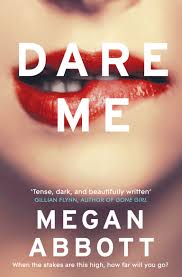
Dare Me – Megan Abbott

daremeWe have cheerleaders at the high school where I teach, but they’re sure as hell not like the cheerleaders in Megan Abbott’s compelling YA novel, Dare Me. These girls are vicious.

Addy Hanlon is the  narrator of this sordid tale.

There I am, Addy Hanlon, sixteen years old, hair like a long taffy pull and skin tight as a rubber band. I am on the gym floor, my girl Beth beside me, our cherried smiles and spray-tanned legs, ponytails bobbing in sync.

Her ‘girl’ is Beth Cassidy, an acerbic teen who spits out insults like bullets. Beth and Addy have been besties since they were young enough to “hang on the monkey bars, hooking [their] legs round each other.” Now they rule their school, part of a cheer squad that makes boys go weak in the knees and girls run for cover when they swagger down the hall, an impenetrable mass of venom.

Ages fourteen to eighteen, a girl needs something to kill all that time, that endless itchy waiting, every hour, every day for something – anything – to happen.

The social order of things is thrown into disarray, though, when the squad gets a new coach.

The New Coach. Did she look at us that first week and see past the glossed hair and shiny legs, our glittered brow bones and girl bravado? See past all the that to everything beneath, all our miseries, the way we all hated ourselves but much more everyone else? Could she see past all that to something else, something quivering and real, something poised to be transformed, turned out, made? See that she could make us, stick her hands in our glitter-gritted insides and build us into magnificent teen gladiators.

Colette French is demanding. On the second day she “takes a piece of Emily’s flab in her fingers” and tells her to “fix it.” The girls discover they can’t fluster her, that she is already bored with their nonsense. Then, Coach dismisses Beth as captain, saying that she doesn’t “see any need for a captain.”

Addy knows Beth’s response, when it comes, will change everything, and it does.

Dare Me is a riveting look at the world of girls on the cusp of adulthood and the woman who allows them a glimpse of what waits for them on the other side. There are no parents here, no sane adults to pull back the reins. Even Coach, who seems dazzling and perfect to the cheerleaders, is soon revealed as damaged and flawed. Addy is particularly taken with Coach and as their relationship morphs into something more intimate, Addy realizes she’s been “waiting forever, my palm raised. Waiting for someone to take my girl body and turn it out.”

I can’t express how  terrific this book is. The writing is dazzling; it was like a mouth full of pop-rocks, you know that candy that fizzes in your mouth? Watching Addy try to navigate her sixteenth year, despite the fact that the world of cheer-leading is totally alien to me, was a thing of horrible beauty.

Highly recommended.

The Raft – S. A. Bodeen

raftRobie, the fifteen-year-old protagonist of S.A. Bodeen’s YA novel The Raft has been back and forth between Hawaii and the island of Midway dozens of times. She lives there with her research scientists parents, but when the novel opens she’s visiting her aunt in Honolulu. When her aunt is unexpectedly called to work on the mainland, Robie isn’t bothered about being alone. She’s used to it and knows how to look after herself.

Looking after yourself on 2.4 square miles of island, as it turns out, is different from looking after yourself in downtown Honolulu. Unfortunately Robie gets accosted on the street one evening — nothing serious — but it spooks her and she decides to take the cargo plane home. Unfortunately, phone and Internet service is spotty on the island and so Robie isn’t able to let her parents know she is coming home. Even more unexpectedly, the plane hits bad weather and goes down. Only Robie and the co-pilot, Max, survive.

This novel is terrific. Like, couldn’t-put-it-down terrific. Robie is resilient and smart and is able to cope with her circumstances better than people twice her age. The raft she floats in leaks, there are sharks in the water — and not much else. It’s impossible to imagine that Robie will make it, but she does.

I don’t want to say too much about the things Robie endures. Once you start reading The Raft you’ll find out pretty quickly because you won’t be able to stop turning the pages. I should also mention that Bodeen slips some compelling stuff about ocean and bird life, conservation and pollution into the mix and it all feels necessary and organic. Robie is at home in this environment and knows “more about ocean fish and seabirds than most post-graduate researchers.” It’s a good thing, too.

Bodeen’s prose is straightforward and Robie’s voice is authentic. In a moment of prescience she remarks: “Lately it seemed there were a lot more days when my life felt less  like luck and way more like suck.”

I’m not one for survival stories, really, but I enjoyed Robie’s tremendously.

Highly recommended.


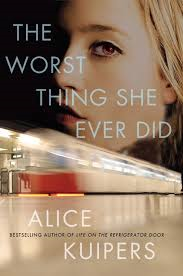
The Worst Thing She Ever Did – Alice Kuipers

worstthing Sophie releases the details of the worst thing she ever did through journal entries and this turns out to be a blessing and a curse in Alice Kuiper’s second YA novel, The Worst Thing She Ever Did. It’s a blessing because we get to hear Sophie’s authentic teenage voice and a curse for the same reason. Teenagers are, by definition, insular and of course no where is this made more apparent than in the pages of a teenager’s diary.

Sophie is keeping this journal at the request of her therapist, Lynda, who tells her that “Writing in here will help you remember.” Sophie doesn’t want to remember, though, and The Worst Thing She Ever Did  takes its own sweet time revealing what it is Sophie is so desperately trying to forget. I’m not suggesting that Sophie’s tragedy is not worth the effort, just that Sophie often teeters on the edge of coming across more like a petulant child than the survivor of a horrific act of violence.

But maybe that is part of what would make this story so compelling to young adults. I think they will recognize themselves in the pages of Kuiper’s novel. Here is a girl who is living her life. Her sister, Emily, is home from art school and Sophie doesn’t varnish their sibling relationship. Sometimes Emily really pisses her off. Sometimes Sophie feels like Emily is the favourite child. Mostly though, Sophie misses her older sister and it is clear that something horrible and unspeakable has happened.

Sophie’s mother is coping with the loss as badly as Sophie is, but the two of them don’t talk about it. In fact, sometimes they “circled each other like cats.” Sophie pretends not to hear her mother crying. There is no joy in the house they share.

There’s no joy for Sophie at school, either. Everything is different. “Everything going on around me – the others, the noise, the ring of the bell to get to class – was so loud it gave me a headache.” Sophie’s best friend, Abigail, has moved on.  Sophie tries to navigate the aftermath of the tragedy (which is only alluded to until almost the end of the novel) and work her way through being a teenager with varying degrees of success. There’s school to contend with and fractured friendships and boys – one boy in particular – and her mother. All of these elements would have been enough for a YA novel and a half, but Kuipers ups the ante here.

If some of the reconciliations seem a tad trite at the novel’s end (I wasn’t really fussy about the subplot concerning Abigail), they don’t really detract from the story’s larger theme: healing takes time. Kuiper’s is a lovely writer and although my feelings about The Worst Thing She Ever Did are similar to my feelings about 40 Things I Want To Tell You, I still think Kuipers is worth checking out.


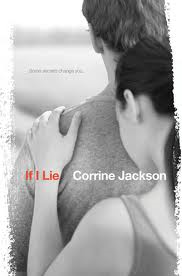
If I Lie – Corrine Jackson

ifilieQuinn, Carey and Blake, the teenagers at the centre of Corrine Jackson’s debut novel If I Lie, seem ill-equipped to deal with the troubles life throws at them. Childhood friends, things begin to unravel in their senior year when Carey and Quinn break up (briefly)  and Quinn discovers she has feelings for Blake. All of this is complicated by the fact that they live in a military town and Carey has enlisted. When the novel opens, the story has already been set in motion and Carey is MIA. Quinn has been shunned by everyone, including her Lieutenant Colonel father because while she and Blake were sharing a private moment under the bleachers, someone snapped a picture and posted it on Facebook. Even though no one knew who the guy was, everyone knew Quinn was the girl.

If it seems complicated – it is. But, then, isn’t high school a complicated time? A time where you often like people who don’t like you back. A time where all your feelings sit like little bombs around your heart, ready to go off any second. A time where friendships splinter over silly things. A time of secrets. And Quinn is carrying around a big secret – one she promised she wouldn’t tell and although it makes her a target she sticks to her word.

If I Lie has a lot going for it – perhaps a little too much. Not only do we have what is happening between Carey, Quinn and Blake – but we also have Quinn’s complicated relationship with her father. Her mother left when Quinn was eleven. Well, she more than left actually; she ran off with her father’s brother – never to be heard from again. Until she shows up. There’s also Quinn’s relationship with George, a veteran she has been charged by her father to help; a punishment that turns out to benefit Quinn in ways too numerous to mention. Really, I think, Jackson was offering up a little lesson about war veterans here and I don’t mean to imply that it’s not a lesson worth learning. It just seemed one more element in an already overstuffed story.

Quinn’s voice is compelling, though. And I liked how the novel navigated her feelings for all the people in her life, without offering up any trite answers. Because if there’s one thing you learn in high school it’s that you don’t have all the answers and that relationships are complicated and the people you care about are worth fighting for.

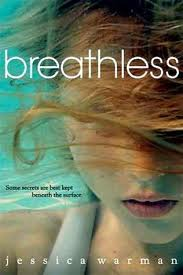
Breathless – Jessica Warman

breathlessA few months back I read Jessica Warman’s novel, Between, and although I didn’t love it straight off it definitely grew on me. A student in my writing class saw Breathless on my bookshelf and told me that I had to read it next. All I can say is that I kept reading for her because there’s really nothing to recommend this book.
Breathless was written when Warman herself was just out of high school and sadly, that’s how it reads. The novel is apparently semi-autobiographical and tells the story of Katie Kitrell, a fifteen-year-old championship swimmer with an alcoholic mother, workaholic father and psychopathic older brother.  When her brother, Will, goes off the deep end again, Katie’s parents make the decision to send her off to boarding school. Breathless ends up cramming every possible teenage trope into its 331 pages: friendship, drinking, religion, sex, drugs, wealth, first love, jealousy, mean girls and damaged girls etc etc.

The characterization is all over the place, too. At the beginning of the novel Katie seems to almost idolize her brother. They spend hours on the roof of their house smoking and talking, but Katie can always sense “his emotional axis shifting a little, off-kilter. It’s something I’ve come to call privately the kaleidoscope pf crazy- shimmering and beautiful in certain lights, paisley and horrifying in others.”

Her parents seem unable to cope. Her father, a doctor, just works more and her mother paints and drinks. In no way is Katie’s family functional.

Once she goes off to school the focus shifts away from her family and we are forced to endure 1) the bitchy pretty girl with whom everyone wants to be friends and her 2) nice but kowtowing friend and 3) Katie’s MIA roommate who suddenly shows up but barely says a word and 4) the most perfect boy in the world who just happens to fall in love with Katie.

Nothing happens, though. This is a coming-of-age story and there are some lovely moments here (it’s clear that Warman has talent) but Breathless  is in desperate need of an editor. It’s biceps not bicep and the glaring error in this sentence almost made me shut the book for good “…all of our hands, white gloves pulled taught  and flawless over out fingers-” Who is editing books these days anyway?

Warman clearly had a story to tell and even at a young age, she had the ability to tell it, but the novel’s uneven characterization and bloodless plot made this a miss for me.

Keep Holding On – Susane Colasanti

keepholdingonNoelle, the narrator of Susane Colasant’s YA novel Keep Holding On,  is just trying to make it through high school so that she can get the hell out of Dodge. (Dodge isn’t actually the name of the town where she lives; Noelle actually calls it “Middle of Nowhere, USA.” ) Every day Noelle wishes she could “be transported to another school in an alternate universe where required learning doesn’t have to involve this traumatic test of survival skills.” Noelle doesn’t stand out, not really, but nevertheless she’s an outsider. Mostly she’s a target because she’s poor; her lunch and clothes are often cause for ridicule. There’s also some stuff following her from her middle school days – a misunderstanding that was blown out of proportion and hangs over her like a dark cloud. The biggest problem in Noelle’s life, besides the jerks at her school who make her life miserable, is her mother.

This one time last year, she came home really late and woke me up when she slammed the front door. Then she whipped my door open. I could see her glaring at me, the light from the hall illuminating the hate in her eyes. She didn’t say anything. She just slammed my door.

Noelle’s mom isn’t abusive per se, but she is neglectful. Noelle can’t remember a time when her mother really looked at her, but it’s certainly been since her stepfather, her mom’s second husband, died of cancer. This was clearly a traumatic event for mother and daughter and yet it’s hard to feel any empathy for Noelle’s mom; she’s just awful.  “There are plenty of days,” Noelle observes,” when mother says less than ten words to me.” Noelle’s biological father isn’t in the picture at all. Then there’s Matt, the boy Noelle likes who seems to like her back at least enough to make out with her – although the fact that they make out is top-secret. Even though you can see the reason for Matt’s need for secrecy a mile away, it still a believable situation for Noelle. Keep Holding On treads familiar teen ground, but the book separates itself from the pack in part because Noelle is immensely sympathetic. She wants, more than anything, to fit in, but what she eventually figures out is that fitting in isn’t nearly as important as finding your own place to belong.

Friends with Boys – Faith Erin Hicks

friends I didn’t know that the author and illustrator of the graphic novel Friends with Boys, Faith Erin Hicks, was  from Halifax until I finished the book. I am not going to let the fact that we are practically neighbours (well, by Canadian standards we actually are!) influence my thoughts about Friends with Boys.

…which overall I liked (although I am by no means an authority on graphic novels and have really only started to read them in any number since I started building my classroom library.) I did feel the novel missed some great opportunities and had some structural problems – but, yeah, liked it.

So, Maggie is starting grade nine. This is a pretty big deal because she has been homeschooled her whole life. She’s super nervous about it. When her dad asks how she’s feeling she says  “It’s only my first day of high school. Nothing to be nervous about. I’m not nervous. I’m not.”

Maggie’s three older brothers, twins Lloyd and Zander and Daniel have already made the transition to high school and as Daniel admits to Maggie, he likes being at school better than learning at home. Of course he’s been there a few years, and is well-known and liked.

School isn’t the only thing complicating Maggie’s life – her mother has left home. Her father says “It’s exactly seventeen years since your mom started homeschooling you lot,” to which her brother Zander replies “Yeah and to celebrate she took off.” There is all sorts of unspoken angst in this situation, which is never satisfactorily dealt with.

And she has a ghost. An actual ghost that she met when she was a kid and whom occasionally follows her around. We never quite find out what the deal is there, either.

Then there’s Lucy and Alistair, the brother and sister who befriend Maggie.  At least we learn why Alistair is a social piranha.

That’s a lot of stuff on the plate of a fourteen-year-old and any of it would could have made a rich and compelling story on its own. I was intrigued by the ghost, loved Maggie’s older siblings and wondered what had happened to the mom. Ultimately, though, I felt like Hicks only scratched the surface of all these stories.