All The Bright Places – Jennifer Niven

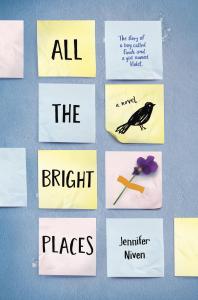
Not all YA books are created equal. When I was a teen in the 70s YA was barely a thing. Basically I went from reading The Bobbsey Twins and Trixie Beldon to reading Jane Eyre and A Tree Grows in Brooklyn. The Scholastic flyer at school offered some options and I can all-the-bright-places-jktspecifically remember reading and falling in love with S.E. Hinton’s That Was Then, This is Now (a book I loved way more than I loved The Outsiders), and Judy Blume’s Forever, but the reading choices certainly weren’t as varied as they are for teens today.  I read a lot of YA now because I teach teens. Lots of it is mediocre. Lots of it is good. Then, every so often, you read a book you just want to tell all your students about. You want every single teen you know on the planet to read it. Jennifer Niven’s All the Bright Places is one of those books.

Theodore Finch is seventeen. He begins his story by asking “Is today a good day to die?” He’s considering this question from “a narrow ledge six floors above the ground.” That’s when he sees the girl, Violet Markey. “She stands a few feet away on the other side of the tower, also out on the ledge…”

This is how Niven begins to tell the story of Finch and Violet. Finch ‘rescues’ Violet, but because he has a reputation as being a freak, a loser, and unstable, the rumour around school is that Violet saved him. From this unlikely scenario, a beautiful friendship springs.

After Finch talks Violet off the ledge he asks her: “Do you think there’s such a thing as a perfect day?…A perfect day. Start to finish. Where nothing terrible or sad or ordinary happens. Do you think it’s possible?”  Just typing that now makes me feel as though I want to cry.

Violet doesn’t seem like a likely match for Finch. She’s “cheerleader popular” and dates Ryan Cross, a movie star handsome baseball star. Still, when the two are paired to participate in a “Wander Indiana” project (part of a course in U.S. Geography), they discover a kinship neither expected. As they travel to various points of interest, they start to trust each other. Violet begins the painful process of shedding the grief of a tragic accident and Finch finds more and more reason to stay “awake.”

One of the things that makes a YA novel great for me is characterization. I want the teens to feel authentic, not like stereotypes. Finch and Violet are beautifully crafted creations, and the people who circle their lives (parents and siblings and friends) are also well-drawn and nuanced. Finch’s mom is broken from her failed marriage; Violet’s parents are over-protective. As a mom of teens myself, I like to see parents in YA portrayed as real people – flawed and messy and trying to do the best they can even when they can’t fix anything at all.

The other element of the novel that Niven handles so well is the issue of mental illness. All the Bright Places is not a “sick lit” book. Finch’s struggles are authentic and nuanced and painfully rendered in prose that is a joy to read. I can’t remember the last time a character has broken my heart, but Finch most certainly did.

I can’t recommend All the Bright Places highly enough. Buy it for every teen you know. Buy it for yourself.


All the Things We Leave Behind – Riel Nason

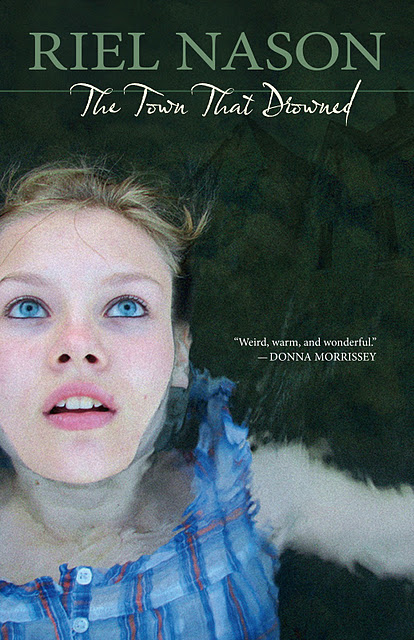
towndrownedA few years back, my bookclub read Riel Nason’s debut novel The Town That Drowned and we all fell in love with Ruby and her younger brother, Percy, inhabitants of a little town called Haventon. Nason’s story drew from actual events: the area was flooded after a dam was built. Anyone who lives in New Brunswick, Canada, where Nason’s story is set, will be familiar with the landscape and many of the place names, even if they don’t quite remember the flood that drowned the town.

All The Things We Leave Behind revisits the Saint John River Valley, this time a fictional town called Riverbend, circa 1977. On this occasion, our narrator, seventeen-year-old Violet, is taking care of the family business while her parents are on a road trip looking for her older brother, Bliss, who disappeared just after his graduation from high school.

The book starts ominously enough as Violet recalls the “boneyard deep in the woods.” She and Bliss discovered the place when they were kids even though “the boneyard’s location is supposed to be secret.  This is the final resting place for the moose and deer that have killed up and down the Trans Canada rielHighway.   When Violet recalls the time she and Bliss had stumbled upon the boneyard, aged nine, she also recalls how Bliss had tried to protect her from the gruesome sight. He assures her they’re never going back, but he also tells her “we can’t let it wreck the whole forest for us.”

Nason weaves Violet’s recollections of her brother into a narrative which is mostly concerned with Violet’s summer-time responsibilities, tending The Purple Barn, her family’s roadside antique store, literally  “an enormous rectangle, a hundred-foot-long-barn, painted purple.”  Violet isn’t too young for the gig

I know what I’m doing and I’m almost an expert on antiques from hanging around the store and listening to my father my whole life. I can rattle off statements like, “It’s a late Victorian, Eastlake period piece, factory made, ash not oak, but excellent quality.”

Violet takes her job seriously, but she is also prone to melancholy and introspection. She is not exactly a typical teenager; she is certainly not partying her way through the summer despite the fact the she is sharing a cabin at Seven Birches Campground and Cabins with her best friend, Jill,  and despite the fact that she promised Jill she’d try to have a fun summer.

All the Things We Leave Behind is a quiet novel of growing up and letting go – even when you don’t really want to do either. Nason adeptly evokes a specific time and place, but the novel’s themes are universal in scope. Even though I didn’t quite settle into the book’s rhythms in quite the same way as I settled into The Town That Drowned and even though I wasn’t totally satisfied with some of the denouement’s machinations, I would still recommend All The Things We Leave Behind because Nason’s prose is consistently good and the novel has many charms.

Ten – Gretchen McNeil

There are enough diversions and red herrings in Gretchen McNeil’s YA mystery Ten to tenkeep attentive readers on their toes. The straight-forward narrative and familiar characters (the mean girl, the jock, the good girl) will certainly be appealing to readers of a certain age, but there isn’t much on offer here for anyone else.

Meg and her best friend, Minnie, have been invited to a weekend party on Henry Island, one of the islands off the coast of Washington State. Meg’s not really the party type and she’s already anxious about the fact that they’ve “lied to [their] parents and gone to a house party in the middle of nowhere.”

The party comes on the heels of a gruesome discovery at a rival high school – “the charred remains of a body found in the locker room.”

When the girls arrive (by ferry), they find the rest of the party guests: T.J. Fletcher, hunky football player and Meg’s not-so-secret-crush; Ben, the new boyfriend of their hostess, Jessica (who never shows us); Gunner, surfer dude; Kumiko, Gunner’s new girlfriend (Minnie was his former girlfriend); Vivian, seemingly sensible; Lori, random girl; Nathan and Kenny; token Neanderthals.

The festivities start with a few beers and then things start to go whacky. First of all, Ben almost dies from anaphylactic shock. Then, the group watches a strange and disturbing video that claims : “Vengeance is Mine.”  Someone tosses the room Meg and Minnie are sharing. Meg finds a strange diary. And then, one by one, people start to die.

Alliances and nerves start to fray as the teens realize they are cut off from civilization (no cell service or Internet) and that no one knows where they are. The most they can hope for is that Jessica arrives, as planned, on the next ferry.

McNeil keeps the action ticking along. The third person narrative is focused pretty tightly on Meg – but who hasn’t heard of an unreliable narrator before? There’s not a lot of opportunity for character development, not that it really matters. I think most teens will enjoy the straight ahead action, the creepy deaths and Meg’s valiant attempt to figure out who the killer is before it’s too late.

For the record: I didn’t get it right.


Last Minute Gift Ideas

Listen here.

Okay, I admit it, with one exception, I haven’t even started Christmas shopping yet.  I think I must need a little bit of snow to get me in the holiday spirit.  That said, I thought I would offer up some gift suggestions for the book lovers out there.

For the teenage boy on your list:

winger-smithWinger by Andrew Smith

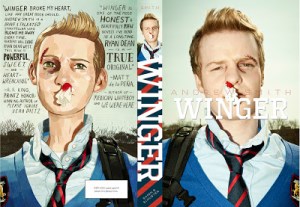
Winger is the story of fourteen-year-old Ryan Dean West, a super smart kid who attends a ritzy boarding school in Oregon. Now, although I am neither 14 nor a boy, I think I can say – based on my day-to-day dealings with them that Smith accurately captures the vernacular of the species.  Ryan Dean is so smart he’s already in Grade 11. He’s a good kid, but he’s been moved into Opportunity Hall, the residence where the kids who have gotten into trouble live. (He got caught hacking a teacher’s cell phone so he could make long distance calls.) He places rugby, thus his nickname) and is in love with his best friend, Annie. Smith’s book is filled with all sorts of cartoons that Ryan Dean draws as a way of sorting out all his feelings about just about everything. This book won loads of awards, but I should point out that there is loads of swearing (although Ryan Dean would never swear out loud, he’s writing so he can) and sex talk (although nothing super explicit.) More importantly, Ryan Dean is kind and sensitive and is just trying to do the right thing, even when he does exactly the wrong thing. Beautifully written, well-drawn characters. This is a winner.

For the teenage girl on your list:

Vanishing Girls – Lauren Oliver vanishing-girls-jacket

Lauren is a well-known YA author. She penned the Delirium series, but Vanishing Girls is my first book by her. This is the story of sisters Nick and Dara and the aftermath of a terrible accident. It’s told via dual first person narratives, police reports, diary entries, illustrations etc  so there’s a bit of a multi-genre approach.  Nick and Dara are super close, but they are also very different and the novel tracks their relationship which post-accident has hit a rather bumpy patch. Dara has actually disappeared. Then, with the disappearance of another young girl, Oliver takes us down a full-on thrill-ride. It’s got a little something for everyone, really: mystery, suspense, a love-interest, family drama. And it’s well-written to boot. No real caveats for this one although it’s definitely for older teens.

achildofbooksFor the young reader on your list:

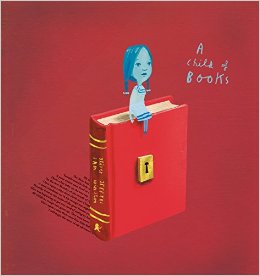
I recently picked up a beautiful book at Indigo – not really as a gift, but I think I know who I will give it to. It’s called A Child of Books and it’s by Oliver Jeffers and Sam Winston. It’s a whimsical book about the love of books – so you can see how it would appeal to me. A little girl  takes the hand of a little boy and they wander together through their imaginations which are fed, of course, by books and words. It’s so pretty and positive. Maybe it’s the gift I will give to myself this year.


For the reader who’d appreciate a book by a local author: riel

I would suggest picking up Riel Nason’s sophomore effort, All The Things We Leave Behind. Readers might remember Riel’s first novel The Town That Drowned and her second novel is also very evocative of small-town NB circa 1970s. In this novel 17-year-old Violet has been left to look after the family business – antiques sold out of a purple barn up past Fredericton. I actually met Riel before she became a novelist – she was actually in the antiques business and so I worked with her because of my job with The Canadian Antiques Roadshow. Anyway, in this story, Vi’s older brother Bliss is missing and her parents have gone looking for him. This novel is a little darker than The Town That Drowned, but it will be  wonderfully familiar to anyone who has spent any time upriver.  Older teens could certainly read it, too.

567For anyone who likes poetry:

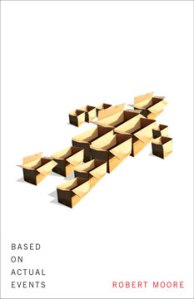
I can’t claim to understand the poems, but if you like poetry and you want a challenge – check out Robert Moore’s latest collection, Based on Actual Events. You might need to read it with a dictionary close by – but even without one, you’ll probably get some of Bob’s dry wit. For those of you who don’t know, Bob is a prof at UNBSJ and I am guessing you can pick up a copy of Based on Actual Events at Tuck, the story his wife Judith Mackin owns.


For those who like a suspenseful read: lastsept

The Last September by Nina de Gramont

This would be a great gift to give to someone who likes suspense with a little meat on its bones because it’s not actually a suspense thriller – even though it sort of reads like one. It’s the story of Brett who falls in love with her best friend Eli’s older brother, Charlie.  When Charlie is murdered  – no a spoiler – we learn Charlie is dead by the end of the first sentence, Gramont spins the story back in time to let us discover how Brett’s love story unfold. Our book club had a great time debating this one – especially when there was some dissention over whodunit. I actually wrote to the author for clarification and she wrote me back, too. It’s a great little book for a stormy winter afternoon.


2016adventcalendar_3Finally, plan for next year and order:

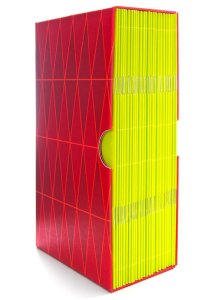
The Short Story Advent Calendar – I ordered this for my son this year. It’s a box of short stories you open one at a time on the days leading up to Christmas. Really cool.  And Canadian!

Order early, though

Happy holidays and happy reading!

Winger – Andrew Smith

It is so much easier for me to read YA books that are geared for girls, but since it’s often the boys who are reluctant readers in my classes, I really make an effort to buy and read books I think might appeal to them. Andrew Smith’s book Winger is one book which has garnered copious praise, and it is definitely a book I can highly recommend to those boys who say they don’t like to read.

Ryan Dean West attends a private school called Pine Mountain in Oregon. He’s in Grade Eleven winger-smitheven though he’s only fourteen. He’s super smart. He’s also a talented artist (many of his drawings, cartoons and graphs are included in this novel) and he’s also a terrific rugby player. His nickname, “Winger”, comes from the position he plays on the team.

But despite a whole list of things in Ryan Dean’s plus column, there’s a few things on the negative side. For one, this year he’s living in Opportunity Hall, O-Hall, where they stuck him “after they caught me hacking a cell phone account so I could make undetected, untraceable free calls.” Living in O-Hall sucks for two reasons: 1. Ryan Dean isn’t living with his two best friends Seanie and J.P. and 2. His new roomie is Chas Becker “a friendless jerk who navigated the seas of high school with his rudder fixed on a steady course of intimidation and cruelty.”

The one thing in Ryan West’s life that is both blessing a curse is Annie Altman.  Annie is also in grade eleven, but she’s sixteen. She’s Ryan Dean’s best friend, but he is also desperately in love with her.

…most people would think there couldn’t possibly be anything between us beyond a noticeable degree of friendship, even if I did think she was smoking hot in an alluring and mature “naughty babysitter” kind of way

This year at Pine Mountain turns out to be a year of firsts for Ryan Dean, but it is also a year when he makes a lot of mistakes. He capitulates to teen pressure and drinks for the first time. He gets into fist fights. He makes out with another guy’s girlfriend. But through it all, he remains self-deprecating. In his words: “I am such a loser.”

Ryan Dean is just one of the many lovely things about Smith’s book. I am not a fourteen-year-old-boy, nor have I ever been, but Ryan Dean’s voice feels authentic to me. He is constantly walking that fine line between making a smart choice and doing something he knows he shouldn’t. His narrative is filled with inappropriate talk about sex (just about every girl/woman he encounters makes his acute sexual radar) and expletives which he only ever uses “in writing, and occasionally in silent prayer.”

Winger is filled with laugh-out-loud moments — mostly due to inappropriate sex-talk– but also really lovely moments between Annie and Ryan Dean and Ryan Dean and Joey, another guy on the rugby team who also happens to be gay.

You couldn’t pay me to be a teenager today. But spending time with them is always a delight, even when they break my heart.

Highly recommended.

26 Letters – Ross DeMerchant

I am not going to ‘review’ Ross DeMerchant’s book 26 Letters, so much as tell you about it26letters and perhaps share some of my own memories. The reason is because Ross is my cousin and I likely wouldn’t have ever read this book ( which is part memoir, part self-help, part spiritual)  if not for that fact.

My dad, Edgar, was the youngest of four. He had three older sisters: Alice, Dorothy and Barbie. There was eleven years between Barbie, the youngest daughter,  and my dad, which meant that most of my cousins were a lot older than my brothers and me. They also didn’t live near us when we were growing up, so unless we went back to my dad’s home town we didn’t really get to see them very much.

seven

L-R: My grandmother, Muriel; I am not sure who the lady is just behind Grammy; my Aunt Barbie, with her arms around my dad; Aunt Alice; Aunt Dorothy. I am going to say this is the mid-forties as my dad was born in 1937.


My father grew up near a really small town about four hours up the St. John River from where I now live.  Ross explains that “On one side of the river was one community called Perth. On the other side of the river was another community called Andover. Obviously, the two communities became joined by a hyphen, making it one town called Perth-Andover.”

I always remember thinking of it as Perth and (wait for it) over. Ha.Ha.

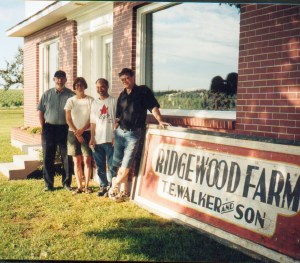
My dad grew up just outside of Perth-Andover on a farm in South Tilley. Although I am not sure of the history of the exchange, the farm came to be in the hands of my Aunt Barbie and Uncle Bernard and so that is where Ross and his siblings Douglas, Diane, Mark  and Paul grew up.  Mark kept the farm running until 2013, but it’s a tough business and he just couldn’t do it anymore, so he sold it.

When I was a kid, going to the farm was magical. Back then it was hundreds of acres (they farmed potatoes) and I have very specific memories of visiting. I remember that there was a one room schoolhouse at the end of their driveway and that is where my aunts and father attended school. My cousin Diane had a sweet little playhouse filled with miniature dishes and furniture and I thought that was the coolest thing ever. There was also a sort of attic (although I may be remembering that wrong) filled with books like The Lennon Sisters and Cherry Ames. If we were lucky to go there in the winter, we could go out on the snowmobiles. That was a blast because there were endless fields to ski-doo through. My Aunt Barbie was a great cook. I specifically remember these raspberry squares she used to make.
family23

My dad, me, and my younger brothers, James and Mark at the farm.

One of the things I was most looking forward to when I picked up 26 Letters, was Ross’s recollections of growing up on the farm. I was hoping for some stories that I might have remembered, too. I guess I am at the age where I am feeling sort of nostalgic about these special places and people from my childhood.

Sadly, Ross’s stories were mostly unfamiliar to me with one notable exception –  the accident his little brother, Paul, had as a toddler.

It was during the potato harvest season when life is incredibly busy exciting on the farm. Potatoes are hauled from the fields and placed in large holding bins within the “potato house.”  The in-ground bins were twelve to thirteen feet deep and large enough that trucks would actually drive onto the platform over the bins and unload from there. It was in that setting that Paul wandered unnoticed onto the platform of the bins. Someone noticed that Paul was missing, and the frantic search by the entire crew began.

Paul was found at the bottom of one of the empty bins. He remained unconscious for two weeks, and as Ross tells it “his first word was in response to me standing at the foot of his hospital bed. He looked up and said, “Ross.”” He had to have a metal plate put in his head and I remember that we were all told we had to be careful around him when he was a kid.
12-22-2009_307

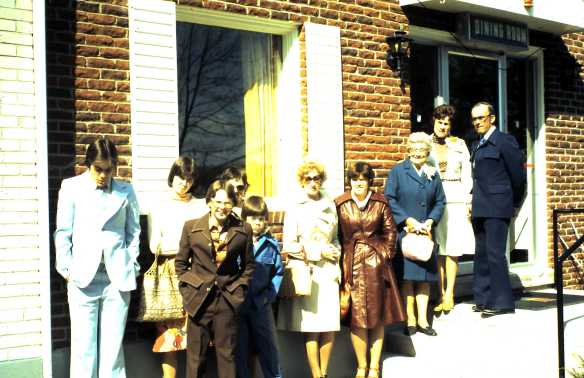
L-R: My cousin Mark, me, my brother Tom (in the brown suit) my brother Mark, my mom tucked behind, Aunt Dorothy and her daughter, my cousin Brenda, my grandmother, Muriel, Aunt Barbie and Uncle Bernard.

Some of Ross’s stories conjured up memories of places in Perth-Andover. Everyone knew York’s for instance. It was world famous for its food, a zillion courses of home cooking. I don’t recall ever once going there as a kid, though. It was too expensive and we never had any money.

I loved his description of how directions work. “In those days,” he says, “mile markers were such things as barns, railway crossings, houses known by the family’s last name and unique places you wouldn’t find listed on any map, like “the gravel pit” or “the four corners.”

That reminded me of a summer many years ago, when my kids were little, and we’d planned a family reunion at the farm. I was confident I could remember the way, but I got us totally lost and we eventually had to stop in a little country store and ask for directions. We weren’t even on the right side of the river and we arrived at the farm at least 45 minutes after everyone else. I was the butt of everyone’s joke that day.

My children loved the farm. They loved Mark’s son, Mitchell, who back then was probably 13 or 14. He was a beautiful kid with white blonde hair and a dark tan that can only come from spending hours working in the sun. He was sweet to my kids, too.

OLYMPUS DIGITAL CAMERA

My daughter Mallory and son Connor with Mitchell at the farm.

He took them on the atv and the tractor and taught them how to dig potatoes.

26 Letters is Ross’s way of encouraging people to have meaningful conversations with the people who matter in their lives. He’s spent his career working  with young people and adults.

“We don’t talk well in our culture. In a world of unparalleled convenience, we struggle more than ever to communicate with each other, ” Ross says.

I don’t disagree. And worse, our shared history is often lost. That’s why I love spending time with family. My cousin Suzanne was home from England a couple summers ago and she, her brother, John, and I went up to Fredericton to visit with our cousins Diane, Brenda and our aunts Dorothy and Barbie. We laughed a lot that afternoon and my aunts shared stories, many of which I had never heard before. At one point, Barbie started to play the piano. John and I looked at each other, stunned.

“Did you know Aunt Barbie could play the piano?”

“Nope. Did you?”

I am fifty-five. John is older than me.

Ross’s motivation for writing 26 Letters was “so that I could leave for my children and grandchildren my understanding of those things that helped shape the person I am.”

I can think of no better legacy than the stories we share with the people we love.
walker3

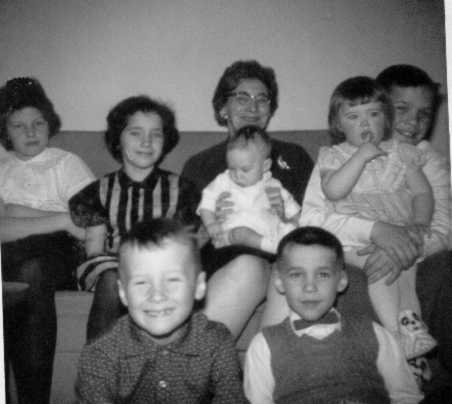
Back: Brenda, Diane, Grammy holding my brother Tom, Douglas holding me, my cousins Colin and Ross.


The Last September – Nina de Gramont

Brett loves Charlie. He’s the older brother of lastsepther best friend, Eli. She and Eli are students in Colorado and one stormy night they attend a party and Charlie is there, too, his flight delayed because of the storm.

That day, the first day I ever saw him, he had three days’ worth of stubble. He wore a thin black thread around his neck, beaded with a smooth lapis stone that matched the color of his eyes.  When I looked at him, his lips slid up at the corners. My heart lurched. I don’t know why. It lurched toward him and refused – stubbornly – to ever lurch away.

Nina De Gramont’s book The Last September takes zero time to hook you by the throat and it doesn’t let you go until the very end. I really couldn’t put this book down. On the surface it’s a love story. But it’s a love story that goes horribly wrong because by the end of the first sentence we learn that Charlie is dead. Brett tells us “Because I am a student of literature, I will start my story on the day Charlie died. In other words, I’m beginning in the middle.” By the end of the first page we’ll know that Charlie has been murdered.

Their love story unfolds in flashback. When the novel opens, Charlie, Brett and their toddler daughter, Sarah, are living in Charlie’s family cottage at Cape Cod Bay. Brett is finishing her PhD dissertation; Charlie is doing odd jobs.  On this particular day, Brett is frustrated with Charlie, a feeling not at all out of place in most marriages. When Charlie mentions that Eli had called and that he wanted to come for a visit, Brett is reluctant to see her old friend because “the last time we saw Charlie’s brother he’d dropped an enormous amount of weight and begun scribbling notes on his jeans and forearms.”

I have guilty reading pleasure buttons and, I have to say, The Last September hit every single one of them. Angsty love affair. Check. Unbearable suspense. Check. Heartbreak. Check. Check.

What happened to Eli? What happened to Charlie? What happens when Ladd, Brett’s former fiancé arrives back in town? If this sounds suspiciously like Peyton Place, you’re not wrong. But, omg, The Last September is so much fun to read. The writing is luminous and so even when I didn’t 100% buy the plot twists, it didn’t matter because I just wanted to find out what had happened to Charlie and I wanted to know that Brett was going to survive the grief.

Highly recommended.


Books for what ails you

Like everyone else in the free world, I watched the recent American presidential election with my heart in my throat. I finally put my phone down at around 12:30 a.m. on the night of the election feeling pretty certain that the impossible had happened. I woke up a handful of hours later and my fears were confirmed.

Back in the day I used to watched The Apprentice. We’d mock Trump as he got off his private jet, that impossible hair flapping in the wind, his mouth like a little anus. He just seemed like a caricature. And now he’s the president of arguably the most powerful country in the world. It’s a terrifying notion to a left-leaning person like me. I hope Trump will surprise us, but I still don’t think he’s qualified for the job.

globalcitizenI have to admit that I was feeling a little smug because, y’know, I’m Canadian and Justin Trudeau is our Prime Minister. He’s not perfect, certainly, and we’re not perfect as a nation, but c’mon. And then Kellie Leitch, one of the people running for the leadership of our national Progressive Conservative Party (as if the national  PC Party is actually ‘progressive’) hitched her star to Trump’s wagon saying we needed to vet our immigrants more carefully. Seriously? I blame Stephen Harper for creating a climate where someone could say something like that in a country that was freakin’ built by immigrants. (Okay, truthfully, I blame Harper for lots of things; I just don’t like the man.)
All the vitriol has me thinking about the world – which is in dire need of some perspective. And some hope. And where do we get it?  Books.

One of the things I always tell my students is that reading allows us to walk in someone else’s shoes.  How can we be sharing this planet and not understand that, fundamentally, we are the same, not different? Sometimes we all live in our own little bubble – me included –  and so we only have a couple options to help us see over our own personal walls: travel and books. I love both, but traveling is expensive, so I guess it’s books (and truthfully, the way I buy books – also expensive).

I thought I’d share some books that might help you see your fellow human differently. If we can’t (try to) understand each other, if we’re not open to listening to someone else’s point of view – even if we don’t agree, if we don’t at least grasp the concept that we are all in this together or we all suffer, well, we’re doomed. I’m a glass half full sort of person, so I would like to believe that perhaps Trump’s victory is a wake-up call to us all that the world is on a precipice. We can either take a step back in love or jump off into the abyss with hate.

I choose love.

These books are about experiences I have never had and all of them got me to ask questions and see people and countries in a new way. Some made me uncomfortable, some made me feel ignorant and blind. All of them were profoundly moving. If we are going to make this world better we need to practice our empathy skills. Books help with that. As Atticus Finch so wisely put it, “You never really understand a person until you consider things from his point of view … until you climb into his skin and walk around in it.”

So go on. Start walking.

The Cellist of Sarajevo – Stephen Galloway 9780307397041

Spend a few hours with Kenan as he braves the streets, making a treacherous journey to the brewery to collect fresh water for his family. He’s a father who only want to keep his children safe, feed and clothe them.

Never Fall Down – Patricia McCormack neverfalldown

Reading Arn’s story has reminded me again of the priviledged life I’ve lead and of the absolute power of literature to crack open the insulated world in which we often live.


Aristotle and Dante Discover the Secrets of the Universe – Bejamin Alire Saenz aristotle_and_dante

I was the age of these characters somewhere around 1976. I didn’t know anyone who was gay. Okay, looking back – of course I did, but we didn’t talk about it. It wasn’t acknowledged. As far as I know, they weren’t out. I am profoundly grateful as a teacher and a parent, just as a human being, that books like this exist.

The Book Thief – Marcus Zusak

the-book-thiefLiesel is extraordinary. She and Hans bond late at night, when Liesel’s nightmares wake her, and Hans teaches her to read. Books and words are central to Liesel’s story. So is her friendship with Rudy, the boy next door. Through their eyes we see Hitler and Nazi Germany; we experience the atrocities and the small kindnesses. Zusak’s story is mostly about everyday things: hunger, pettiness, laughter, hope, cruelty and kindness.


Bel Canto – Ann Patchett bel-canto1

For me, though, this is a book about love- how it shapes us and changes us, how beauty transforms and transports and how you just might take a risk if you thought it might be your last opportunity to do so.


totally joeTotally Joe – James Howe

Joe is totally self-aware. It’s one of the pleasure of Totally Joe, really, that he is a person who understands and accepts himself. That doesn’t mean he’s not susceptible to the taunts of others.


Alia’s Mission: Saving the Books of Iraq – Mark Alan Stamaty  alia

When the fighting starts in Iraq, Alia feels compelled to save the books in the library. When she can’t get her own government to help her, she starts moving the books herself.

everythingEverything I Never Told You – Celeste Ng

Everything I Never Told You is an astounding, complex and heart-breaking look at the secrets we keep, not only from our families but from ourselves. Why we keep them, and the damage caused because of it, is just part of what happens in Ng’s book.


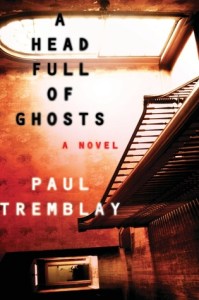
A Head Full of Ghosts – Paul Tremblay

23019294Paul Tremblay’s novel A Head Full of Ghosts has been sucking up all the oxygen on the Internet for the past few weeks and even Stephen King said that it scared the “living hell” out of him. As you might imagine, that’s probably pretty hard to do and therefore high praise.
The Barrett family are kinda sorta normal in a completely dysfunctional way. Dad, John, has just been made redundant at the job where he’s worked for the last nineteen years. Times are tough and he hasn’t been able to find work since. Mom, Sarah, is tense and cold. Then there are the daughters: fourteen-year-old Marjorie and eight-year-old Meredith or Merry. The story is actually narrated by Merry, aged 23. She is sharing what happened to her family the year she was eight with best-selling author Rachel Neville but she is unsure how to proceed because she doesn’t “know how to explain to her that [her] sister hasn’t aged at all in fifteen-plus years and there never was a before everything happened.”

Despite the six year age gap, Marjorie and Merry are close. They share made up stories and have a sister-speak  shorthand. When Merry visited Marjorie’s room “she was convinced that [she] was going to grow up exactly like Marjorie, entering her room was like discovering a living, breathing map of [her] future.”  Lately, though, Marjorie has begun to act strange.

She tells Merry that the posters on her walls “disembodied hands, legs, arms, hair and a pair of eyes” were like that when Marjorie had woken up. She writes Merry a note that tells her:

I sneak into your room when you are asleep, Merry-Monkey. I’ve been doing it for weeks now, since the end of summer. You’re so pretty when you are asleep. Last night, I pinched your nose shut until you opened your mouth and gasped.

Merry isn’t the only one concerned about Marjorie. She’s seeing a psychologist and then John decides he needs to get the church involved. That’s how the Barrett family find themselves at the center of a reality television series, The Possession. No one could have predicted how it would all turn out, least of all Merry, but when she agrees to talk to Rachel Neville, the veil of what really happened in the Barrett house is lifted.

Or is it?

A Head Full of Ghosts is not scary, let’s just get that out of the way. It’s creepy and mind-bending and certainly capitalizes on the whole reality TV phenomenon. But full out pants-wetting scares are in short supply.

Truthfully, I am not sure how I feel about this book. I didn’t love it. I found it odd and unsettling, for sure, and neither of those things are bad necessarily, but I wasn’t enthralled. I kept changing my mind about what I thought was really going on  – which also isn’t a bad thing. I don’t need my fiction to be tidy.

I guess how I feel about A Head Full of Ghosts is that despite its numerous accolades, I wouldn’t tell everyone to read it, but I definitely would read another book by Tremblay. How’s that for wishy-washy?


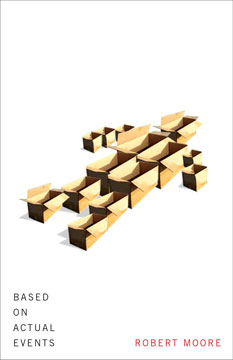
Based on Actual Events – Robert Moore

Writing a review of a collection of poetry is not the same as writing a book review. I tried the last time Robert Moore released a collection of poems, The Golden Book of Bovinities. Poetry is a pricklier proposition. (See what I did there with the alliteration and all – just so you know I do get some of those poetic bells and whistles.)

567 Bob and I have known each other for twenty-five years. I met him back in 1991, when I returned to university to finish my Arts degree. He’s only a handful of years older than I am and one of the benefits of being a mature student is getting to know your profs on another level. I loved being in Bob’s class and was thrilled when he agreed to be my honours thesis advisor. We’ve stayed friends over the years and I have always found our conversations entertaining and hard work in equal measure. (Hard in the sense that Bob is off-the-charts smart and has a vocabulary that keeps mere mortals on their toes.)

Based on Actual Events is Moore’s fifth volume of poetry. I’ve got all his poetry collections, but to be honest he started to lose me a little in 2012 with The Golden Book of Bovinities.

The blurb on the back of Based on Actual Events says

Robert Moore gives us a book-length sequence of sleek, fiercely comic, colloquial poems whose aphoristic storytelling is pegged to nostalgia for sublimity. His project is to find frames of reference for our estrangement from the world.

That may very well be what Bob’s trying to do with these poems, but I didn’t get it. (Geesh, I barely got the blurb!) His earlier poems dealt with relationships and his parents and art and, you know, stuff I could mostly relate to. Based on Actual Events is for wicked-smart people, which generally counts me out. That said, poetry in general is often layered and mysterious and requires fortitude.  However,  if you take Billy Collins’ advice and “press an ear against its hive” or “walk inside the poem’s rooms”, a poem will always reward you.

So, that’s kind of my approach reading this collection. I listen for what I like; I walk around in the bizarre rooms Bob’s constructed. I make my own meaning.

25.

Even under enhanced interrogation the vampire

refused to give us anything. And we tried it all,

shit we didn’t even know we could do and still call

yourself human. Nihilo. Zilch. If anything, his smirk

got smirkier, his ass even wiser. And those fangs!

Growing back each time; pellucid as milk,

alert as metal against skin.


So we waited until high noon – both hands reaching for God –

then shoved him out of the van in the Sears parking lot.

It was like you’d lit a gasoline fart. It was like wings

opening inside you.


Over before you could swallow. Seen more ash

at the end of a Virginia Slim. “Holy screaming fuckballs,”

sighed the captain, as much to himself as to the assembled,

we who’d done things we couldn’t even share

with ourselves, never mind over breakfast

or lost weekends, in earshot of our televisions,

which knew every lie in the book.


Anyone who knows me will know why I liked this poem. 🙂

These poems are ironic, often funny (I think) and use a lot of words I had to look up in a dictionary. Whatever, my vocabulary could use some work.