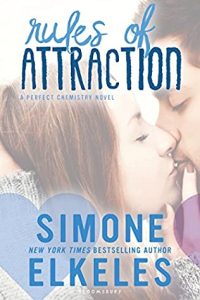
Rules of Attraction – Simone Elkeles

I read the first  novel in Simone Elkeles Perfect Chemistry trilogy, Perfect Chemistry sevenrules years ago. (Yikes!!!) Since then, I have recommended the book countless times to students looking for a romantic, fast-paced story. I have never had a single student tell me they didn’t like it. It’s a great book and even boys enjoy the story of Alex and Brittany. And if they like that book, well, Alex has two brothers and they each get their own novel. I hadn’t read either of the follow -ups, so I grabbed Rules of Attraction to bring home to read during this strange time of quarantine.
At the end of Perfect Chemistry, Alex and Brittany had left Chicago and gone off to college in Colorado. Carlos, 18, has now been sent to live in Colorado to get him away from the gangs in Mexico, where his mother and younger brother Luis still live. Carlos is the proverbial “angry young man”. The decision to go to America was not his

Mi’ama didn’t ask if I wanted to leave Mexico and move to Colorado to live with my brother Alex for my senior year of high school. She made the decision to send me back to America “for my own good” – her words, not mine.

So, he’s pissed off at the world: At his brother who left gang life when he fell in love with Brittany, at the system which seems against him, at the world, and at Kiara, the daughter of the professor with whom he lives as a condition of getting caught with drugs soon after he starts school.

Kiara, also a senior, is a good girl. (Of course, that’s the way these stories go. :-)) She’s recently been text-dumped and she’s feeling a little raw. She knows Alex because he works as a mechanic (to help pay for college) and he’s been helping her refurbish her car. When he asks her to show Carlos around school, she happily agrees. Carlos, however, isn’t interested in being shown anything.

I don’t need a damn peer guide because (1) it’s obvious from the way Alex greeted Kiara a few minutes ago that he knows her, and (2) the girl is not hot; she has her hair up in a ponytail, is wearing leather hiking boots and three-quarter stretch pants with an Under Armour logo peeking out the bottom, and is covered from neck to knee by an oversized T-shirt with the word MOUNTAINEER written on it, and (3) I don’t need a babysitter, especially one my brother arranged.

Of course, readers know that Kiara and Carlos will end up together, that she will bring out the hidden softness in him, that he will fall in love with her inherent goodness, that they’ll overcome the obstacles chucked in their path.

Teen readers will eat it up.

The House at Midnight – Lucie Whitehouse

housemidnightLucie Whitehouse’s debut novel The House at Midnight tells the story of Joanna and her close-knit circle of friends who spend weekends at Stoneborough Manor in Oxfordshire. Her dearest friend, Lucas, has recently inherited Stoneborough from his Uncle Patrick, a well-known art dealer. On their first visit there, Joanna observes that the house is “Three storeys high, [and] it reared up out of the night as if it were facing the darkness down.” The house gives Joanna a “pang of anxiety.” She wonders “How could it not change things between us.”

Whitehouse’s story works on a variety of different levels. First of all, the house is, at least to Joanna, menacing. To her, it feels like a malevolent entity, intent on causing harm. Despite the fact that she and her friends Martha (an American ex-pat and Jo’s roommate), Rachel and her new boyfriend Greg, Michael, Danny and, of course, Lucas, gather here to drink and dance and try, in some ways, to recapture the headiness of their college days, there is something about the house that unsettles her.

I had the sudden sense that there were eyes on me…My skin prickled. The sound of my voice played in my ear. I took a breath and forced myself to stand still for a moment and look into the unlit corners away from the lamps and up above my head to the landings. I half expected to see someone there, leaning over the banisters watching me. There was nothing. And yet there was.  It seemed to me that there was something lurking, something that was not benevolent.

Then there’s Lucas. Joanna meets him during her first week at college and the two form a strong bond. For a minute it seemed like their friendship might morph into something more romantic, but the moment passed. Now, ten years later, Jo is wondering whether she and Lucas might have a chance.

The House at Midnight captures that fraught period post college when you might be wondering what you’re going to do with the rest of your life. Lucas is a lawyer; Danny is in advertising. Jo works as a junior writer for a small weekly newspaper. None of them is particularly satisfied with their lives.

Then comes the romantic entanglements, which in a small, close-knit group often seem almost incestuous. As the novel moves along, it draws and redraws lines in the romantic sand, and some of the shifts cause irreparable damage to the group.

There were moments in the novel whether I wondered if Jo was a reliable narrator. Could I trust what she was telling me? Were her feelings about the house the result of an over-active imagination or something else? I liked that I didn’t quite trust her.

This book is SO good. The house itself is a character, full of shadowy corners and dark secrets.  There’s something claustrophobic about it and about these friends as they try to sort themselves out. Ultimately, the most sinister thing about the book is the length people will go to get what they want and the damage they are willing to cause in the name of love.

This is my second novel by Whitehouse. I read and loved Before We Met at the beginning of the year.

I can highly recommend both of these books.

The Lost Daughter – Lucy Ferriss

The whole time I was reading Lucy Ferriss’s novel The Lost Daughter,  I was trying tolostdaughter figure out whether I liked it — not the book, exactly, the whole family drama thing. Am I really interested in life’s ups and downs? Do I care about people’s children and marriages? Well, if every book was as good as this one, the answer would be yes.

When the novel opens high school seniors Brooke and Alex have taken refuge in a hotel where Brooke is about to give birth. It’s a harrowing beginning to their stories. Brooke was bound for Tufts in the fall, and Alex was going off to college on a soccer scholarship.

Fast forward fifteen years and Brooke is married to Sean. They have a six-year-old daughter called Meghan. Their marriage is solid, but Sean is pressing for another baby; in his big Irish Catholic clan, a single child is blasphemy. Brooke is reluctant; she has her reasons although it’s difficult for her to articulate them. Sean doesn’t understand Brook’s reticence and her

excuses bewildered him. His love for her harbored no doubts, and he had seen the joy she took in Meghan. Every time they talked about another pregnancy it went this way, but he loved her too much to stop.

Then Alex blows through town. He’d been living in Japan with his wife and young son, but his life has fallen apart. “I’d like to see you from time to time…If that’s okay. I’m not going to, you know,  invade your life or anything,” Alex tells her. Their reunion causes a ripple effect and sets them both on a path from which there is no turning back.

There are no bad guys in The Lost Daughter. This is a novel that asks you to examine the choices people make, the consequences of those choices and how sometimes life throws you an unexpected curve ball. Ferriss’s characters seem like real people. Sean’s bewilderment over Brooke’s behaviour and his own disappointments make him a dynamic character, rather than just a foil against which Alex and Brooke’s story plays out. Brooke and Alex are equally authentic. It didn’t really matter whose part of the journey I was following, it was all compelling. That’s a credit to Ferriss’s writing. I’ve never read anything by her before this, but I would definitely like to read more of her work.

While The Lost Daughter is ultimately hopeful, it does recognize that “…life itself, in the end, [is] a tragic journey…”. This journey, however, is well worth taking.

Highly recommended.


Goldengrove – Francine Prose

goldengroveNico is just thirteen when her seventeen-year-old sister Margaret drowns. Nico tells us “We lived on the shore of Mirror Lake, and for many years our lives were as calm and transparent as its waters.” Margaret is the poet in the family, the beautiful daughter about to graduate from high school and head off to study music. She was named for Gerard Manley Hopkins’ poem “Spring and Fall: To a Young Child.”

Nico is “Debbie Downer.” She doesn’t resent her older sister; she admires her. Her beauty, her talent, her relationship with Aaron.

Francine Prose’s novel Goldengrove follows the summer immediately following Margaret’s death and it is a masterful meditation on grief. Margaret’s death is “like a domino falling and setting off a collapse that snakes out toward the horizon and spills over into the future.”

Nico and her parents struggle to make sense of Margaret’s drowning, and they retreat into their own lives. For Nico’s mother Daisy, it’s a cocktail of pain-killers; for her father, it’s working on his book about how different cultures viewed end-of-days. For Nico, it’s Aaron, the beautiful boyfriend Margaret left behind. Over the course of the long, hot summer she and Aaron drift perilously close to each other in an effort to mend their broken hearts.

I didn’t care that he was a boy. An older guy. A relative stranger. At that moment, he was the person who knew me best in the world.

And she and Aaron do feel the same about the loss of Margaret. Aaron tells Nico

…the strangest part is that she was alive and now she isn’t. That’s the thing I can’t get past. I can’t get my head around it. The absence. How someone can be here one minute, and the next minute they’re gone. You tell them everything in your life and then they…can’t be reached. Unlisted number forever.

I loved Goldengrove.  If Nico sounds perhaps too worldly for a kid, it’s because she is telling this story from a place far in the future. From this vantage point, she understands that “time layered over everything, cementing in the gaps, repairing or covering over what was cracked and broken, pressing it down into the earth and building on top, and on top of that.”

Goldengrove is a coming-of-age story, and a story about grief that it is beautifully written and crackles with energy.

Highly recommended.

The Savage Garden – Mark Mills

savagegardenIt’s 1958 and 22-year-old British student Adam Strickland has been given the opportunity to study a Renaissance garden at the Villa Docci in Tuscany. Of course, he jumps at the chance. Signora Docci will soon be leaving her home in the care of her son, Maurizio, but until she goes she knows the garden has some secrets to give up.
Mark Mills’ historical mystery The Savage Garden is a slow, thoughtful and complex puzzle of a book that begs you to pay attention. Adam arrives in Tuscany and “In almost no time he had fallen under Villa Docci’s spell.” The garden in question was built as a memorial to Flora Bonfadio. Her husband Frederico Docci had built the estate and then added the garden after her premature death at just 25.

The memorial garden at Villa Docci sat firmly within this tradition, and although it couldn’t match its eminent counterparts at Villa di Castello, Villa Gamberaia and Villa Campi for sheer size and grandiosity, it stood out for its human dimensions, its purity of purpose, the haunting message of love and loss enshrined in its buildings, inscriptions, and groupings of statues buried in the woods.

It is hard not to be caught up in Adam’s story, especially if you have spent any time at all in Italy. Interactions with the locals and with Signora Docci’s family, including her lovely granddaughter, Antonella, offer Adam both distraction and cause for concern: not all the pieces of the family’s history quite add up.

Although The Savage Garden isn’t a ‘page-turner’ in the strictest sense of the word (the novel’s pace is relatively slow and the nods to Greek mythology and Italian history were probably mostly lost on me), I still felt wholly invested in Adam’s story. Signora Docci is delightful and I enjoyed their relationship. I also really liked Adam’s older brother, Harry. He’s a sort of irreverent character, someone at odds with Adam’s more scholarly personality and while Harry certainly seems to rub Adam the wrong way, his arrival in Italy breathes fresh air into Adam’s hot and insular  life. There are two mysteries at Villa Docci, and Adam is keen on solving them both.

It’s  worth the effort to tag along.


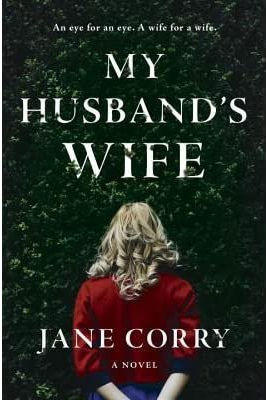
My Husband’s Wife – Jane Corry

By the time I got to page 100 of Jane Corry’s debut novel My Husband’s Wife, I felt like it myhusbandswifewas too late to abandon it even though I didn’t like any of the characters. I just don’t get why this book garnered so much praise. Geesh, Parade even compared it to Gone Girl! 
Lily is a brand new solicitor in London. She’s also newly married to Ed, an artist. Theirs was a whirlwind romance, and I am not joking. They married about two weeks after meeting. Lily has some dark secrets in her past, though, and she is hoping that this marriage will help her move on.

Her first professional job is to meet with Joe, a guy serving time for scalding his girlfriend to death. Yes, you heard that correct. Joe is an odd man, but Lily finds herself strangely attracted to him.

Then there’s Carla, a nine-year-old, who lives with her single mother. They are Italian, which is apparently cause for much ridicule…in London…in 2000. Carla is picked on mercilessly by the other kids, has no friends and is not even cared for by the teachers at her school. She is a strange child, no question. Her path crosses with Lily’s because they live in the same apartment complex. Soon Lily and Ed are looking after Carla when Carla’s mother is “working” (code for meeting her married lover).

One of the issues I had with My Husband’s Wifeis that there is SO much going on. There’s Joe’s case. There’s Carla’s sad little life. There’s Lily’s precarious marriage to Ed. There’s her secret past.  And then the novel flashes forward twelve years.

Carla returns to London from Italy where she’s been living with her mother and grandparents. She is bent on revenge for some imagined slight. She reconnects with Lily and Ed; she thinks she is owed a great deal of money because of a painting Ed did of her as a child. Lily and Ed now have a son, Tom, but he has Asperger’s and is too difficult to handle, so they’ve shipped him off to live with Lily’s parents in Devon. Lily is now a well-respected lawyer because of what happened with Joe. Her marriage, however, is less successful. And she still has her dark secrets.

It’s not that I couldn’t keep up with all the plot’s machinations, it’s more like I just didn’t care about them and that has less to do with the plot points and more to do with the characters. Not a single one of these people were sympathetic (perhaps with the exception of Lily’s parents) or even all that believable.  I felt like I was being told a story, rather than experiencing events as they unfolded.

Just a huge disappointment…and yet I did finish it, so I guess that’s something. And I suspect I am in a very small minority of readers who didn’t like this book.

The Window – Amelia Brunskill

Amelia Brunskill’s YA novel The Window follows teenage narrator Jess as she tries towindow come to terms with the unexpected death of her twin sister, Anna. Although the sisters were identical, they were also complete opposites. Anna was outgoing and popular; Jess is solitary and, some might say, a bit strange.

Anna’s body is discovered by her mother “underneath her window: eyes closed, not moving.” The police determine that she’d been sneaking out and fallen to her death accidentally.  But none of that makes sense to Jess who recalls that night

Had Anna seemed upset? I didn’t think so. If anything, she’d seemed calmer than she’d been in a while, more peaceful. Happy, almost shining with it, like she had a secret. A good one.

Anna’s death pushes Jess way out of her comfort zone. She’s aware that she’s not necessarily like other teens and notes “My parents used to think there was something wrong with me.” Numerous visits to doctors, and not the kind who checked her physical health, don’t yield any answers, at least not to the reader. It does make Jess an unreliable narrator, which suits this story quite well because she just doesn’t understand where her sister was going and why she didn’t know about it. These are girls who used to share everything, or at least that’s what Jess thought.

…I thought I’d understood her too. Thought I’d known everything about her. But I kept going back to the policeman’s questions: if she’d seemed upset recently, if she’d had a boyfriend. I’d said no to both, without even thinking I could be wrong.

Brunskill’s story is a mystery the builds steam as it goes along. There’s a former best friend who moves away and won’t talk to Jess; there’s a suspicious relationship with a authority figure; there’s whispered rumours; there’s a recovered phone. As Jess becomes more certain that Anna’s fall is part of a bigger story, she also slowly starts crawling out of her social shell. Perhaps it’s because she’s playing Nancy Drew, but she does make friends along the way.

The Window is a clever novel about the damage of secrets and family. It’s well-written and would certainly appeal to readers who enjoy a strong female protagonist, and a few well-placed twists and turns.

The Roanoke Girls – Amy Engel

Sometimes I can’t resist the three for $10 bargains at Indigo. Just because a book finds its way onto the bargain shelves doesn’t mean it’s a dud. Case in point: My Sunshine Away  I managed to snag a handful of bargain copies for my classroom library and I was thrilled to be able to offer it as a choice for my grade 12 students this year. That is an amazing book.

RoanokeAnd then there’s The Roanoke Girlsby Amy Engel. Can’t remember when I bought it or how long it’s been languishing on my tbr shelf, but I started reading it and finished reading it in just a few hours because it has ALL THE THINGS I love in a book.  (Lots of other reviewers loved all the things, too, because this book received lots of well-deserved praise.)
Lane Roanoke is fifteen when a terrible tragedy brings her to small-town Kansas to live with her grandparents, Yates and Lillian, and her cousin, Allegra, who is also fifteen.  She knows very little about these people. Her mother left the family home as a teenager and never returned because her life there was a “nightmare.”

Lane is mesmerized by the family home

Roanoke had clearly started out as something resembling a traditional farmhouse – white clapboard, wraparound porch, peaked dormers. But someone had tacked on crazy additions over the years, a brick turret on one side, what looked like an entirely new stone house extending from the back, more white clapboard, newer and higher on the other side. It was like a handful of giant houses all smashed together with no regard for aesthetics or conformity. It was equal parts horrifying and mesmerizing.

The house is symbolic of the labyrinthine Roanoke secrets.

Her cousin Allegra is alternately  moody and loving, and Lane is never quite sure which version she’s going to get. Her grandmother is mostly distant. Her grandfather “was fiercely handsome. …If charisma was power, my grandfather was king.”

The Roanoke family has a long history of loss. Yates’s two sisters are gone, so are his daughters. Until Lane returns to Kansas, Allegra has been the only Roanoke girl. It is a special designation, Lane comes to discover.

The novel toggles back and forth between ‘Then’ (Lane’s fifteenth summer) and ‘Now’, which happens eleven years later when Lane gets the call that Allegra is missing. Yates begs Lane to return to Roanoke. Despite her reservations, the pull of family is strong and Lane finds herself back in Kansas. Her return puts her back in contact with Tommy, Allegra’s on again – off again teenage boyfriend, now a cop, and Cooper, “still the most beautiful person” Lane has ever seen. It’s a toxic mix and makes for absolutely riveting reading.

What happened to Allegra? What happened to all the Roanoke girls? That’s the central mystery in the book. Actually, you’ll learn  the what pretty early on and it’s an explosive family secret.

This book had all the things I loved: great writing, a compelling main character who is damaged, but fierce and smart, a never-ending air of menace and unease, a hot, broken guy and a lot of twists.

LOVED it.


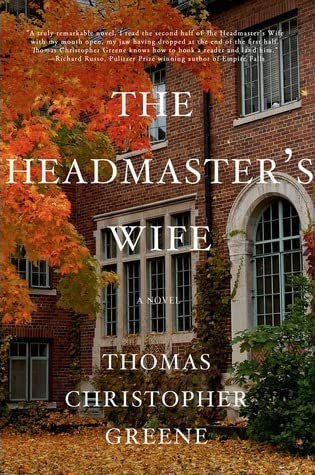
The Headmaster’s Wife – Thomas Christopher Greene

The Headmaster’s Wife is my second outing with Thomas Christoper Green. I read his headmaster's wifenovel Envious Moon almost a decade ago. The Headmaster’s Wife has been on my tbr shelf for quite a while, and I read it in one sitting.

Arthur Winthrop is headmaster/Literature teacher at Lancaster School, an elite boarding school in Vermont. When we first meet him, he’s walking through Central Park reminiscing about a time he’d visited the park with his wife, Elizabeth, and their young son, Ethan. That was years ago, though. Now “standing on the same path…he gives up trying to find this memory.” Instead, he disrobes and starts walking. “All that matters to him is the feel of his bare feet crunching wonderfully on the crusty snow beneath him.”

Of course he is scooped up by the police, and in the interrogation room he tells the story of Betsy Pappas, a young student in his Russian Literature class. At first, Arthur is attracted to Betsy’s mind, but soon he becomes almost obsessed with her. The novel tracks Arthur’s increasingly desperate attempts to woo and possess Betsy.

At the halfway point – after a wallop of a revelation – the story switches its focus to Elizabeth Winthrop. Her story, about being a student at Lancaster, fills in some backstory and allows a glimpse into her marriage to Arthur. It also allows us to meet, however briefly, the Winthrop’s son, Ethan, whose own story is the catalyst for some of the drama in their marriage.

I don’t want to spoil anything because one of the delights of this books (if you can actually call a novel about grief ‘delightful’) is letting the pieces of this puzzle click together in their own time. This is a book that sort of reads like a mystery, but isn’t that what life is at the end of the day? An unfathomable mystery.

Greene suffered a personal tragedy while writing this book. It’s highly worth reading his acknowledgments if this is something you generally skip when you read.

Highly recommended.

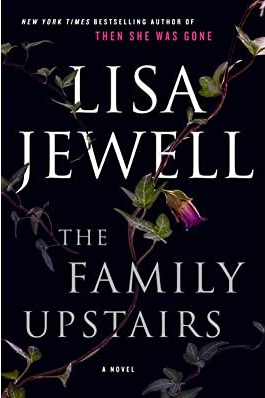
The Family Upstairs – Lisa Jewell

familyupstairsJust when I thought nothing was going to really distract me from this Covid-19 craziness, I dove into Lisa Jewell’s novel The Family Upstairs. I am a Jewell fan to begin with and I usually have a couple unread books by her on my shelf…you know, in case of a reading emergency. I think this pandemic qualifies and, Holy Smokes, did this book ever deliver.

There are three separate narratives in this novel. There’s Libby, a twenty-five-year-old kitchen designer who lives in St. Albans, a commuter suburb just north of London. On her birthday, she receives notice that she has inherited a house in Chelsea, an extremely desirable London neighbourhood. (And by desirable I mean the house is worth millions…of pounds.) The thing is, the house comes with some baggage…including three dead bodies.

That’s Henry Lamb’s story to tell. He grew up in that house with his parents and younger sister. His father was “the sole beneficiary of his own father’s fortune” and his mother was “a rare beauty.” When Henry is eleven and his sister nine, their lives begin to unravel. First of all, Mr. Lamb has squandered the family fortune and then Birdie Dunlop-Evers and her partner, Justin,  arrive.

It all happened so slowly, yet so extraordinarily quickly, the change to our parents, to our home, to our lives after they arrived. But that first night, when Birdie appeared on our front step with two large suitcases and a cat in a wicker box, we could have never guessed the impact she would have, the other people she would bring into our lives, that it would all end the way it did.

The third story belongs to Lucy, a woman we meet in Cote d’Azure where she is living rough with her two young children, Marco and Stella. With no money, and no passport, Lucy must make a difficult choice to protect her children and save herself.

What do these three very distinct and separate stories have to do with each other? Obviously I am not going to tell you, but let’s just say this…I literally could NOT put this book down. Jewell’s trademark is writing twisty plots filled with secrets dying to be revealed. The added bonus is that she’s a great writer and her characters are always believable. Sometimes with books that depend on plot twists, characters get short shrift. Not when Jewell writes them. I happily followed the three separate story threads, trying to race ahead to see if I could figure out how they all belonged together.

The Family Upstairs has everything I love in a book: great writing, an unreliable narrator, sinister characters, secrets galore and a not-too-tidy ending. Story perfection – pandemic or not.

Highly recommended.