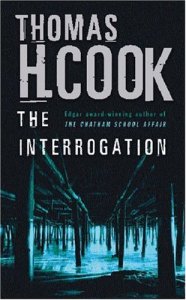
The Fate of Katherine Carr – Thomas H. Cook

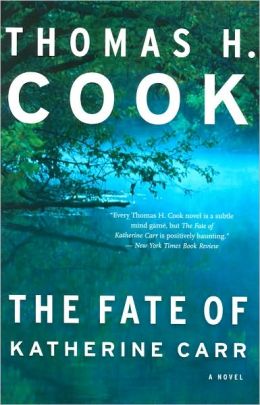
katherine carrThe Fate of Katherine Carr is the story of things lost and found. George Gates is a former travel writer who now writes features for the local paper and spends his evenings drinking scotch at his neighbourhood bar. He’s a broken man, but no wonder: his eight year old son, Teddy, had been taken off the street on his way home from school, murdered and the murderer had never been caught. That was seven years ago, but George hasn’t recovered. He was supposed to pick Teddy up at the bus stop and hadn’t because he’d been trying to write the perfect sentence. He’s consumed with guilt.

One night at the bar, George runs into Arlo McBride, a retired police detective. Over drinks, Arlo tells George about the one missing person’s story which has stayed with him because it was never solved.  She vanished, Arlo tells George,  “like she cut a slit in the world and stepped through it into another one.”

George is intrigued. Before he’d retired from travel writing, he’d spent the bulk of his career writing about places where people had disappeared. Creepy places like Saipan, where Japanese parents – fearing American soldiers – had hurled their children and then themselves from the cliffs. He suddenly finds himself investigating what might have happened to Katherine. As it turns out, Katherine was also a writer and she left behind a handful of poems and a story which Arlo provides to George.

During the course of his ‘investigation’ George meets Alice Barrows, a twelve-year-old with progeria, a disease which causes premature aging. At first, Alice is just a potential subject for a story, but their relationship quickly becomes more profound. Alice is alone in the world and so is George. She is interested in mysteries and George is soon sharing  Katherine’s story with Alice.

Thomas H. Cook is one of my favourite writers. I’ve said it before and I’ll say it again – he writes literary mysteries. They’re page-turners, to be sure, but they are beautifully written, too. The characters are complicated and, more often than not, damaged. George is particularly sympathetic. As a parent, I can only imagine how horrific it must be to lose a child to a monster, but to live daily with the guilt of not being where you said you would. Cook ups the ante every single time.

The Fate of Katherine Carr works on many levels. Narratively, it’s a story within a story within a story. Emotionally, it’s hard not to be moved by George’s never-ending grief or Alice’s own sad fate. Some might argue that nothing much happens, but I respectfully disagree. While Cook might not write blood and guts thrillers, and while his endings might not leave all the loose ends tied in a neat bow – I think he writes fantastic books for careful and thoughtful readers.


More Than This – Patrick Ness

morethanthis“Here is the boy, drowning” is the opening line of Patrick Ness’s confounding, riveting, philosophical and profoundly moving YA novel More Than This. If you are a regular visitor to The Ludic Reader then you know that I am a Ness fan. I have huge love for his novels A Monster Calls, The Knife of Never Letting Go, The Ask and the Answer and Monsters of Men.

More Than This was my pick for book club and we gathered on Feb 18th to discuss the novel over dinner. The discussion was rich with differing viewpoints; the dinner itself was only moderately successful. My book club – despite the fact that three of its members, myself included, are teachers – doesn’t normally choose YA fiction. The only other book we’ve chosen from the YA canon was Marcus Zusak’s amazing novel, The Book Thief. In any case, as I was reading I had a feeling that my choice might not float everyone’s boat. Even I had trouble wrapping my head around Ness’s ‘big picture.’

More Than This is the story of a boy who, in the novel’s riveting opening, drowns. And then he finds himself, well, not dead.

He seems to be lying on a concrete path that runs through the front yard of a house, stretching from the sidewalk to a front door behind him.

The house is not his own.

And there’s more wrong than that.

For 163 pages, Seth (as the boy eventually remembers) is alone in a post-apocalyptic town in England. This is, as it turns out, the town where he grew up before he moved to America. Bits and pieces of his story come back to him when he dreams. For example, he remembers something horrible happening to his younger brother, Owen, something for which his mother never forgave him. He remembers Gudmund,  a boy for whom he has more than friendly affection. He remembers his other friends, H and Monica. As his previous life filters back to him in dreams, he tries to survive in this new wasteland.

And then he meets Regine and Thomasz. And the Driver, a creepy faceless virtually indestructible being whose sole purpose seems to be to try to catch the three teenagers. And how can there be just them? What has happened to the world?

One member of book club was certain that Seth was suffering from a psychotic break and while her argument is certainly plausible, I am happier taking Seth’s dilemma at face value. I think it’s a more interesting book if we believe in what he sees and experiences. Otherwise, it just feels like Bobby Ewing in the shower.

But believing what Seth does also proves problematic. I’ll admit: I was often confused. But that didn’t negate my love of Seth or his new friends. And, ultimately, I think More Than This has interesting things to say about the myopic lens through which teenagers view their lives. As Seth’s past and present converge, he starts to understand how his story, the story of his life, is unknowable, but that “whatever is forever certain is that there’s always more.”

The last couple of pages of More Than This are outstanding. Some members of my group felt that the novel was 150 pages too long, but I disagree. I think the novel packs a terrific punch and Seth’s journey from self-centered adolescence to manhood is memorable and magnificent.

I continue to be filled with admiration for Ness and look forward to talking about this novel with my students. But make no mistake – this novel has lots to offer thoughtful readers of any age.

Highly recommended.

Joyland – Stephen King

joylandAlthough I devoured Stephen King as a teen and young adult, it’s probably been 15 years since I’ve read a King novel (Bag of Bones, which I loved). I decided to give Joyland a go and it was like settling into a comfortable pair of slippers. (I know, it’s ridiculous to compare the Master of Horror to a pair of comfy slippers, but I’m talking more about that feeling of just knowing that you are in really good hands — which you always are with King.)

Joyland is not a horror story really. It’s the story of Devin Jones, a college student who takes a job at Joyland, a Disney-style amusement park (I imagined Family Kingdom at Myrtle Beach, S.C., which I visited once as a teen) in North Carolina.  Devin tells the story of his summer and autumn at Joyland through the lens of late middle age. He says

That fall was the most beautiful of my life. Even forty years later I can say that. And I was never so unhappy. I can say that, too.

Devin’s unhappiness stems from his recent break-up with his first serious girlfriend, Wendy. Devin has an inkling that their relationship has run its course when Wendy doesn’t even hesitate to encourage him to take the job at Joyland, even though it means that they will be separated for the summer. “It’ll be an adventure,” she tells him, without realizing just how much of an adventure it’ll actually be.

Devin meets a cast of interesting characters at Joyland and in the little seaside town he calls home while he works there. Characters like Lane Hardy (who shows him the ropes around the park) and Rosalind Gold (the resident fortune teller who makes a couple of astute predictions about Devin’s future) and Emmalina Shoplaw (who owns the boarding house where Devin rents a room and who tells him about the murder associated with Joyland’s  Horror House) add a bit of local character to the story.  Other characters, like Mike and his mother, Annie, have a more profound impact on Devin’s life.

Devin Jones calls that summer “the last year of my childhood” and he is right. King expertly balances the story’s nostalgic look back, and his protagonist’s bittersweet reminiscences (“I still want to know why I wasn’t good enough for Wendy Keegan”). Joyland is as much a coming-of-age tale as it is a murder-mystery. Both aspects of the novel will keep you turning the pages.

Paper Towns – John Green (with a shout out to John Hughes)

If you are a person of a certain age, you probably have fond memories of John Hughes’ films. Even though I was already in my early 20’s when he started producing arguably the best teen movies ever – I was still young enough to see myself in the characters he committed to celluloid.

Sixteen Candles is my all-time favourite Hughes film, for reasons which will be apparent to anyone who has ever seen the film. I still watch it occasionally and it still makes me laugh and it breaks my heart a little now that Hughes has died.

Yes, you can argue that Jake Ryan isn’t perfect – he did let an underage, unlicensed driver take his very drunk girlfriend home in his father’s Mercedes, but it was the 80’s and, come on,  Jake Ryan is pretty damn dreamy. Also, who didn’t see some part of themselves in the other characters on the screen: Molly Ringwald’s slightly awkward Samantha Baker, Anthony Michael Hall’s loveable dork. Everyone you ever went to high school with is lovingly represented in this flick and in Hughes’ other teen masterpieces, Pretty in Pink, The Breakfast Club,  and Ferris Bueller’s Day Off. 

I would posit that John Green is this generation’s John Hughes and I hope Mr. Green will consider that a compliment because it is certainly meant as one.

Last year because everyone and their dog was reading The Fault in Our Stars I did, too. That was a reading experience I will never forget – curled in the fetal position on my bed at 2 a.m., laughing then crying, then laughing again. That is the experience I want my students to have.

PaperTowns2009_6AThe only other John Green book I have in my classroom library is Paper Towns and I just finished it yesterday. (Trust me, I’ll be rectifying the lack of Green books post-haste.) Paper Towns received rave reviews and the Edgar Award (a prize awarded by the Mystery Writers of America) and it’s totally deserving of both.

Quentin Jacobsen is just weeks away from graduating from high school when his next door neighbour Margo Roth Spiegelman shows up at his window in the middle of the night. Although Quentin and Margo had been childhood friends, they’d drifted apart as they’d gotten older and now, in Quentin’s eyes at least, Margo is this exotic and beautiful creature, but not necessarily his friend.

Margo Roth Spiegelman, whose six-syllable name was often spoken in its entirety with a kind of quiet reverence. Margo Roth Spiegelman, whose stories of epic adventures would blow through school like a summer storm: an old guy living in a broken-down house in Hot Coffee, Mississippi, taught Margo how to play guitar. Margo Roth Spiegelman, who spent three days traveling with the circus – they thought she had potential on the trapeze.

The stories, when they were shared, inevitably ended with, I mean, can you believe it? We often could not, but they always proved true.

Quentin’s best friend, Ben, describes Margo as “the kind of person who either dies tragically at twenty-seven, like Jimi Hendrix and Janis Joplin, or else grows up to win, like, the first-ever Nobel Prize for Awesome.”

Anyway, Margo needs Quentin’s help. She also assures him that this will be the best night of his life. Quentin is a guy who generally plays by the rules, so his decision to help Margo is slightly out of character for him. Nevertheless, he helps Margo carry out a list of tasks, some of them vengeful and some of them contemplative and he is indeed changed by the experience. Which is why when Margo suddenly disappears, he is compelled to follow the breadcrumb trail of clues she’s left behind.

Paper Towns is a clever mystery for sure, but that’s not the only reason to admire the heck out of it. What I love about John Green is the way he writes dialogue. His characters are smart and funny and honest-to-goodness people. In the same way that John Hughes made his characters painfully awkward or awesome or self-deprecating or ironic, Green’s teens are whole and fragile and super smart and laugh-out-loud funny.

And they think thinky-thoughts. The fact that Paper Towns is set in Orlando, Florida (John Green’s hometown) is significant. Margo says “you can see how fake it is…It’s a paper town. I mean, look at it Q: look at all those cul-de-sacs, those streets that turn in on themselves, all the houses that were built to fall apart.”

Quentin’s journey to find Margo makes him question not only everything he thought he knew about her, but also everything he believes about himself and Green does a great service to his characters (and the young adults who will be reading this book) by not giving us pat answers.

So – read John Green. Watch John Hughes. Through their eyes you’ll see teenagers at their worst…and their best. And it’s all beautiful.

A Monster Calls – Patrick Ness

Monster-calls_shadow“Are you crying, Mom?”

My daughter was settled in at the foot of my bed playing on her iPhone and I was  reading the last few pages of Patrick Ness’s remarkable novel, A Monster Calls.

And, yeah, I was crying. Hard by the end of it.

Damn you, Patrick Ness.

Siobhan Dowd is credited for the idea for A Monster Calls, but sadly Ms. Dowd died  – at the age of 47 – before she ever had the chance to see her idea through to the end. As Ness acknowledges in his Author’s Note, “the thing about good ideas is that they grow other ideas. Almost before I could help it, Siobhan’s ideas were suggesting new ones to me, and I began to feel that itch that every writer longs for: the itch to start getting words down, the itch to tell a story.”

A Monster Calls is the story of thirteen-year-old Conor O’Malley who lives with his mom in a little house in a little town in England. His parents are divorced and his dad now lives in the States with his new wife and a baby daughter. Conor rarely sees him.

Conor’s mom is ill. Readers will figure out early on that she has cancer and that Conor is doing his level best to cope, with varying degrees of success.  Then the monster shows up “just after midnight. As they do.”

Conor isn’t particularly afraid of this monster. Despite its “great and terrible face”, Conor tells the monster he’s “seen worse.” And even though he claims not to be frightened of the monster, the monster replies that he will be “before the end.”

The monster continues to visit at night with stories that make no sense to Conor. The monster also claims that there will come a time for the fourth tale – that is Conor’s story. Conor knows what the monster is talking about: a recurring nightmare which terrifies him and which he insists he will not be sharing. In the meantime, his mother grows weaker, his grandmother steps in to help out (much to Conor’s dismay) and his father visits from America – a sure sign of the Apocalypse.

The monster drives Conor to action, but also to irrefutable truths. The monster says,      “Stories are important. They can be more important than anything. If they carry the truth.”

Conor’s truth is one that he is unwilling to face, but which comes barreling towards him anyway. And as a reader, I have to say, I was unprepared for its impact.

A Monster Calls reminded me a little bit of John Connolly’s brilliant novel The Book of Lost Things. Connolly’s story is also about a boy on a journey from innocence to experience. You should definitely check it out.

As for A Monster Calls – I cannot recommend it highly enough.


Master of the Delta – Thomas H. Cook

masterofthedeltaI always say Thomas H. Cook is a mystery writer and he is…but I think he is also so much more than that. Master of the Delta is my 8th outing with Cook and it didn’t disappoint, even though some of the themes were familiar. The novel has the propulsive energy of a mystery, a book with a thread of whodunit twined with a ribbon of ‘is this going to end like I think it’s going to end?’ And of course – nothing is ever quite what it seems. But Cook operates on another level and this is where I think he excels.

Master of the Delta is Jack Branch’s story. Branch is a twenty-three year old teacher who has returned to his hometown to teach at Lakeland High School. Branch has had a priviledged upbringing: he grew up at Great Oaks, one of the town’s massive plantation homes.  It is 1954.

As a boy I’d sat with my father on just such a veranda, evenings that despite all that has happened since still hold a storied beauty for me. There was something calm and sure about them, and it would never have occurred to me that anything might shatter the sheer stability of it all, a father much admired, a son who seemed to please him, a family name everywhere revered and to which no act of dishonour had ever been ascribed.

Branch is a fussy young man – no, fussy isn’t the right word. He’s cocky. He believes his own hype. I don’t mean to say that he is without merit, but his youthful arrogance is partly to blame for events that haunt him for the rest of his life.

And that’s one of the cool things about Master of the Delta (and Cook’s novels in general). Cook always manages to weave past and present together seamlessly so Branch’s story is told as it unfolds, but also from the vantage point of Branch as a much older man – someone who is, from this vantage point at least, able to see his own character flaws.

Branch is teaching a course on evil through the ages and he discovers that one of his students, Eddie Miller, is the son of Luke Miller, the Coed Killer – a man who had killed a local girl and subsequently been killed in jail. Branch encourages Eddie to write a paper about his father. He feels it will help Eddie get out from under the weight of his awful heritage. So Eddie starts to research the father he barely remembers, but when this research reaches into his own life, Branch’s age and inexperience begin to show.

Really, Master of the Delta is a book about fathers and sons, about the part luck plays in how our lives turn out, about kindness and cruelty.  It is a book that has something to say about teachers and books and as a teacher who loves books, I enjoyed that. I truly believe Cook is a masterful observor of human life – our weaknesses and our strengths.  He might wrap it all up in a mystery, but I can’t think of anyone who does it better than he does.

The Greatcoat – Helen Dunmore

The-Greatcoat-Helen-DunmoreI am a Helen Dunmore fan, no doubt about it. Although her novels aren’t especially propulsive, I still find her work compulsively readable. She is particularly gifted when it comes to creating believable and sympathetic characters and her novels are moody and atmospheric. Her latest novel, The Greatcoat, caught my eye in the horror section – of all places.

Isabel Carey is a young bride who has moved to Yorkshire with her husband, Philip, a doctor.  They’ve been married just two months and this move to Kirby Minster is isolating: it’s a small town where they are clearly outsiders, Isabel is somewhat socially awkward and “bookish” and although she considers finding some work, Philip doesn’t think it would be acceptable for the wife of the town’s newest doctor to be employed. It is 1952. Although the war is over, both Isabel and Philip “had been children of wartime and all they asked of food was that it should fill them up.”  Good thing: Isabel is a terrible cook and food is still scarce and often unpalatable. Isabel is clearly out of her depth. She is “a little girl pretending to be her mother.”

Isabel and her husband take a flat in the home of Mrs. Atkinson, a woman Isabel dislikes on sight.  The flat is cold and grey and their landlady is constantly pacing the floor over their head. There is something decidedly menacing about her.

One particularly cold night, Isabel roots around in a closet looking for something extra to put on the bed and discovers an old greatcoat.

It was a coat. An RAF   officer’s greatcoat, she saw at once, recognising it with a thud of memory. There was the heavy, slatey grey-blue  wool, the buttons, the belt with its heavy brass buckle. It had been folded up a long time, she thought.

The coat does provide warmth, but it also brings a visitor. A man comes to her window:

She saw the pallor of his face first, as it seemed to bob against the glass, too high up to belong to a man who had his feet on the ground. The street lamp lit him from the side, throwing the sharp shadow of his cap over his face. He was too close, inside the railings that separated the house from the pavement. Of course, the level of the ground there was higher than the level of the floor inside. That was why he seemed to float in middair. A man in a greatcoat.

From this point in the novel, Dunmore elegantly weaves past and present as Isabel succombs to loneliness and the thrall of the past.

The Greatcoat was published under the Hammer banner (horror aficianados will recognize Hammer as the British production company behind  films like The Woman in Black and Let Me In.  They’ve entered the world of publishing in partnership with Arrow, a subsidiary of Random House. It’s nice to read a “horror” story that is less about blood and guts and more about the kind of chills which prickle your skin and send a shiver up your back. There are no mosters here, but The Greatcoat is deliciously creepy nonetheless.

A Spell of Winter – Helen Dunmore

I read Helen Dunmore’s novel With Your Crooked Heart many years ago and I’ve been a fan ever since. Dunmore’s prose is like poetry, every sentence a perfect balance between beauty and truth. Winner of the 1996 Orange Prize, A Spell of Winter is the fourth novel I’ve read by her, and I have also read her collection of short stories, Ice Cream.

A Spell of Winter concerns the lives of Cathy and Rob, siblings who live in a crumbling manor house in England.  Their guardian is their maternal grandfather, “the man from nowhere”, and through Cathy’s eyes he is seen as stern and unsympathetic.

When A Spell of Winter begins Rob is nine and Cathy, our narrator, is seven. They are on their way, with Miss Gallagher, to visit their father in the sanatorium. It’s a traumatic visit –and also marks the last time the children will see their father alive.

The children’s lives are isolated and insular. Cathy remarks:

I look at the house, still and breathless in the frost. I have got what I wanted. A spell of winter hangs over it, and everyone has gone.

Perhaps it is isolation, perhaps it is abandonment, but eventually Cathy and Rob cross the line. Their story reminds me of another pair of British siblings who become lovers: Cathy and Christopher, protagonists of Carolyn Slaughter’s magnificent novel Relations (also published as The Story of the Weasel.) With a huge house to creep around in and no one to pay attention to them except Kate, their trusted servant, Cathy and Rob fall into a strange spell of their own.

A Spell of Winter has many of the gothic hallmarks: the gloomy dwelling, a sense of mystery, a distressed heroine. As long as Cathy and Rob are isolated, they manage to sustain their relationship. But like winter, it can’t last. Eventually, the real world seeps in in ways both expected and unexpected.

I loved A Spell of Winter. It’s not a ‘love’ story in the way Relations is. I wasn’t rooting for Cathy and Rob. I was rooting for Cathy. She is abandoned many times during her life, but her resilient nature, whether through necessity or tenacity, keeps her going.  The language is beautiful. And the story despite its dark subject matter, is brimming with the promise of spring.


Monsters of Men – Patrick Ness

My love affair with Patrick Ness’s Chaos Walking trilogy began with The Knife of Never Letting Go. The next book, The Ask and the Answer was also fabulous. Last night I finished the third book, Monsters of Men. I am not ashamed to say that I cried.

Monsters of Men begins on the eve of war. Todd and the Mayor, and  Viola and Mistress Coyle are not only at a stand-off with each other, The Spackle (the indigenous people of New World) have risen up to annihilate them. War proves to be frightening and messy and dangerous.

The flames spill out from the top of the horned creacher and cut thru the middle of soldiers and men are screaming  and burning and screaming and burning and soldiers are turning back and running and the line is breaking and Angharrad is bucking and bleeding and squealing and we’re slammed by a wave of men retreating and she bucks up again and–

The lines between hero and villain, good and evil, are  blurred in Monsters of Men. I found my feelings about the Mayor constantly changing. Is he a decent man caught up in extraordinary times? Is he a master manipulator? Is he a monster? Mistress Coyle didn’t fair much better in my estimation. Viola and Todd ask the same questions about the adults nearest them and as they aren’t physically together for much of this book, they also ask it of each other. How have circumstances changed them?

There’s also a new point of view to consider in Monsters of Men: the Spackle. For the first time we get to hear their noise. Truthfully, I found some of this bothersome because of the names they ascribed to things: the Burden, the Clearing, the Knife, the Sky, the Source. I was caught up in the narrative and it slowed me down trying to figure out who or what  they were talking about. Nevertheless, the Spackle are no longer a faceless enemy — if they ever were the enemy at all.

There are big questions to be considered in this novel, in the series as a whole. Despite the fact that Chaos Walking is marketed as a Young Adult series, Ness doesn’t shy away from asking them. Why do we fight? What does it mean to be human? I even think there is something in the books about this information age — the constant bombardment of data and noise we endure every day. With no quiet space to think, don’t we all have the potential to be driven a little mad? Alternatively, can’t we use this information to better understand and empathize with each other?

As the Mayor says to Todd near the end of the book, “War makes monsters of me, you once reminded me.” It is messy business, to be sure. But there is great humanity in these books. And Todd and Viola, as characters, will be with me for a long, long time.

A Must Read series!

The Mercy Killers – Lisa Reardon

I first discovered Reardon a few years back when I read Billy Dead, a novel that continues to haunt me. The Mercy Killers has been on my tbr shelf for ages but I kept putting off reading it because its subject matter didn’t really appeal to me. Once I started it, though, I couldn’t put it down.

Lisa Reardon writes about characters who live in a world vastly different from my own. They are broken-down people whose lives are messy – filled with violence and alcohol and drugs and hopelessness.

The Mercy Killers concerns the fortunes (and misfortunes) of a group of people who hang out at Gil McGurk’s bar. When the novel opens, one of the regulars, Old Jerry, is complaining about his inability to take a bath. He wants to die.  It’s his birthday.

PT is one of Old Jerry’s grandsons. He’s nineteen and developmentally delayed after suffering one too many beatings at the hands of his father. Charlie, PT’s younger brother, is a petty criminal. He hangs out with Gino whose “bottle blue eyes and falling black hair” make him attractive to Gil’s daughter, Katie. Thing is, Gino’s not interested in women.

When PT decides to grant his grandfather’s wish and smothers him with a pillow, Charlie and Gino decide to cover up the crime. This propels the novel forward; Charlie ends up in Vietnam. Gino, too.

Although these characters weren’t familiar to me – the bonds of family and friendship, the small acts of kindness  in unexpected places certainly were. Charlie is fiercely protective of his older brother, the brother who had put himself in harm’s way to protect him against their violent father as children. Although Charlie is not without his flaws, he has the potential to be decent and it is this inherent goodness on which other characters (Gino in particular) hang their hopes.

Reardon’s writing is propulsive. As with Billy Dead I couldn’t stop turning the pages. I wanted one of these characters to break the cycle of violence and addiction. While there’s no question that Vietnam has a role to play in this book – and that the psychological aftermath of that horrific war adds another layer of despair to the lives of the characters – it is clear that sometimes our own choices cause just as much pain.

As I was surfing around the web looking for a picture of the book, I came across a few stories about Reardon’s personal life. In August 2009, she shot her father. She didn’t kill him, but apparently she meant to. From what I have read, it seems like there was some bad blood between them. When asked whether he knew of any reason Lisa would want to harm him he said “yes,” but wouldn’t elaborate.

Perhaps the marginalized and damaged characters Reardon writes about are cut from personal cloth. I feel badly that she’s had some  trouble. I think she’s an amazing writer.