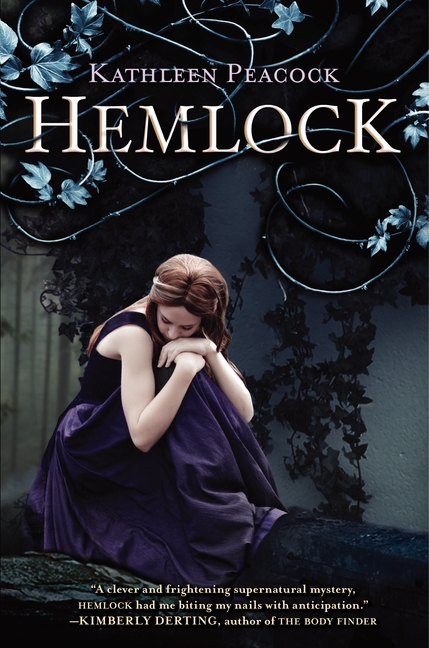
Hemlock – Kathleen Peacock

HemlockSo this rarely happens to me. The other night, after I turned my light off, I couldn’t turn my brain off and so I stared at the shapes in my room until 1 a.m.. Then I turned my light back on and raced through the final 100 or so pages of Kathleen Peacock’s debut novel, Hemlock.

Seventeen-year-old Mackenzie ‘Mac’ Dobson lives with her cousin, Tess, in the small town of Hemlock.  Her close knit circle of friends, Jason, Kyle and Amy, have recently been reduced by one: Amy was found dead in an alley, victim of a werewolf attack.

Those pesky werewolves, always maiming and eating.

Mac is suffering from very disturbing dreams brought on, she believes, by a guilty conscience. Amy had called her the night she’d died, but Mac had blown her off so she could study. But her grief and guilt are compounded by other issues: her growing feelings for her best friend, Kyle; Jason’s increasingly erratic behaviour after the death of his girlfriend, Amy, and the arrival of the Trackers, specialized werewolf hunters. On top of all this, Mac decides she is going to figure out what really happened to Amy on the night she was attacked.

There’s a lot going on in Hemlock – the town and the book. Here’s what I liked:

– I liked the fact that the whole werewolf thing just ‘is’. Werewolves exist, let’s move on. In Peacock’s version of the lore, anyone  who is scratched or bitten by a werewolf (at least those that survive the attack) become infected with lupine syndrome. Those people are captured – where it is possible to find them – and sent to rehabilitation camps. (I immediately thought of the Nazis rounding up the Jews and whether this comparison was Peacock’s intention or not, it actually works on all sorts of levels.)

– I also liked how there were werewolf supporters, sort of a ‘live and let live’ faction, which means that anyone who shares this view is also in danger of persecution, thus upping the stakes for a whole bunch of other characters. Mac is decidedly on the fence about this issue:

…I knew not all werewolves were good. Some of them did attack and kill people. And one of them had killed Amy. But Charles Manson, the kids from Columbine, that guy with the Kool-Aid – regs did horrible things to each other, too.

– I liked how propulsive the narrative was. I think Peacock really excelled at moving things along, especially when it came to fight scenes, or scenes where the wolves transformed from human to wolf.

– I liked Peacock’s sense of humour. Sometimes the dialogue made me chuckle.

But here’s my problem. Werewolves.

werewolf2I have no problem with fantasy worlds built around creatures of the night. I have a healthy imaginary life which involves virile vampires. Trust me, I get it. But I don’t get werewolves. There’s nothing sexy about them. Or particularly sympathetic, even. (Yeah, I know, they didn’t ask for this life.)

I was invested in Mac’s quest to find out the truth about Amy. I was less invested in her love triangle, a sort of Bella, Edward, Jacob thing. There was something contrived about it that just didn’t work for me. Bottom line: I didn’t care about them. Jason’s a douche. Kyle is in full-on push pull mode. Both have their reasons; all will be revealed, but I never settled into a space where I wanted her to be with either particularly and that’s a problem in a paranormal romance.

And I felt like there was perhaps a tad too much going on in the opening book of a trilogy. Love. Duplicity. Politics. Family issues. Murder and Werewolves. All the pieces click together neatly by the end though and will leave fans howling for Hemlock‘s sequel. Thornhill.

thornhillI have had the pleasure of ‘meeting’ Kathleen Peacock – virtually. She graciously agreed to speak to students at last year’s Write Stuff workshop. We linked Kathleen via the Internet and had Riel Nason, author of The Town That Drowned with us at the venue and both authors talked to the participants about the perils and rewards of writing. It was really exciting for me and for the students, too. How often do you get to talk to published writers? Kathleen is funny and smart and honest in person – well, you know what I mean. She’s also geeky, which appeals to me. I predict she has a long and successful writing career ahead of her.

Anna Dressed in Blood – Kendare Blake

Anna Dressed in Blood[1]I love the cover of Kendare Blake’s YA novel Anna Dressed in Blood. And I loved the first 200 or so pages of the book, too. And then – not so much. Of course, the first clue that things might have the potential to go south was Cassandra Clare’s ringing endorsement. But okay – I was ultimately willing to overlook that. The plot fell apart for me…and the characters…and it just felt like a hot mess by the end.

But in the beginning…

Cassio ‘Cas’ Theseus Lowood kills the dead. He’s got this cool athame (a double-edged daggar) and his dead father’s blood connection to these things that go bump in the night. Cas and his mother (who sells occult supplies on the net) travel from place to place so that Cas can put the dead to rest.  Cas is just 17 but he’s already “seen just about every variety of spook and specter you can imagine.”

Cas and his mother are en route to Thunder Bay, Ontario where the particularly vicious ghost of sixteen-year-old Anna Korlov ‘lives’ in a crumbling Victorian house. Anna’d had her throat slashed on her way to a school dance in 1958 and now she’s been known to haunt her house, wearing the white dress she’d had made for the dance only now covered in blood – hence the name ‘Anna dressed in blood’.

Cas is uneasy about this one from the start, but other things don’t go his way either. First of all – he’s usually able to fly under the radar, but not in Thunder Bay – where he quickly makes friends (and enemies) which necessitates him ‘coming out’ about his ‘calling.’ Sound familiar. Don’t worry – the one-girl-in-all-the-world ‘s name will be dropped before it’s all over.

Blake does create some creepy-crawly fun

Her feet drag horribly along like she can’t use them at all. Dark, purplish veins cut through her pale white skin. Her hair is shadowless black, and it moves through the air as though suspended in water, snaking out behind and drifting like reeds. It’s the only thing about her that looks alive.

She doesn’t wear her death wounds like other ghosts do. They say her throat was cut, and this girl’s throat is long and white. But there is the dress. It’s wet, and red, and constantly moving. It drips onto the ground.

Blake has set herself a difficult task; she has to make Anna both menacing and sympathetic and I think she manages, for the most part. That success comes, partly, from the fact that Cas is a likeable narrator: smart and  resilient. Since we see Anna through Cas’s eyes, we can empathize with her story – which is told via a brief seance-like flashback. Blake had my full attention up until then because that’s about when Cas starts to realize that his feelings for Anna aren’t strictly professional.

And then the kissing starts and – um – how do you kiss a ghost? I would have much preferred a heaping helping of angst to go along with my horror.

Blake further complicates the story with the introduction of the creature who had killed (aka eaten) his father and then the story just sort of falls apart…leading us to the inevitable sequel.

The ingredients for a terrific novel are all here. Blake’s writing is propulsive and straight forward. I think there’s just too much going on: a Dean Winchester-esque hero, wannabe Scoobies, a family friend who sounds suspiciously like Rupert Giles, ghosts aplenty, and a star-crossed love affair that isn’t quite believable.

Too bad – there was so much early potential.


Paper Towns – John Green (with a shout out to John Hughes)

If you are a person of a certain age, you probably have fond memories of John Hughes’ films. Even though I was already in my early 20’s when he started producing arguably the best teen movies ever – I was still young enough to see myself in the characters he committed to celluloid.

Sixteen Candles is my all-time favourite Hughes film, for reasons which will be apparent to anyone who has ever seen the film. I still watch it occasionally and it still makes me laugh and it breaks my heart a little now that Hughes has died.

Yes, you can argue that Jake Ryan isn’t perfect – he did let an underage, unlicensed driver take his very drunk girlfriend home in his father’s Mercedes, but it was the 80’s and, come on,  Jake Ryan is pretty damn dreamy. Also, who didn’t see some part of themselves in the other characters on the screen: Molly Ringwald’s slightly awkward Samantha Baker, Anthony Michael Hall’s loveable dork. Everyone you ever went to high school with is lovingly represented in this flick and in Hughes’ other teen masterpieces, Pretty in Pink, The Breakfast Club,  and Ferris Bueller’s Day Off. 

I would posit that John Green is this generation’s John Hughes and I hope Mr. Green will consider that a compliment because it is certainly meant as one.

Last year because everyone and their dog was reading The Fault in Our Stars I did, too. That was a reading experience I will never forget – curled in the fetal position on my bed at 2 a.m., laughing then crying, then laughing again. That is the experience I want my students to have.

PaperTowns2009_6AThe only other John Green book I have in my classroom library is Paper Towns and I just finished it yesterday. (Trust me, I’ll be rectifying the lack of Green books post-haste.) Paper Towns received rave reviews and the Edgar Award (a prize awarded by the Mystery Writers of America) and it’s totally deserving of both.

Quentin Jacobsen is just weeks away from graduating from high school when his next door neighbour Margo Roth Spiegelman shows up at his window in the middle of the night. Although Quentin and Margo had been childhood friends, they’d drifted apart as they’d gotten older and now, in Quentin’s eyes at least, Margo is this exotic and beautiful creature, but not necessarily his friend.

Margo Roth Spiegelman, whose six-syllable name was often spoken in its entirety with a kind of quiet reverence. Margo Roth Spiegelman, whose stories of epic adventures would blow through school like a summer storm: an old guy living in a broken-down house in Hot Coffee, Mississippi, taught Margo how to play guitar. Margo Roth Spiegelman, who spent three days traveling with the circus – they thought she had potential on the trapeze.

…

The stories, when they were shared, inevitably ended with, I mean, can you believe it? We often could not, but they always proved true.

Quentin’s best friend, Ben, describes Margo as “the kind of person who either dies tragically at twenty-seven, like Jimi Hendrix and Janis Joplin, or else grows up to win, like, the first-ever Nobel Prize for Awesome.”

Anyway, Margo needs Quentin’s help. She also assures him that this will be the best night of his life. Quentin is a guy who generally plays by the rules, so his decision to help Margo is slightly out of character for him. Nevertheless, he helps Margo carry out a list of tasks, some of them vengeful and some of them contemplative and he is indeed changed by the experience. Which is why when Margo suddenly disappears, he is compelled to follow the breadcrumb trail of clues she’s left behind.

Paper Towns is a clever mystery for sure, but that’s not the only reason to admire the heck out of it. What I love about John Green is the way he writes dialogue. His characters are smart and funny and honest-to-goodness people. In the same way that John Hughes made his characters painfully awkward or awesome or self-deprecating or ironic, Green’s teens are whole and fragile and super smart and laugh-out-loud funny.

And they think thinky-thoughts. The fact that Paper Towns is set in Orlando, Florida (John Green’s hometown) is significant. Margo says “you can see how fake it is…It’s a paper town. I mean, look at it Q: look at all those cul-de-sacs, those streets that turn in on themselves, all the houses that were built to fall apart.”

Quentin’s journey to find Margo makes him question not only everything he thought he knew about her, but also everything he believes about himself and Green does a great service to his characters (and the young adults who will be reading this book) by not giving us pat answers.

So – read John Green. Watch John Hughes. Through their eyes you’ll see teenagers at their worst…and their best. And it’s all beautiful.

Blacklands – Belinda Bauer

blacklandsTwelve-year-old Steven Lamb, the protagonist of Belinda Bauer’s debut novel Blacklands, lives with his mother, Lettie, his grandmother and his little brother, Davey,  in a small English village called Shipcott.  Steven spends his time out on the moors digging holes. He’s looking for the body of his mother’s brother, Billy, who had been killed by pedophile and serial killer, Arnold Avery, eighteen years earlier.  Avery had never given up the location of Billy’s body (or that of two of the other children he’d killed) and Steven thinks if he can find the body, it might bring closure for his perpetually grim and unhappy grandmother and his own mother, who has had to live under the weight of the tragedy her whole life.

Everything in Steven’s young life is miserable. Not only is his home life unhappy (even though he loves his family), he only has one friend at school (and it’s a relationship of convenience more than anything) and he’s constantly bullied by the “hoodies,” three lads who make it their mission to pick on him in and out of school. Even the teachers don’t know him. So Steven is a relatively solitary kid whose only goal is to find Uncle Billy so that “everything would change. [His nan] would stop standing at the window waiting for an impossible boy to come home; she would start to notice him and Davey, and not just in a mean, spiteful way, but in ways that a grandmother should notice them – with love, and secrets, and fifty pence for sweets.”

But Blacklands isn’t just Steven’s story; it’s Arnold Avery’s story, too. He’s rotting away in prison and, trust me, time spent with him isn’t so we can know his story and empathize with him. He’s reprehensible –  a cunning deviant with a predilection for sexual torture and murder. He’s been a model prisoner because “model prisoners wanted to be rehabilitated, so Avery had signed up for countless classes, workshops and courses over the years.” It had all paid off, too, because two years earlier he’d been moved from a high-security prison to Longmoor Prison, a low-security facility.

So when he receives Steven Lamb’s first letter, a plea for help in finding Billy’s body, Avery begins to dream of escape.

Blacklands was the 2010 winner of the Crime Writers’ Association Gold Dagger Award for Crime Novel of the Year.  It works on multiple levels – as a story of what grief does to a person and how that legacy trickles down to poison all who come after, as a coming-of-age tale, and finally, as a can’t-turn-the-pages-fast-enough thrill-ride. Bauer manages the tricky shift between Steven and Avery with finesse and the whole story races, with only a couple minor missteps, towards an inevitable and  thrilling denouement.

Popular Music from Vittula – Mikael Niemi

popularmusicI didn’t get this book – at all. Everyone from the New York Times to Entertainment Weekly waxed poetic about its beauty and prose that “buzzes with wonder, fearlessness and ecstatic ignorance.” Um. I didn’t get it.

Translated from the Swedish, Popular Music from Vittula is a “novel” that actually seems more like a memoir  – or a series of loosely connected short stories –  because if there was a narrative thread here, I wasn’t seeing it.

The main character and narrator is Matti and we meet him as an adult “in a fix in the Thorong La Pass” (which is on Mount Annapurna, Nepal) where  he finds himself 17, 765 feet above sea level, with his lips stuck to  a Tibetan prayer plaque. I am sure what happens next is meant to be comical but, sadly, I didn’t laugh. And I didn’t laugh at any of the other crazy escapades Matti finds himself embroiled in from the age of five straight through to his teenage years.

Matti and his friend, Niila, meet at the neighbourhood playground and their friendship is cemented during a nose-picking session. The rest of this story traces their frienship, particularly their love for music, for the next decade or so.  Their otherwise straightforward lives are touched by elements of magical realism. (Did these two five year olds really manage to get on a plane and fly all the way to Frankfurt?)

Matti’s story dips in and out of his life, giving the reader a chance to experience the first time he ever heard Elvis Presley sing (in his sister’s bedroom), the first time he goes to school, his first kiss. I wish I could say that the book was more than the sum of its parts, but for me I just didn’t get it.

Story of a Girl – Sara Zarr

storyofagirlSara Zarr’s debut novel Story of a Girl kept me turning the pages far past my bedtime – a sure indicator of its quality. I read before bed and most nights I’m lucky if I manage a couple dozen pages, but last night I settled in early and once I started, I couldn’t stop.

Story of a Girl begins with sixteen-year-old Deanna Lambert’s admission that she “was thirteen when my dad caught me with Tommy Webber in the back of Tommy’s Buick, parked next to the old Chart House down in Montara at eleven o’clock on a Tuesday night. Tommy was seventeen and the supposed friend of my brother, Darren. I didn’t love him. I’m not even sure I liked him.”

Deanna had been parking with Tommy for a year before she’s finally caught, but her dad’s discovery of her in a compromising position casts the reality of her life in a harsh light. Now her dad can barely look at her. And when the novel opens, at the end of sophomore year (that’s grade ten here in Canada), it’s clear that the story of her tryst with Tommy is still the topic du jour in her small hometown of Pacifica, a sea-side suburb of San Francisco. At least pretty much everyone at Deanna’s high school knows about it – or some version of it. The only people who don’t care are her two best friends: Jason, a boy she’s known forever and Lee, a girl who moved to Pacifica after the incident.

Story of a Girl takes place during the summer between sophomore and junior year. Deanna’s strained relationship with her dad causes her to daydream about leaving home and living with her older brother Darren, his girlfriend, Stacy and their infant daughter, April. Currently they live in the basement. Stacy and Deanna’s dad don’t get along. In fact, Deanna’s household is pretty dysfunctional and so Deanna quickly finds work at a local pizza dive…where, it turns out, Tommy also works.

What I loved about this book was how realistic it seemed. Everyone judges Deanna for a decision she made when she was thirteen, but it isn’t until she comes into contact with Tommy again that she figures out why she always went off with him. And forgiving him – and herself – also allows her to empathize with her father.

…I imagined us through his eyes – his family, sitting in a pink kitchen: his tired wife, who never complained; his son who looked exactly like him; his daughter, who used to be the baby, his baby girl; and now April, his grand-daughter, who had a whole life in front of her, with no real mistakes in it yet. Could he look at us someday, I wondered, maybe today, and not be disappointed? Could he see us, and himself, for who we really were?

Story of a Girl is a beautiful book because, although it is Deanna’s story, no one’s life is lived in isolation. This is a book about family – the family given to us by  biology and the family we choose. The path to adulthood is thorny and it’s good to have some people who are on your side.  There are no villains in this book. Even Tommy, douche that he is, is probably trying to fill in the gaps in his own life. The thing is, we carry our mistakes with us and as Deanna’s boss at the pizza place, Michael, tells her: “…don’t mistake a new place for a new you.”

Big love for this book.

With apologies to Adrian and Jon

If my younger self had gotten her act together, I might have found a place in the publishing business. Nothing gives me more pleasure than reading and anyone who knows me, knows that I am really critical about what I read – just ask me what I think of Fifty Shades of Grey or Twilight. Or visit my Book Graveyard

By day, I am a high school English teacher and I really and truly feel that the most important part of my job is to put students on a path towards a lifetime of reading. During the 2012-13 academic year I had an astounding grade ten class. These kids were amazing – smart and funny and hard-working – and a true joy to spend time with. They also, for the most part, loved to read. So we did read, a lot.

I have a pretty good-sized classroom library…and it’s getting bigger. I have already asked our Mill & Cab teacher if he could get his students to build me a bigger and better bookshelf in my room in the fall because I am outgrowing all the bookcases I’ve purchased and scavanged over the past few years. I love having all those books in my room because it shows students I am a serious reader. It also allows me to have real conversations about books and gives me the ability to put a book into a kid’s hands and say “Read this.”

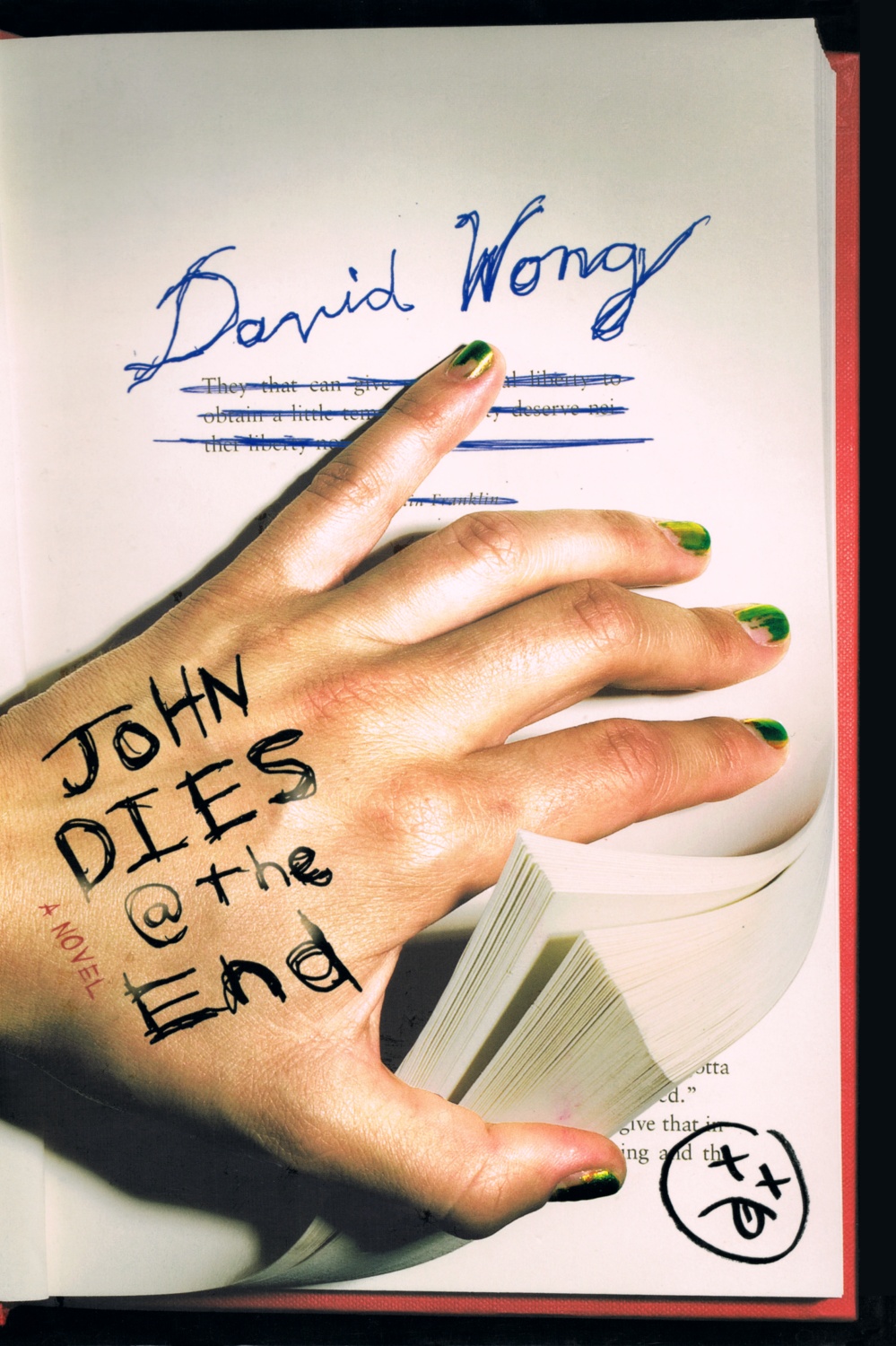
So, when a student turns the tables and puts a book in my hands, I feel obliged to read that book. In this case, the book was called John Dies @ the End  by David Wong.

ea_johndiescover And I tried, guys; I really did. I got to page 142 and I just couldn’t go on.  In a nutshell, John Dies @ the End is a crazy hybrid of horror and comedy about two friends, Dave and John, who appear to be some sort of supernatural investigators (think Sam and Dean from Supernatural) who come into contact with this mind-altering drug called ‘soy sauce’. Wackiness ensues.

Sadly, the wackiness just wasn’t interesting to me.

According to Cracked.com (where David Wong, a pseudonym for Jason Pargin, was an editor), John and Dave “find out the world is being attacked by a Lovecraftian god named Korrok,  whose godhood has not saved him from being totally retarded. Dave must overcome  Korrok’s dark and invisible army, while overcoming his own personal demons. His  primary demon is the fact that he just doesn’t give a shit.”

John Dies @ the End had an interesting introduction to the world.  The novel “has been published in no less than four formats: as an online serial, then  through the print-on-demand service at CafePress, then via indie horror  publisher Permuted Press, and now by  huge megapublisher St. Martin’s.” It has also been made into a movie.

I can certainly see why the book would appeal to the two young men who recommended it to me. It’s over-the-top and ridiculous and, I suppose, creepy in parts. It’s like a cult film: Hobo With a Gun, say. Maybe if I had discovered this book 30 years ago, I would have enjoyed it more. But I doubt it.

So, this made me think about book recommendations. Something The Guardian also pondered in its article When book recommendations go wrong. I know how I feel when I fall in love with a book and want to share it and other readers aren’t quite as enamoured. It cuts like a knife, people.

Book Riot (an absolutely fabulous book-related site) had a great article about What To Do When Friends Give You a Book You Don’t Want to Read. I really felt obligated to read John Dies @ the End because how can I expect my students to accept my recommendations if I won’t accept theirs? The truth of the matter is that I have my own criteria for deciding whether or not I should keep on trucking through a book that doesn’t immediately grab me.

I considered what makes me give up on a book in 2012 in my post Books are like a relationship, sometimes you have to end it

At the end of the day – with so many books on my tbr shelf – I just had to break up with John Dies @ the End. I hope Adrian and Jon can forgive me.

What makes you give up on a book?

Paper Covers Rock – Jenny Hubbard

paper-covers-rockJenny Hubbard, the author of Paper Covers Rock, was a high school and college English teacher for seventeen years and I am guessing she was a good one. Her debut novel is filled with  references to poetry and literature and how they make us have “the feels” and allow us to connect with the world etc.

Sixteen-year-old Alex Stromm attends Birch Academy, a boarding school in North Carolina. He is, by his own admission, a good solid kid. When the story opens, Alex is writing in a journal his father had given him to write his impressions in when he’d started at Birch two years previously. Although the book has remained blank, now has something to write about: his friend Thomas is dead. He writes:

What I carry in my backpack down to the river, I carry not knowing that in less than an hour Thomas Broughton will be dead. That is not a knowledge I carry yet, but I will carry it soon – the knowledge of my darkest self – and I will carry it forever.

The reader learns about what happened that fateful day when Alex, Thomas, Clay and Glenn were at the rock by the river in fits and starts. Alex’s feelings of grief and guilt are only part of what compels him to scribble in his journal. He is also in love with his English teacher, Miss Dovecott, a recent Princeton graduate who is only a few years older than the boys she teaches. When she takes an interest in Alex’s writing he becomes even more conflicted about what happened that day on the rock.

Sounds sinister, eh? It’s not really, but I have to say that I did keep turning the pages and read the book in one sitting. Alex’s feelings for Miss Dovecott are complicated by his feelings of loyalty for Glenn. (Clay has taken the blame and left school; I’ll leave you to discover the reason why on your own.) Turns out that just after Thomas drowned, drawn by the screams, Miss Dovecott arrived on the scene and Glenn is convinced that she knows more than she is letting on. Oh what a tangled web.

And I have to say, the writing is stellar. The poetry Alex writes is lovely and it’s easy to see why Miss Dovecott takes an interest in him. Ms. Hubbard captures the male voices beautifully (not as crass as they might be now because, after all, the story is set in 1982) and also manages to make Alex both sympathetic and self-serving on his journey to manhood.


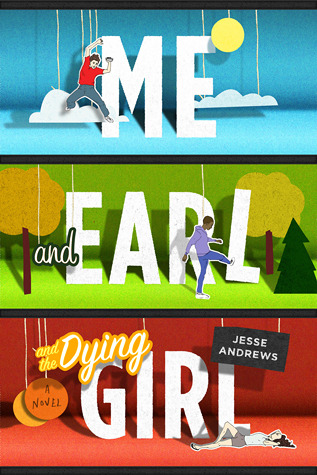
Me and Earl and the Dying Girl – Jesse Andrews

earlThis book contains precisely zero Important Life Lessons, or Little-Known Facts About Love, or sappy tear-jerking Moments When We Knew We Had Left Our Childhood Behind For Good, or whatever. And, unlike most books in which a girl gets cancer, there are definitely no sugary paradoxical single-sentence paragraphs that you’re supposed to think are deep because they’re in italics.

Meet Greg Gaines. He’s the seventeen-year-old narrator of Jesse Andrews’ debut novel Me and Earl and the Dying Girl.  He lives with his parents, and two younger sisters in a Pittsburgh suburb. He’s a trash-talking, cynical, slacker who is just trying to make it through his final year of high school.

…you have to to start from the premise that high school sucks. Do you accept that premise? Of course you do. It is a universally acknowledged truth that high school sucks.

Greg goes through the days in a weird state of disconnect because he feels as though the only way to survive school is to stay on the periphery of all the various groups, rather than belonging to any one of them.  He says, “I didn’t join any group outright, you understand. But I got access to all of them.” Of course, that makes having real relationships slightly problematic.

Greg’s only friend is Earl; well, as Greg puts it, they are more like co-workers.   They’ve known each other since they were in kindergarten and discovered a shared love of movies. Since then they have made several films together.

So Greg goes through his days doing as little as possible, using his sense of humour to cover up the fact, I think, that he is insecure about his weight and his looks and his life (all totally relateable to anyone who has ever survived a difficult – or any –  high school  experience.) And then Rachel Kushner is re-introduced to his life.

Greg and Rachel had been sort-of friends when they were kids although Greg admits that he hadn’t been all that nice to her. Turns out Rachel has recently been diagnosed with leukemia and Greg’s mom calls in a favour – rally around Rachel.

Me and Earl and the Dying Girl is not a cancer book, though. It is a profane, often funny and honest look at a teenager on the cusp of adulthood who doesn’t get it…and then does. Despite a great family, Greg is sort of closed off to the world. He doesn’t know how to have authentic relationships even though he is clearly capable of them. He spends his time with Rachel making lame jokes, trying to divert the focus away from Rachel’s illness –  not for her benefit, but for his own.

There is no way Greg is going to come away from spending time with “the dying girl” unscathed and he doesn’t. Mature readers won’t either.

I read this book as part of a program that lets teachers read books being considered for classrooms in New Brunswick. I do think this is a worthwhile and well-written book. My one caveat would be that there is a lot of swearing. A lot a lot. That said, as a high school teacher and a mom of teenagers I think we are fooling ourselves if we think kids don’t talk like this (not my kids, of course!). I think we do mature teens a disservice by leaving books like this off the shelf. I think some students will see themselves in Greg and Earl and it would be a shame not to give strong readers the opportunity to share time with them. I don’t believe in censorship anyway, but beyond that Me and Earl and the Dying Girl has real merit.


Endangered – Eliot Schrefer

endangeredWhen my 14-year-old son saw that I was reading Eliot Schrefer’s novel Endangered he rolled his eyes and said, “Mom, our teacher tried to read us that book last year and no one liked it – not even her.” Connor is a voracious reader and we have often read and enjoyed the same books so I have to admit that I was skeptical as I started this book.

Fourteen-year-old Sophie is visiting her mother in the Democratic Republic of the Congo (DRC). Her parents  are divorced and she has been living with her father in Miami since she was eight, but it’s the summer holidays and so she is visiting with her mom at the bonobo sanctuary her mother runs in Kinshasa. Bonobos are a member of the ape family and they are endangered. Bonobos, as it turns out, are our closest relatives, “sharing over 98.7 percent of our DNA.” Adult bonobos are often killed for food; babies are kidnapped and sold on the black market. It is just such an encounter that starts Sophie’s story.

The little ape sat down tiredly in the dirt and lowered his arms, wincing as his sore muscles relaxed. I kneeled and reached out to him. The bonobo glanced at his master before working up the energy to stand and toddle over to me. He leaned against my shin for a moment, then extended his arms to be picked up. I lifted him easily and he hugged himself to me, his fragile arms as light as a necklace.

Sophie’s mother is none-too-happy when her daughter arrives at the sanctuary with the bonobo. Not because Sophie rescued the bonobo, but because she didn’t follow the proper protocol and that could cause more trouble down the road. But Sophie has fallen in love with the little bonobo she names Otto and their relationship sustains them through the difficult times ahead.

In the beginning I found Endangered a little didactic. Admittedly, I knew nothing about bonobos and even less about the scary situation in the DRC, but the way the information was relayed to the reader – via Sophie – just didn’t feel organic. Thankfully, Schrefer didn’t spend a lot of time instructing us.  When the Congo’s president is assassinated and rebels flood into the area Sophie’s peaceful existence at the sanctuary crumbles.  That’s when things get really interesting.

Sophie is a remarkably resilient character. Despite the fact that she has been leading a relatively privileged life in the States for the past six years, she hasn’t forgotten where she came from. As she and Otto travel through the jungle and up the Congo river to find her mother (who had left just before the coup to take some bonobos to an island release site), my heart was really racing. I mean, this war (despite being fictional) is based on decades of bloody conflict and although Schrefer stays away from the truly graphic, one only has to use their imagination to imagine the atrocities Sophie and Otto encounter on their way.

And don’t even get me started on the subject of Sophie’s bond with Otto. If even half of what transpires between them is true, bonobos are beyond remarkable; they’re us.

Con, honey, I respectfully disagree with your assessment of this book.