
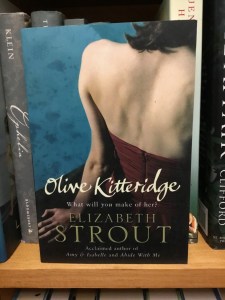
 I don’t know how much readers actually care about the awards books win, but Elizabeth Strout’s novel Olive Kitteridge won the Pulitzer in 2009 and the book has been languishing on my tbr shelf since about then. It was June’s #bookspin choice on Litsy and I just managed to get it finished. Well, I shouldn’t say “managed” — that sounds like it was a book I had to force myself to read and it most certainly was not.
Truthfully, though, I wasn’t quite sure what to make of the titular character or the novel’s structure when I first started reading. The novel is written as a collection of short stories in which Olive Kitteridge often figures only peripherally. In the first story “Pharmacy” we meet her husband, Henry, a kind and patient man who owns the pharmacy of the title. He seems quite capable of managing Olive’s prickly personality. When he suggests they invite his new employee Denise to dinner Olive responds that she is “Not keen on it.”
Olive’s relationship with her son, Christopher, is also strained. She loves him, but she is not, it seems, a mother given to the warm fuzzies. When adult Christopher, a podiatrist, marries Suzanne, Olive fights “the sensation of moving underwater – a panicky, dismal feeling…”. When she overhears Suzanne making unkind remarks about her, she exacts a small revenge.
…there is no reason, if Dr. Sue is going to live near Olive, that Olive can’t occasionally take a little of this, a little of that — just to keep the self-doubt alive. Give her a little burst. Because Christopher doesn’t need to be living with a woman who thinks she knows everything.
Olive comes across as rigid and unsympathetic. As a former school teacher she was feared. One of her former students, whom we meet in the story “Incoming Tide” says that “He’d been scared of her, even while liking her.” It turns out, though, that our initial assessment of Mrs. Kitteridge couldn’t be further from the truth. The humanity bursts out of her in ways that are, quite frankly, breathtaking.
In “Starving” a chance encounter with a young girl suffering from anorexia shows us one of the first cracks in Olive’s steely exterior.
Olive Kitteridge was crying. If there was anyone in town Harmon believed he would never see cry, Olive was that person. But there she sat, large and big-wristed, her mouth quivering, tears coming from her eyes. She shook her head slightly, as though the girl needn’t apologize.
[…]
Olive shook her head again, blew her nose. She looked at Nina, and said quietly, “I don’t know who you are, but young lady, you’re breaking my heart.”
This is just one instance of Olive demonstrating a tremendous amount of compassion and empathy. There are many more in this novel, and the cumulative effect of all these elliptical moments in a life is stunning. Each story is perfection and each character is fully realized. There are moments of tragedy and hope, of humour and despair; that is, there all the moments that make up a life.
Although I am sorry that I waited so long to read this novel, I am also thrilled that I got to discover it for the first time. I loved it and highly recommend it.
 I was invested in Jacob McNeely, the narrator of David Joy’s novel Where All Light Tends to Go, by the end of the first chapter. The eighteen-year-old high school drop out has climbed to the top of the water tower to smoke a joint and watch what should have been his graduating class leave the school. From his perch, he can see Maggie, the girl he has loved for as long as he can remember.
 Lucie Whitehouse’s debut novel The House at Midnight tells the story of Joanna and her close-knit circle of friends who spend weekends at Stoneborough Manor in Oxfordshire. Her dearest friend, Lucas, has recently inherited Stoneborough from his Uncle Patrick, a well-known art dealer. On their first visit there, Joanna observes that the house is “Three storeys high, [and] it reared up out of the night as if it were facing the darkness down.” The house gives Joanna a “pang of anxiety.” She wonders “How could it not change things between us.”
 figure out whether I liked it — not the book, exactly, the whole family drama thing. Am I really interested in life’s ups and downs? Do I care about people’s children and marriages? Well, if every book was as good as this one, the answer would be yes.
 Nico is just thirteen when her seventeen-year-old sister Margaret drowns. Nico tells us “We lived on the shore of Mirror Lake, and for many years our lives were as calm and transparent as its waters.” Margaret is the poet in the family, the beautiful daughter about to graduate from high school and head off to study music. She was named for Gerard Manley Hopkins’ poem “Spring and Fall: To a Young Child.”


 of a man and woman who meet by chance at Heathrow airport. Over a drink, the man reveals that he thinks that his wife is having an affair and he wants to kill her – which may be a bit of an extreme reaction, but there you go. The woman offers to help the man’s fantasy become a reality and the novel does not let up from there.
 One last book you should add to your tbr pile is M.O. Walsh’s debut


 And then there’s The Roanoke Girlsby Amy Engel. Can’t remember when I bought it or how long it’s been languishing on my tbr shelf, but I started reading it and finished reading it in just a few hours because it has ALL THE THINGS I love in a book. (Lots of other reviewers loved all the things, too, because this book received lots of well-
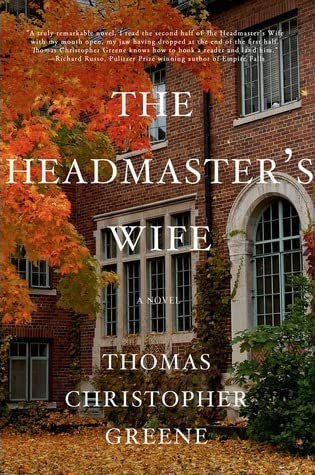 novel
novel 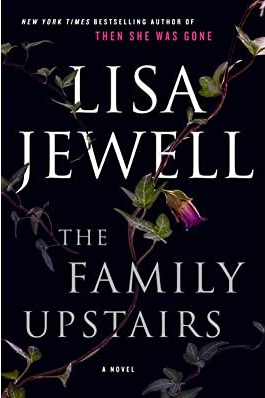 Just when I thought nothing was going to really distract me from this Covid-19 craziness, I dove into Lisa Jewell’s novel The Family Upstairs. I am a Jewell fan to begin with and I usually have a couple unread books by her on my shelf…you know, in case of a reading emergency. I think this pandemic qualifies and, Holy Smokes, did this book ever deliver.
 book we discussed at my book club’s first ever virtual meeting. It was chosen for our March meeting, but of course those plans were canceled due to Covid 19. I had started the book and then put it aside. When we decided to meet virtually, I picked up the book again and read it straight through. It’s kinda un-put-downable.
 The Ludic Reader